Which option correctly slates a recommended guideline for formulating 8DD scenarios0
SELECT ONE OPTION
Correct Answer:C. The scenario should describe a general behavior that the system supports from the perspective of a specific user
Explanation:
In Behavior-Driven Development (BDD), scenarios are formulated to describe the general behavior of the system from the perspective of a specific user. This helps in understanding the user's needs and how the system should respond. It's important for scenarios to be clear and understandable to all stakeholders, including non-technical ones, which is why they are often written in simple language describing the behavior rather than the technical actions.
Question 2
What is the primary purpose of the debriefing meeting when exploratory testing is used in an Agile setting?
Correct Answer:C. To provide a status of the progress and coverage of the session
Explanation:
Debriefing Meetings in Exploratory Testing:
Debriefing meetings serve as a feedback mechanism where testers and stakeholders review the outcomes of exploratory testing.
The focus is on progress, coverage, and findings to evaluate the test session's effectiveness and adjust charters or objectives if needed.
Analyzing the Options:
A: Identifying defects is a part of testing but not the primary focus of the debriefing meeting.
B: Defining the test charter occurs before the session, not during the debriefing.
D: Reviewing tester actions is not a primary purpose and could be seen as micromanagement.
C: Providing status updates and coverage details aligns directly with the primary goal of debriefing meetings.
ISTQB Advanced Agile Technical Tester syllabus emphasizes debriefing as a critical step in exploratory testing for evaluating progress and coverage.
Question 3
You have been asked to supply the list of keywords for a keyword-driven test automation script that will be used to test the following story:
As a customer, I want to be able to add and delete items from my shopping cart, so that I can buy the right number of items and still get free shipping on some of the items.
The automation will add and delete items from a customer's shopping cart and will then verify that the total shipping cost is correct. The test automation library has a large set of keywords that have been coded to support this e-commerce site. Which of the following is the smallest set of keywords that contains the ones needed to support testing this story?
This approach requires a focused set of keywords tailored to the actions described in the user story.
Story Actions:
The ability to add and delete items from the cart.
Viewing the cart to confirm changes.
Calculating shipping costs.
Smallest Set of Keywords:
Login: To simulate a user session.
Add Item and Delete Item: For cart modifications.
View Cart: To verify cart contents.
Compute Shipping: To check shipping costs.
Conclusion:
Option D includes the minimum keywords required to meet the story's needs.
Question 4
You are testing a mission-critical system and want to use exploratory testing for part of the testing. According to the syllabus, what is the correlation between this type of testing and the risk level of the item being tested?
Correct Answer:C. High = highly recommended, Medium = highly recommended, Low = highly recommended
Explanation:
Exploratory Testing and Risk Levels:
Exploratory testing is a flexible approach that involves simultaneous test design and execution, making it highly valuable across all risk levels.
For high-risk systems, exploratory testing is essential as it uncovers critical issues efficiently.
For medium- and low-risk systems, it is equally beneficial for identifying functional and usability defects, especially when formal test cases may not cover all scenarios.
Analyzing the Options:
A and B: These fail to emphasize the importance of exploratory testing for high-risk systems.
D: States that exploratory testing is 'not recommended' for high-risk systems, which is inaccurate.
C: Correctly states that exploratory testing is 'highly recommended' across all risk levels, aligning with the ISTQB syllabus guidance.
ISTQB Advanced Agile Technical Tester syllabus highlights exploratory testing as a versatile and valuable technique for all risk levels.
Question 5
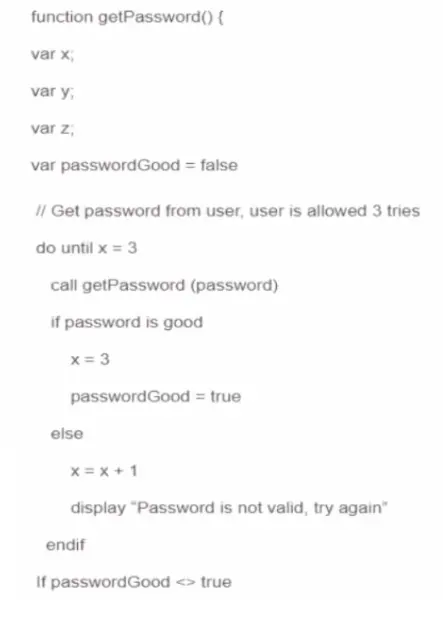
Consider the following section of pseudocode
Display "You exceeded the number of tries to enter a password. Your account is now locked. Call customer.
For this section of code, which of the following issues should be identified during a code review?
1. Variables have not been properly defined with meaningful names
2. There are unused variables defined
3. Divisors are not tested for zero
4. Loop counters are not properly initialized
5. There are endless loops
6. There are statements within the loop that should be outside the loop
Correct Answer:D. 1, 2, 4, 6
Explanation:
The pseudocode provided for review indicates a password entry system with a lockout mechanism after a certain number of failed attempts. The issues identified during the code review are:
Variables have not been properly defined with meaningful names - the variables used in the pseudocode are not descriptive, which can make the code difficult to understand and maintain.
There are unused variables defined - the pseudocode includes variables that are declared but not used, which is inefficient and can lead to confusion.
Loop counters are not properly initialized - if a loop counter is used, it must be initialized correctly to ensure the loop functions as intended.
There are statements within the loop that should be outside the loop - certain messages or actions may be repeated unnecessarily within a loop when they should be placed outside to execute only once.
Question 6
which statement about test automation is TRUE?
SELECT ONE OPTION
Correct Answer:B. Test automation levels can be influenced by and can constrain the frequency of code deployments
Explanation:
Test automation is a key component in Agile development, particularly in the context of continuous deployment and delivery. The level of test automation can indeed influence and potentially constrain the frequency of code deployments. This is because the extent and robustness of automated tests determine how quickly and reliably new code can be pushed to production. If the test automation is not comprehensive or reliable, it may require additional manual testing or cause delays in deployment. Conversely, a high level of test automation can support more frequent and confident deployments by ensuring that new changes do not break existing functionality.
Correct Answer:C. A stateful mock service that appears to provide the same behavior and data handling as the real service without actually performing the processing
Explanation:
Definition of Virtualized Services:
Virtualized services simulate the behavior of real services, including handling data and interactions, without performing actual backend processing.
Stateful Nature:
Unlike stateless mocks or stubs, virtualized services can maintain state and mimic complex behaviors of the original service.
Analysis of Options:
A describes a stateless mock, not a virtualized service.
B refers to third-party production services, not virtualization.
C correctly identifies a stateful mock that behaves like the real service.
D describes simple stubs, not virtualized services.
Conclusion:
Option C is the best description of a virtualized service.
Question 8
From these results, what can you conclude about the TDD process?
Correct Answer:C. The tests are insufficient and need to include more options
Explanation:
Analyzing the TDD Process:
The provided test cases only cover two inputs: 'smith' and 'x,' and these pass successfully.
Real-world inputs such as longer names ('Steinbrenner') or edge cases (blank inputs) are not tested, resulting in errors and crashes.
Insufficient Tests:
The developers have not accounted for all possible input scenarios, such as names exceeding 30 characters or invalid inputs.
Expanding the tests to cover such cases would align the implementation with the acceptance criteria.
Analyzing the Options:
A: The tests are running but are inadequate in scope.
B: The tests are likely passing for the covered cases but fail to address uncovered scenarios.
D: The story already includes relevant details; the issue lies with test case insufficiency.
Aligned with ISTQB guidance on the importance of comprehensive test coverage in TDD.
Question 9
You have been asked to supply the data file for a data-driven test automation script that will be used to test the following story:
As a customer, I want to be told how many items I need to purchase, so I can receive free shipping.
You have been told the automation will verify whether or not the free shipping message is displayed. Which of the following columns should appear in your data file to support the automated testing of this story?
Data-driven testing focuses on varying inputs and verifying expected outputs. For this story, the key input is the quantity of items purchased, and the output is whether free shipping applies.
Relevant Columns:
Item ID: Identifies the product.
Quantity Purchased: Determines whether the free shipping threshold is met.
Free Shipping (y/n): Validates if the message is correctly displayed.
Conclusion:
Option B is correct as it includes the minimum required data to test the user story effectively.
Question 10
According to the syllabus, which of the following is a correct statement about automation in a mission-critical system versus a non-critical system?
Correct Answer:A. Automation is more important with the mission-critical system as the risk increases
Explanation:
Automation and System Criticality:
For mission-critical systems, automation ensures consistent, repeatable testing, particularly for high-risk functionalities.
As risk increases, automation plays a key role in validating critical features and reducing the chance of human error.
For non-critical systems, the focus on automation is generally reduced, depending on cost-benefit analysis.
Analyzing the Options:
A: Correctly states that automation is prioritized for mission-critical systems as risk increases.
B: Incorrectly diminishes the importance of automation for non-critical systems without clarifying context.
C: Misrepresents automation levels as equal for critical and non-critical systems.
D: Incorrectly dismisses automation for non-critical systems, which can be valuable depending on the context.
ISTQB Agile Technical Tester syllabus emphasizes automation for high-risk systems while balancing cost and risk for non-critical systems.