
Question 1
Which one of the following metrics to be produced needs traceability between the test cases and each item in a proper test basis?
K2 1 credit
Correct Answer:
A. Requirements coverage
Which one of the following metrics to be produced needs traceability between the test cases and each item in a proper test basis?
K2 1 credit
Assume that you are the Test Manager for a small banking application development project. You have decided to adopt a risk-based testing strategy and 5 product risks (R1, R2, R3, R4, and R5) have been identified during the quality risk analysis. The following table shows the risk level associated to these product risks (higher numbers mean higher risk):
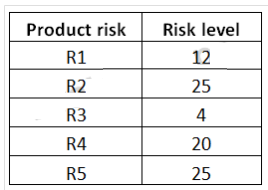
55 test cases have been designed and implemented to cover all these 5 product risks. The coverage is described in a traceability matrix.
This is the test execution status table, after the after the first week of test execution:
About 56% of the planned test cases have been successfully executed.
Assume that no additional product risks have been identified during the first week of test execution.
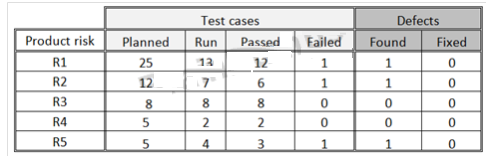
Which of the following answers would you expect to best describe the residual risks associated with the identified product risks, at the end of the first week of test execution? K3 2 credits
Assume you are managing the system testing phase of a project.
The system test execution period is scheduled to twenty weeks.
All tests are manual tests. You are following a risk-driven test approach.
During the last staff meeting the project manager tells you new deadlines that will not allow completion of all the system tests.
Which of the following would you expect to be the best way to respond to this situation? K2 1 credit
Which of the following answers describes a factor that may reduce the effort spent when using distributed test teams without negatively affecting system quality?
K2 1 credit
In the test strategy document your organization declares:
- To adopt a V-model development lifecycle, with three formal levels of testing. unit, integration and system testing
- To use a blended risk-based and regression-averse testing strategy for each level of testing The following is an excerpt of the ''approach'' section for the system test plan document of a new project:
''Testing will only use manual tests. Due to the short period of time for test execution, the following activities will be performed in parallel with test execution: Test planning, test analysis and test design.
Basic metrics will be taken for test effort (i.e. person-hours), test cases executed (passed/failed), and incidents (no more metrics, such as code coverage, will be collected).'' In the system test plan, no deviations from the test strategy are described. Based only on the given information, which of the following statements is true?
K4 3 credits
The following are the requirements identified as ''critical'':
REQ-SEL-001. The user shall be able to combine all the three products with all the four durations to define an item to purchase
REQ-SEL-002. The user shall be able to add a maximum of six different items to the shopping cart REQ-PUR-001. The user shall be able to purchase all the items in the shopping cart using a credit voucher
REQ-PUR-002. The user shall be able to purchase all the items in the shopping cart using the available credit already charged on the smartcard
REQ-PUR-003. The user shall be able to purchase all the items in the shopping cart using all the accepted credit cards (Visa, MasterCard and Great Wall Card)
REG-LOGO-001. The user shall be able to logout (by clicking the logout button) from both the ''select'' and ''purchase'' pages going back to the ''browse'' page (anonymous navigation)
Moreover the following quality risk item has been identified as ''critical'':
QR-P1. The web customer portal might not be able to provide the expected response time (less than 10 sec) for the purchase transactions under a load of up-to 1000 concurrent users Test analysis for system testing has just begun and the following test conditions have been identified.
TC-SEL-01. Test the combinations of products and durations to define an item to purchase TC-SEL-02. Test the maximum number of items, which can be added to the shopping cart
TC-PUR-01. Test the purchase of an item
TC-PUR-02. Test the purchase of an item with the credit charged on the smartcard
What is the MINIMUM number of test conditions that must be added to fulfill both the EXCR1 and EXCR2 exit criteria?
K3 2 credits
Which of the following statements best describes an appropriate approach for managing exploratory testing?
Number of correct responses: 1
K2 1 credit
During the follow-up phase the following conditions are checked:
X1. The code has been completely reviewed
X2. All the identified defects have been correctly fixed and the modified code has been compiled successfully and run through all the static analyzers used by the project without warnings and errors X3. The modified code is available under the configuration management system with a new version number for the specified CI
If these conditions are fulfilled then the review process terminates.
Which of the following characteristics of a formal review is missing in this description? K2 1 credit
Consider the following skills assessment spreadsheet for your test team (consisting of four team members):
This spreadsheet has three sections: technical expertise, testing skills and professionalism.
The skill levels for each skill area for both the ''technical expertise'' and ''testing skills'' sections have been rated on a four-point scale:
- E (Expert): indicates that a person has expert knowledge and experience in the skill area
- B (Beginner): indicates that a person has some knowledge and experience in the skill area but he/she is not autonomous
- W (Wants to learn): indicates that a person has no knowledge or experience in the skill area but he/she wants to learn that skill
- NI (Not Interested): indicates that a person has no knowledge or experience in the skill area and he/she is not interested to learn that skill
The skill levels for each skill area of the ''professionalism'' section have been rated on a three point scale (H=High, M=Medium, L=Low).
Consider the following analysis of testing skills performed on four people. Alex, Robert, John and Mark (all the skills have been rated on an ascending scale. The higher the score, the better the skill):
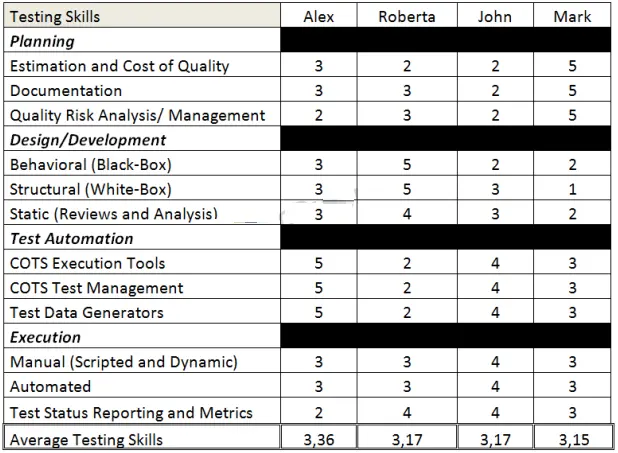
Which of these people, based on this analysis, would you expect to be most suitable to work specifically as test designer?
K4 3 credits
You are the Test Manager for a project to develop a client-server application that allows wine vendors to order custom-assorted packages of wines of several winemakers to sell special packages in their wine shops.
You decide to apply a blended risk-based and reactive testing strategy. Below the exit criteria for the system testing.
EXCR1- Each ''critical'' quality risk item must be covered by at least one test condition EXCR2- Each ''critical'' requirement must be covered by at least one test condition The following are the ''critical'' requirements of the application:
REQ-SEL-1. The application shall allow the user to order only one package at a time
REQ-SEL-2. The application shall allow the user to select between four different packages (2-bottles, 6-bottles, 12-bottles, 15-bottles)
REQ-SEL-3. The application shall allow the user to order a package containing at least 1 bottle and no more bottles than the package size. No error messages shall be displayed if the user selects a valid number of bottles (at least 1 bottle and no more than the package size) REQ-SEL-4. The application shall display an error message ''Invalid number of bottles'' if an invalid number of bottles is selected by the user (zero bottles or a number higher than the package size)
REQ-PAY-1. The application shall allow the user to pay with the three accepted credit cards (Visa, MasterCard, American Express)
REQ-PAY-2. The application shall display an error message ''Invalid credit card'' if invalid credit card data are given by the user
The following is the unique ''critical'' quality risk item that has been identified:
CR-RSK-1. The GUI of the application might accept non-integer values for the input field designed
to get the number of bottles from the user
Test analysis for system testing has just begun and the following test conditions have been identified.
TC-SEL-2. Test the selection of the package sizes
TC-SEL-4. Test wrong numbers of bottles for an order
TC-CR-RSK-1. Test the accepted values from the input field designed to get the number of bottles from the user Assume that you have used traceability to determine the logical test cases that cover all the requirements and the single risk item identified in that scenario.
Which of the following is a positive logical test that is complete and correct, and covers the REQSEL-4 requirement?
K3 2 credits