Limited-Time Offer: Enjoy 50% Savings! Ends in 00h 00m 00s Coupon code: 50OFF
Skip to content

Free iSQI ISTQB Certified Tester Foundation Level (CTFL) v4.0 CTFL_Syll_4.0 Exam Questions

Page: 1 / 14 Total 200 questions

Want more questions? Get Premium Access.

Question 1

A test manager decided to skip static testing since he believes bugs can be found easily by doing dynamic testing. Was this decision right or wrong?

Correct Answer: D. The decision was wrong. Static testing can find defects early in the development process, reducing the overall cost of testing and development
Explanation:

Static testing is a form of testing that does not involve executing the software or system under test. It includes activities such as reviews, inspections, walkthroughs, and analysis of documents, code, and models. Static testing can find defects early in the development process, before they become more expensive and difficult to fix in later stages. Static testing can also improve the quality of the software or system by preventing defects from being introduced in the first place. Static testing can complement dynamic testing, which involves executing the software or system under test and checking the results against expected outcomes. Dynamic testing can find defects that static testing may miss, such as performance, usability, or integration issues. However, dynamic testing alone is not sufficient to ensure quality, as it may not cover all possible scenarios, inputs, or paths. Therefore, a test manager who decides to skip static testing is making a wrong decision, as he or she is ignoring the benefits of static testing and relying solely on dynamic testing, which may not be effective or efficient enough to find andprevent defects.Reference= ISTQB Certified Tester Foundation Level Syllabus, Version 4.0, 2018, Section 2.1.1, page 14; ISTQB Glossary of Testing Terms, Version 4.0, 2018, page 36; ISTQB CTFL 4.0 - Sample Exam - Answers, Version 1.1, 2023, Question 3, page 9.


Question 2

Scenario 2 ''Big Drop'':

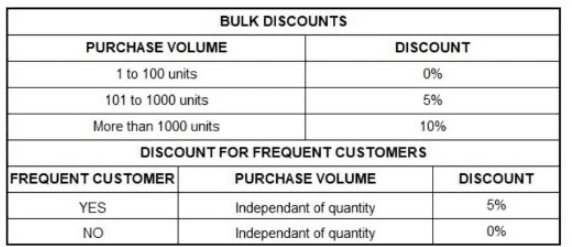
The management of the company ''The Big Drop'' has instructed the Product Team to configure the discounts in the sales terminals so that frequent customers receive an additional discount on top of a bulk discount, based on the following table:

You must design test cases to represent allPOSSIBLEandREALbusiness scenarios. Test cases should be generated using the input data provided in the table above.

How many POSSIBLE decision rules can be extracted from the table above?

Correct Answer: D. 6 decision rules
Explanation:

Comprehensive and Detailed Explanation From Exact Extract:

This is a classic application of theDecision Table Testingtechnique.

We are combining two conditions:

Purchase Volume, which has3 equivalence classes:

1 to 100 units 0%

101 to 1000 units 5%

More than 1000 units 10%

Customer Type, which has2 categories:

Frequent Customer = YES 5% extra

Frequent Customer = NO 0%

This gives:

3 (bulk discount levels) 2 (frequent customer options) = 6 unique decision rules

Each combination of these input conditions defines a separate test scenario with its own outcome.

''Decision table testing is used to identify the different combinations of inputs and their associated outputs. Each unique combination of input values defines a rule.''

(ISTQB CTFL Syllabus v4.0, Section 4.2.3 -- Decision Table Testing, Page 40)

Thus,Option D (6 decision rules)is the correct answer.


Question 3

Which of the following examples represents System Integration testing?

Correct Answer: A. Testing if e-commerce website works correctly with a third-party payment gateway
Explanation:

System Integration Testing (SIT) involves testing the interactions between different systems or components. Testing an e-commerce website's integration with a third-party payment gateway is an example of SIT, as it checks the correct functioning of the integrated systems. This ensures that the e-commerce platform can successfully interact with external systems to process payments.


ISTQB CTFL Syllabus V4.0, Section 2.2.2 on system integration testing.

Question 4

A test status report should:

Correct Answer: A. specify the impediments to carrying out the planned test activities in the reporting period and the corresponding solutions put in place to remove them
Explanation:

A test status report communicates the current status, progress, and issues encountered during testing to stakeholders. It is crucial for effective test management and decision-making.

Option A:Correct as it involves reporting impediments and solutions, which are essential for ongoing test activities.

Option B:Incorrect because test status reports are not limited to test completion activities and focus more on ongoing test status rather than final unmitigated risks.

Option C:Incorrect as the structure and contents of reports should be tailored to the audience's needs to ensure effective communication.

Option D:Incorrect because specifying communication lines is typically done in the test plan, not the status report.

Thus, option A best describes a key aspect of a test status report.


Question 5

Which of the following statements is CORRECT about the value added by a tester to release planning?

Correct Answer: B. The tester assesses the testability of the user stories
Explanation:

During release planning, a tester adds value by assessing the testability of user stories. This involves evaluating whether the user stories are clear, concise, and testable. The tester ensures that the acceptance criteria are well-defined and that the stories can be effectively tested within the given timeframe.


ISTQB CTFL Syllabus V4.0, Section 5.1.2 on the tester's contribution to iteration and release planning, which includes assessing the testability of user stories.

Question 6

Which ONE of the following elements is TYPICALLY used to guide testing duringexploratory testing?

Correct Answer: A. A test charter that defines the testing objectives for the test session.
Explanation:

Exploratory testingis an unscripted approach where testersactively design and execute testsbased on theirintuition, experience, and knowledgeof the system. Atest charter (A)provides a guideline on what areas to explore, defining test objectives but leaving room for dynamic adaptation.

(B), (C), and (D) contradict exploratory testing principles, which focus on freedom rather than rigid documentation.

Exploratory testing is especially useful inagile environments, usability testing, and uncovering unexpected defects.


Question 7

The four test levels used in ISTQB syllabus are:

1. Component (unit) testing

2. Integration testing

3. System testing

4. Acceptance testing

An organization wants to do away with integration testing but otherwise follow V-model. Which of the following statements is correct?

Correct Answer: D. It is not allowed as organizations can't change the test levels as these are chosen on the basis of the SDLC (software development life cycle) model
Explanation:

The V-model is a software development life cycle model that defines four test levels that correspond to four development phases: component (unit) testing with component design, integration testing with architectural design, system testing with system requirements, and acceptance testing with user requirements. The V-model emphasizes the importance of verifying and validating each phase of development with a corresponding level of testing, and ensuring that the test objectives, test basis, and test artifacts are aligned and consistent across the test levels. Therefore, an organization that wants to follow the V-model cannot do away with integration testing, as it would break the symmetry and completeness of the V-model, and compromise the quality and reliability of the software or system under test. Integration testing is a test level that aims to test theinteractions and interfaces between components or subsystems, and to detect any defects or inconsistencies that may arise from the integration of different parts of the software or system. Integration testing is essential for ensuring the functionality, performance, and compatibility of the software or system as a whole, and for identifying and resolving any integration issues early in the development process. Skipping integration testing would increase the risk of finding serious defects later in the test process, or worse, in the production environment, which would be more costly and difficult to fix, and could damage the reputation and credibility of the organization. Therefore, the correct answer is D.

The other options are incorrect because:

A . It is not allowed as organizations can decide on the test levels to do depending on the context of the system under test. While it is true that the choice and scope of test levels may vary depending on the context of the system under test, such as the size, complexity, criticality, and risk level of the system, the organization cannot simply ignore or skip a test level that is defined and required by the chosen software development life cycle model. The organization must follow the principles and guidelines of the software development life cycle model, and ensure that the test levels are consistent and coherent with the development phases. If the organization wants to have more flexibility and adaptability in choosing the test levels, it should consider using a different software development life cycle model, such as an agile or iterative model, that allows for more dynamic and incremental testing approaches.

B . It is not allowed because integration testing is not an important test level and can be dispensed with. This statement is false and misleading, as integration testing is a very important test level that cannot be dispensed with. Integration testing is vital for testing the interactions and interfaces between components or subsystems, and for ensuring the functionality, performance, and compatibility of the software or system as a whole. Integration testing can reveal defects or inconsistencies that may not be detected by component (unit) testing alone, such as interface errors, data flow errors, integration logic errors, or performance degradation. Integration testing can also help to verify and validate the architectural design and the integration strategy of the software or system, and to ensure that the software or system meets the specified and expected quality attributes, such as reliability, usability, security, and maintainability. Integration testing can also provide feedback and confidence to the developers and stakeholders about the progress and quality of the software or system development. Therefore, integration testing is a crucial and indispensable test level that should not be skipped or omitted.

C . It is not allowed because integration testing is a very important test level and ignoring it means definite poor product quality. This statement is partially true, as integration testing is a very important test level that should not be ignored, and skipping it could result in poor product quality. However, this statement is too strong and absolute, as it implies that integration testing is the only factor that determines the product quality, and that ignoring it would guarantee a poor product quality. This is not necessarilythe case, as there may be other factors that affect the product quality, such as the quality of the requirements, design, code, and other test levels, the effectiveness and efficiency of the test techniques and tools, the competence and experience of the developers and testers, the availability and adequacy of the resources and environment, the management and communication of the project, and the expectations and satisfaction of the customers and users. Therefore, while integration testing is a very important test level that should not be skipped, it is not the only test level that matters, and skipping it does not necessarily mean definite poor product quality, but rather a higher risk and likelihood of poor product quality.

Reference= ISTQB Certified Tester Foundation Level Syllabus, Version 4.0, 2018, Section 2.3, pages 16-18; ISTQB Glossary of Testing Terms, Version 4.0, 2018, pages 38-39; ISTQB CTFL 4.0 - Sample Exam - Answers, Version 1.1, 2023, Question 104, page 36.

Question 8

Which ONE of the following options is a practice that does NOT TYPICALLY correspond to a shift left approach?

Correct Answer: D. Performing non-functional testing starting at the system test level.
Explanation:

Comprehensive and Detailed Explanation From Exact Extract:

Theshift-left approachfocuses on executing testing activitiesas early as possiblein the software development lifecycle, including static testing, unit tests, and early reviews. Activities like writing tests before code (test-first) and continuous integration are central to this principle.

However, performingnon-functional testing at the system test levelhappenslaterin the lifecycle and doesnotalign with the shift-left philosophy.

''The shift-left approach involves the adoption of practices to move tasks related to testing (e.g., reviews, test design) to earlier stages in the lifecycle.''

(ISTQB CTFL v4.0 Syllabus, Section 2.1.5 -- Shift-Left Approach)

''Non-functional testing is often performed at the system test level, but the shift-left approach aims to begin such testing earlier, possibly at integration or even unit levels.''

(ISTQB CTFL v4.0 Syllabus, Section 2.2.2 -- Test Types)

Therefore,Option Ddoes not correspond to shift-left practices and is the correct answer.


Question 9

Which ONE of the following statements BEST applies tochecklist-based testing?

Correct Answer: B. Checklists should contain specific test conditions that can be individually and directly checked.
Explanation:

Checklist-based testingusesspecific test conditions(B) that help testers ensure key aspects are validated. The checklist items can be derived from past defects, requirements, or regulatory standards.

(A) is incorrectbecause general guidelines lack specificity.

(C) is incorrectbecause checklists can be used for both manual and automated testing.

(D) is incorrectbecause checklists are useful for both functional and non-functional testing (e.g., security, performance).

Checklistshelp ensure completenesswithout enforcingstrictly scriptedexecution.


Question 10

Which of the following about typical information found within a test plan is false?

Correct Answer: C. The list of the product risks which have not been fully mitigated at the end of test execution
Explanation:

A test plan is a document detailing the objectives, resources, schedule, and scope of testing activities. It also outlines the test strategy, environment, tools, and criteria for test completion and suspension.

Option A:Correct as it indicates resource planning which is a crucial part of a test plan.

Option B:Correct as it describes exit criteria which are essential for test completion.

Option C:Incorrect because a test plan typically addresses known risks and mitigation strategies but does not list unmitigated risks post-test execution.

Option D:Correct as it mentions suspension criteria which are also a part of a test plan.

Therefore, option C is false as it does not reflect the typical information found within a test plan.


Question 11

Which ONE of the following options is aPRODUCT riskand NOT aPROJECT risk?

Correct Answer: A. Incorrect calculation logic in the software, leading to inaccurate results.
Explanation:

Product risksare risks thatimpact the quality or functionality of the software, whereasproject risksaffect theprocess, resources, or timeline.

(A) is correctbecause incorrect calculations impact software correctness.

(B), (C), and (D) are project risksas they relate toteam coordination, staffing, and schedulingrather than software defects.

Identifyingproduct risksearlyimproves defect detection and ensures better coverage for high-risk areas.


Question 12

A number of characteristics are given for impact of SDLC on the testing effort.

i.Finishing of requirements review leading to test analysis

ii.Both - static and dynamic testing performed at unit testing level

iii.Frequent regression testing may need to be performed

iv.Extensive product documentation

v.More use of exploratory testing

Which of the following statements is MOST correct?

Correct Answer: B. i and iv are characteristics of sequential models;ii, iii and varecharacteristicsof iterativeandincrementalmodels
Explanation:

Sequential models, such as the Waterfall model, typically involve completing the requirements review before moving on to test analysis, as well as producing extensive product documentation (i and iv). Iterative and incremental models, like Agile and Spiral models, often involve both static and dynamic testing at the unit testing level, frequent regression testing due to continuous integration and changes, and more use of exploratory testing (ii, iii, and v).


ISTQB CTFL Syllabus V4.0, Section 2.1 on software development lifecycle models and their impact on testing, which discusses the characteristics and testing practices of different lifecycle models.

Question 13

Which of the following is an advantage of the whole team approach?

Correct Answer: D. It helps team members develop better relationships with each other and make their collaboration more effective for the benefit of the project
Explanation:

The 'whole team approach' in Agile methodologies emphasizes collaboration and communication among all team members, including developers, testers, and business representatives. This approach fosters better relationships and effective collaboration, which ultimately benefits the project by leveraging diverse skills and perspectives. It helps ensure that everyone is aligned with the project's goals and quality standards, thus improving the overall effectiveness and efficiency of the team.


Question 14

A document describes the test procedures that have been derived for the identified test sets. Among other things, the order in which the test cases in the corresponding test set are to be executed according to the dependencies described by preconditions and postconditions is specified. This document is a typical work product produced as part of:

Correct Answer: C. test implementation
Explanation:

The document that describes the test procedures, including the order in which test cases are to be executed according to dependencies described by preconditions and postconditions, is typically produced during the test implementation phase. During this phase, detailed test procedures and scripts are developed, organized, and prioritized for execution. The main goal of test implementation is to ensure that all test cases are prepared and structured in a way that supports efficient and effective test execution.


ISTQB CTFL Syllabus 4.0, Chapter 5.1.6, page 49: Test Implementation

Question 15

A system has a self-diagnostics module that starts executing after the system is reset. The diagnostics are running 12 different tests on the systems memory hardware. The following is one of the requirements set for the diagnostics module:

'The time taking the diagnostics tests to execute shall be less than 2 seconds' Which of the following is a failure related to the specified requirement?

Correct Answer: B. The diagnostic tests take too much time to execute
Explanation:

A failure is an event in which a component or system does not perform a required function within specified limits1.A requirement is a condition or capability needed by a user to solve a problem or achieve an objective2. In this case, the requirement is that the diagnostics tests should execute in less than 2 seconds. Therefore, any event that violates this requirement is a failure. The only option that clearly violates this requirement is B. The diagnostic tests take too much time to execute. If the diagnostic tests take more than 2 seconds to complete, then they do not meet the specified limit and thus fail. The other options are not necessarily failures related to the specified requirement. Option A. The diagnostic tests fail to start after a system reset is a failure, but not related to the time limit. It is related to the functionality of the self-diagnostics module. Option C. The diagnostic tests that measure the speed of the memory, fail is also a failure, but not related to the time limit. It is related to the accuracy of the memory tests. Option D. The diagnostic tests fail due to incorrect implementation of the test code is also a failure, but not related to the time limit. It is related to the quality of the test code.Reference=ISTQB Certified Tester Foundation Level Syllabus v4.0,Requirements Engineering Fundamentals.