
Question 1
Which of the following is NOT a valid use of decision coverage?
Correct Answer:
D. Checking that at least 50% of decisions have been exercised by a test case suite
Which of the following is NOT a valid use of decision coverage?
Which of the following lists contains only black-box test techniques?
Black-box test techniques are test techniques that are based on an analysis of the test basis without reference to the internal structure of the system under test. Decision table testing is a black-box test technique that uses a table showing combinations of inputs and/or stimuli (causes) with their associated outputs and/or actions (effects). Use case testing is a black-box test technique that uses scenarios based on use cases (descriptions of sequences of events that a system performs that yield an observable result of value to a particular actor). State transition testing is a black-box test technique that uses models of the state transitions and events of a system to design test cases.
Given the following priorities and dependencies for these test cases:
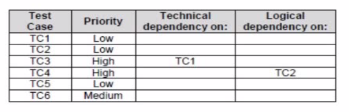
Which of the following lest execution schedules BEST takes into account the priorities and technical and logical dependencies?
Execute high priority test cases before medium or low priority test cases
Execute test cases that have technical dependencies in the correct order
Execute test cases that have logical dependencies in a sensible order
The following table shows how option A follows these rules:

You have been asked to improve the way test automation tools are being used in your company.
Which one of the following is the BEST approach?
Which of the following statements about estimation of the test effort is WRONG?
Effort estimate depends on the budget of the project is the wrong statement about estimation of the test effort, because it confuses the cause and effect relationship between effort estimate and budget. Effort estimate does not depend on the budget of the project, but rather influences it. Effort estimate is an approximation of how much time and resources are needed for testing activities based on various factors such as scope, complexity, risks, quality, etc. . Budget is the amount of money that is allocated or available for testing activities based on the effort estimate . The other options are true statements about estimation of the test effort. Option A is true, because effort estimate can be inaccurate because the quality of the product under test is not known, which affects the number and severity of defects that need to be detected and fixed . Option B is true, because once the test effort is estimated, resources can be identified and a schedule can be drawn up, which are part of test planning . Option C is true, because experience based estimation is one of the estimation techniques that relies on the judgement and expertise of testers or other stakeholders who have previous knowledge or experience with similar projects .
You are testing an e-commerce system The system accepts four different types of Credit Cards; each card has its own rules for valid and invalid numbers. The following is a portion of the Decision Table for Order Management.:
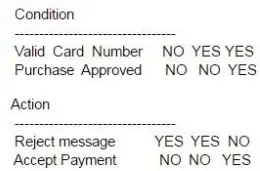
The combination of the conditions Valid Card Number (NO) + Purchase Approved (YES) is not feasible.
You wish to perform a test which completely covers all the combinations of equivalence partitioning tor the different types of credit card, according to the rules shown in the above Decision Table
How many test cases do you need?
The combination of the conditions Valid Card Number (NO) + Purchase Approved (YES) is not feasible, as a purchase cannot be approved with an invalid card number. Therefore, this combination can be ignored in the equivalence partitioning for the different types of credit card. Each type of credit card has two valid equivalence partitions: Valid Card Number (YES) + Purchase Approved (YES) and Valid Card Number (YES) + Purchase Approved (NO). Each type of credit card also has one invalid equivalence partition: Valid Card Number (NO) + Purchase Approved (NO). Therefore, to cover all the combinations of equivalence partitions for the four types of credit card, we need 4 x (2 + 1) = 12 test cases.
A, B, and D are incorrect answers. A implies that there are two equivalence partitions for each type of credit card, which is not true as there are three. B implies that there is only one equivalence partition for each type of credit card, which is not true as there are two valid ones and one invalid one. D implies that there are four equivalence partitions for each type of credit card, which is not true as there are only three.
Which of the following Is an example of tasks most associated with the test design activity?
According to the syllabus, test design is the activity of deriving and specifying test cases from test conditions to test software. Test design involves processes such as identifying test data, designing test scenarios, creating test procedures, and defining expected results. The answer A is correct because it is an example of a task most associated with the test design activity. Test data, derived from production data, is developed for use during testing. The other answers are incorrect because they are examples of tasks associated with other test activities, such as test planning (B), test implementation , and test monitoring and control (D).
Which statement about Static Testing is TRUE?
Static testing is a type of testing that does not involve executing the software or system under test, but rather analyzing it using various techniques, such as reviews, inspections, walkthroughs, checklists, static analysis tools, etc. Static testing can be applied to any work product that participants know how to read and understand, such as requirements specifications, design specifications, code, test cases, test plans, user manuals, etc. Static testing can help find defects and improve the quality of any work product at any stage of the software development lifecycle.
Your task is to compile a test execution schedule for the current release of software.
The system specification states the following logical dependencies:
* An admin user must create/amend/delete a standard user.
* A standard user is necessary to perform all other actions.
The test plan requires that re-tests must be performed first, followed by the highest priority tests. To save time, the test plan states that tests should be scheduled to create test data for the subsequent tests in the schedule.
The following test cases have been designed, with an indication of priority (1 being the highest priority) and whether the test has previously failed.
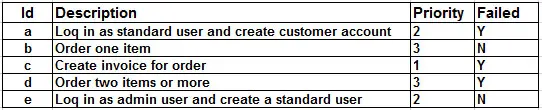
Which test execution schedule meets the test plan requirements and logical dependencies?
A system calculates the amount of customs duty to be paid:
_ No duty is paid on goods value up to, and including, $2,000.
_ The next $8,000 is taxed at 10%.
_ The next $20,000 after that is taxed at 12%.
_ Any further amount after that is taxed at 17%.
To the nearest $, which of these groups of numbers fall into three DIFFERENT equivalence classes?
Group
Equivalence Classes
$20,000 $20,001 $30,001
No duty (up to $2,000), 10% duty ($2,001-$10,000), 12% duty ($10,001-$30,000), 17% duty (above $30,000)
$2,000 $2,001 $10,000
No duty (up to $2,000), 10% duty ($2,001-$10,000), 12% duty ($10,001-$30,000)
$2,000 $8,000 $20,000
No duty (up to $2,000), 10% duty ($2,001-$10,000), 12% duty ($10,001-$30,000)
$1,500 $2,000 $10,000
No duty (up to $2,000), 10% duty ($2,001-$10,000)
The following checklist has been produced to help reviewers detect defects with user stones:
User Story Checklist:
1. The user story must have a unique identifier
2 The user story must contain the user/customer
3 The user story must contain the need
4. The user story must contain the reason.
5. The user story must contain testable acceptance Criteria-Using the checklist above what is wrong with the following user story?
User Story US2018
As a bank account customer, I would like to transfer money from one account to another using the mobile banking application by using the drag
and drop feature.
This is acceptable when
* I can drag and drop from one account to another and select any of the pre-defined amounts
* I can drag and drop from one account to another and type in any positive amount
* Once I confirm the details the amount is debited from the first account and credited to the second account
According to the user story checklist, the user story must contain the reason for the need, which is usually expressed by using the word ''so that'' or ''because''. For example, the user story could be rewritten as:
User Story US2018 As a bank account customer, I would like to transfer money from one account to another using the mobile banking application by using the drag and drop feature,so that I can easily manage my finances.
This way, the user story provides a clear value proposition and a justification for the need. The reason also helps to define the scope and priority of the user story, as well as to verify the acceptance criteria.
For the code fragment given below, which answer correctly represents minimum tests required for statement and branch coverage respectively?
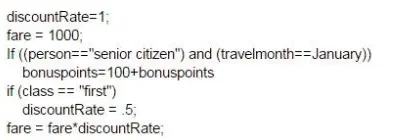
For the code fragment given below, one test case is required for statement coverage and two test cases are required for branch coverage. Statement coverage requires that every executable statement in the code is executed at least once. Branch coverage requires that every possible outcome of each decision point in the code is executed at least once. The following table shows how to achieve statement and branch coverage for the code fragment:
Test Case
Input
Output
Statement Coverage
Branch Coverage
1
x = 3
y = 9
S1, S2, S3
T1 = true
2
x = 5
y = 25
S1, S2
T1 = false
As shown in the table, test case 1 covers all three statements (S1, S2, S3) in the code fragment, achieving 100% statement coverage. Test case 2 covers only two statements (S1, S2) in the code fragment, but it exercises a different outcome of the decision point T1 (if x < 4), achieving 100% branch coverage.
Which of the following activities is appropriate to the test planning stage?
Assigning resources for the planned activities is an activity that is appropriate to the test planning stage, because it involves estimating and allocating the necessary human and physical resources for testing . Test planning is the process of defining the objectives, scope, approach, and resources for testing . The other options are not activities that are appropriate to the test planning stage, but rather to other stages of testing. Option A is an activity that is appropriate to the test analysis stage, because it involves analysing the test basis (such as requirements, design, or code) to identify test conditions . Option C is an activity that is appropriate to the test implementation stage, because it involves designing and preparing the test environments (such as hardware, software, network, or data) for test execution . Option D is an activity that is appropriate to the test execution stage, because it involves writing a test execution schedule that defines the order and dependencies of test cases or procedures .
Which of the following statements about Use Case Testing is FALSE?
Use case testing is a technique that helps us identify test cases that exercise the whole system on a transaction by transaction basis from start to finish. It is a functional black box testing technique.
Use cases are prepared by analysts and domain experts who document the functional requirements of a system from an end-user perspective. Each use case typically has a mainstream scenario and may have alternate or exceptional scenarios that describe different paths or outcomes.
Use case testing can help to verify that all the interactions between actors and the system under test work as expected and meet the user requirements. It can also help to detect integration defects between different components or subsystems.
A, B, and D are correct statements about use case testing. Use case generally has a mainstream scenario and may have many alternate or exceptional scenarios (A), as use cases describe different paths or outcomes depending on various conditions or events. A use case can be defined at different levels of abstraction, such as user goal level, summary level, subfunction level, etc., but not at the abstract level detached from the implementation or at the system level describing a set of executed functions (B), as use cases always describe interactions between actors and systems rather than abstract concepts or functions. Each use case has preconditions which need to be met for the use case to work successfully (D), as preconditions specify what must be true before a use case can begin.