Limited-Time Offer: Enjoy 50% Savings! Ends in 00h 00m 00s Coupon code: 50OFF
Skip to content

Free ISTQB Certified Tester Advanced Level Test Management v3.0 CTAL-TM Exam Questions

Page: 1 / 16 Total 228 questions

Want more questions? Get Premium Access.

Question 1

You have replaced informal code reviews with technical reviews for the most complex and critical components, in an attempt to reduce the high number of defects being found during component and integration test levels. The project manager is concerned about the costs of implementing formal reviews and has asked you to measure whether they actually provide a return on investment.

Which three of the following metrics would be MOST effective in helping you to achieve this?

a. Identification of defect clusters across components

b. Number of lines of code reviewed

c. Number of defects found during reviews d Root cause for each defect detected

e Post-review cost of detection and internal failure per defect

f. Type of review

g. Effort to conduct the review including rework
Correct Answer: A. c. e and g.

Question 2

The Test Manager must assemble team members that have which of the following characteristics? [1]

Correct Answer: C. Will spark informal cross training among themselves
Explanation:

A test manager must assemble team members that will spark informal cross training among themselves. This means that the team members are willing and able to share their knowledge, skills, and experiences with each other, and learn from each other's feedback and suggestions. This can improve the team's performance, productivity, and quality, as well as foster a collaborative and supportive culture. Cross training can also help the team members to develop new competencies, fill skill gaps, and handle different roles and tasks when needed.Top 10 Leadership Qualities to Distinguish a Test ManagerTest manager roles and responsibilities (with FAQs)Reference:

Top 10 Leadership Qualities to Distinguish a Test Manager - Software Test Professionals

Test manager roles and responsibilities (with FAQs) - Indeed


Question 3

Which of the Mowing Is commonly used by a test manager to identity risks'

Correct Answer: C. Experience with similar projects
Explanation:

Common Risk Identification Techniques:

A test manager often relies on experience with similar projects to foresee risks related to technical complexity, domain challenges, or previous defects.

Other options listed are less effective for comprehensive risk identification.

Evaluation of Options:

A (Lines of code) and B (Function points) are quantitative measures, not directly tied to risk identification.

C is correct as past experience is crucial for identifying risks early.

D (Record/playback tools) is irrelevant to risk analysis.

Reference and Syllabus Alignment:

Risk identification techniques are discussed under 'Risk Management' (TM-1.3.1).


Question 4

You are a test team lead working on a large project and have been subject to considerable stress due to exceptional workload. Your manager has suggested that you need to delegate more work to your team members to both reduce the pressure on yourself and allow team members to take on more responsibility which would, in turn, benefit their growth. Which phase of the Tuckman model would this situational skill represent?

Correct Answer: C. Performing
Explanation:

The 'Performing' stage in the Tuckman model is characterized by high-performing teams that are well-organized, motivated, and able to manage and delegate responsibilities effectively. Delegation and enabling team member growth are signs of a mature and performing team. This corresponds to fostering autonomy and productivity, a key trait of the Performing stage.


Question 5

SCENARIO 3

You are the Test Manager for a software house called "MakeMyApp" that specialise in mobile phone applications, agile techniques are used for all software development projects.

A new project is underway to develop enhancements to a 'photo sharing' application, known as 'PictureFriend'. There are two types of user account available -Premium Users and Guest Users. Guest users only have limited functionality available. The enhanced features to PictureFriend are:

* Feature 1: Guest Users can share photos with other Guest Users and Premium Users;

* Feature 2: Premium Users can edit pictures before posting to their account;

* Feature 3: Premium Users can create '3D-effect' photographs

The requirements for each feature will be broken down into a number of User Stories with acceptance criteria created for each of them. User Stories are planned and delivered in 2-week 'Sprints'. The project will have 3 sprints.

Refer to SCENARIO 3

You have been asked to select an appropriate review type and review remit for the project.

Which of the following is the BEST review type and remit for this project?

SELECT ONE OPTION

Correct Answer: C. Informal reviews will be used to review acceptance criteria and design documentation. The artifacts will be reviewed and updated during each sprint.

Question 6

Which of the following metrics is MOST LIKELY to trigger a control directive to increase test execution resources?

Correct Answer: A. Percentage of manual test cases by their execution status, showing that the number of tests run is less than planned
Explanation:

The most direct trigger for resource adjustment is evidence that test execution is behind schedule.

''Test control... includes re-prioritizing tests... or changing the test schedule due to availability of resources.''

-- ISTQB-CTFL_Syllabus_2018_V3.1, section 5.3

Option A points directly to under-execution relative to plan, suggesting a need to scale up resources.


Question 7

Which of the following Is the common set of information to be produced in a test estimate''

Correct Answer: D. Effort time cost, test activities
Explanation:

Key Factors in Test Estimation:

Test estimation requires identifying measurable factors that influence the testing process, including effort (workload in person-hours), time (calendar duration), cost, and the specific test activities (e.g., planning, design, execution).

These are critical to align resources and schedules, ensuring effective project management.

Evaluation of Options:

A is incorrect: While 'lines of code' may relate to testing scope in specific cases, it is not universally applicable in test estimation.

B is incorrect: 'Start and end dates' are outputs of planning, not estimation.

C is partially correct but lacks a focus on 'test activities,' which is crucial for completeness.

D is correct as it covers effort, time, cost, and test activities, reflecting a comprehensive test estimate.

Reference and Syllabus Alignment:

As per ISTQB Advanced Test Management syllabus, test estimation should consider effort, time, cost, and activities under 'Test Planning' (TM-1.1.1).


Question 8

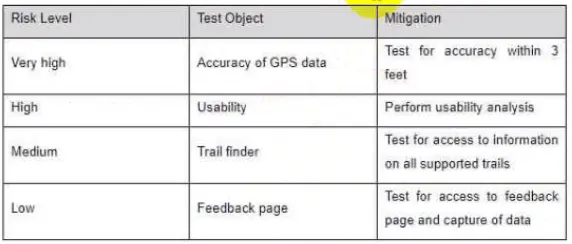
You are managing the test team that is testing a new mobile application that provides a "step-by-step' hiking guide Your risk assessment resulted in the following table:

Your team has clone the depth and breadth testing for the GPS accuracy and usability features but when the product was given to beta testers there were some issues Despite the users reporting the app was easy to use at least one user walked off the edge of a cliff and another one ended up in a river. Your team has confirmed that the functionality is working correctly. and the GPS information is accurate.

What other area of testing should you now prioritize?

Correct Answer: A. Usability
Explanation:

Analysis of the Situation:

The GPS accuracy and functionality have been confirmed to work correctly as per depth and breadth testing.

Despite this, users experienced severe issues such as walking off a cliff or into a river. These incidents point to usability problems related to user interpretation of the GPS data and system feedback.

Testing Prioritization:

Usability testing evaluates how effectively and safely users interact with the application. Here, it should focus on improving user guidance, error prevention, and alerts.

Functionality and Performance are not the problem since they passed testing.

Security is unrelated to the specific reported issues.

Reference and Syllabus Alignment:

This aligns with usability-focused risk mitigation strategies in the ISTQB Advanced Test Management syllabus under 'Test Process' and 'Test Techniques' (TM-1.3.4).


Question 9

Which classification information would be most useful to capture for newly identified defects? [2]

Correct Answer: B. The system build that the defect was found in
Explanation:

Capturing the system build information for newly identified defects is crucial as it helps in tracking the defect back to a specific state of the software. This information is essential for developers to understand the context of the defect and for testers to manage regression testing effectively. It allows for precise identification of when the defect was introduced, aiding in quicker resolution and ensuring that similar issues can be prevented in future builds.


ISTQB Glossary, Distributed Testing1

Defect Report in ISTQB: Software Engineering - The Knowledge Academy

ISTQB Advanced Level Test Manager Syllabus, Section 3.2.1

Defect classification and prioritisation: ISTQB offers a standardised defect classification scheme

The most useful classification information to capture for newly identified defects is the system build that the defect was found in. This is because the system build is the version of the software that is compiled, integrated, and tested together. By capturing the system build for each defect, the test team can track and manage the defects more effectively, and identify the root causes and impacts of the defects. The system build can also help to reproduce and verify the defects, and to measure the quality and progress of the software development.Defect Management - ISTQB not-for-profit associationReference:Certified Tester Advanced Level Test Manager (CTAL-TM) - ISTQB not-for-profit association,ISTQB Test Manager Certification - ISTQB Exams Worldwide - ISTQB Official Registration,Defect Management - ISTQB not-for-profit association

Question 10

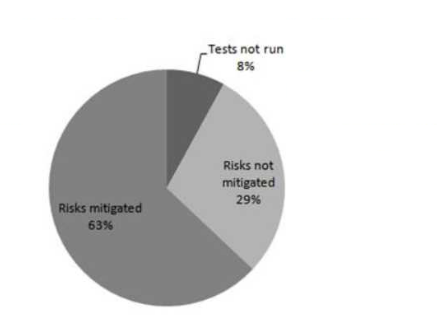
You are the Test Manager of a risk-based testing effort. You develop the following graph to show residual risk. Assume that "Risks mitigated" represents passed tests and "Risks not mitigated"

represents failed tests and other discovered failures.

Which of the following answers best represents what the graph shows? [3]

Correct Answer: C. Project is at risk due to the number of failed tests
Explanation:

The graph indicates that a significant portion of risks, 29%, have not been mitigated, which suggests that these are either failed tests or other discovered failures. This level of unmitigated risk puts the project at risk, as it implies that there are still substantial issues that need to be addressed.

Reference: The ISTQB Advanced Level Test Manager documents outline the importance of risk-based testing and the interpretation of residual risk graphs.These graphs are used to communicate the current status of risk mitigation efforts in the project, and a high percentage of unmitigated risks is a clear indicator of potential problems1.


Question 11

You are a new lest manager in an organization You have been asked to assess the defect process to determine if there are any efficiency improvements that could be made that would reduce the cost of quality You have started digging through the defect Information What information would be most helpful for this investigation?

Correct Answer: D, D
Explanation:

Key Data for Defect Process Improvement:

Analyzing when defects are introduced versus when they are detected is critical to identifying process inefficiencies.

This information helps pinpoint gaps in earlier phases, allowing the team to implement preventive measures and reduce overall costs.

Evaluation of Options:

A and B are useful but do not address the root cause of inefficiencies.

C (Risk areas and severity relationship) is helpful but secondary to understanding phase discrepancies.

D is correct as it provides the most actionable insights for process improvement.

Reference and Syllabus Alignment:

Defect lifecycle analysis is discussed under 'Defect Management' (TM-2.3.1) in the ISTQB syllabus.


Question 12

You have been carefully monitoring the progress of testing for your project. You have been using the established traceability to verify that the requirements and test

conditions are being adequately addressed. The test team is proceeding well in their test case execution and you can see that you are achieving about 80% coverage of

the test conditions per the traceability mapping in your test management system. You have seen a number of defects being logged against test conditions that are failing,

but you do not see a mapping of the test cases to those conditions.

What is likely to be occurring in the testing area that is causing the traceability to break down? [2]

Correct Answer: D. The testers are not updating the test execution information in the test management system.
Explanation:

The most likely cause of the traceability breakdown in the testing area is that the testers are not updating the test execution information in the test management system. This is because the test management system is a tool that supports the test process, and it can store and manage the test documentation, such as the requirements, the test conditions, the test cases, and the test results. If the testers do not update the test execution information in the test management system, such as the test cases that are run, the test results that are obtained, and the defects that are found, the traceability between the test cases and the test conditions will be lost or inaccurate. This can affect the test analysis and reporting, and the test coverage measurement.Test Management - ISTQB not-for-profit associationReference:Certified Tester Advanced Level Test Manager (CTAL-TM) - ISTQB not-for-profit association,ISTQB Test Manager Certification - ISTQB Exams Worldwide - ISTQB Official Registration,Test Management - ISTQB not-for-profit association


Question 13

You are a Test Manager and have started a program of test process improvement. You are following the IDEAL model and have completed the first three phases, now you are ready to go further. Which TWO of the following activities will enable you to complete the remaining phases of the IDEAL model?

Correct Answer: C. Trial one or more of the highest-priority improvements in a pilot project; E. Check to see which benefits have, or have not, been achieved from the improvement made
Explanation:

According to the ISTQB glossary:

The IDEAL model comprises five phases: Initiating, Diagnosing, Establishing, Acting, and Learning.

''Acting'' includes piloting and implementing improvements (e.g. trialing highest-priority improvements).

''Learning'' includes evaluating the success and capturing lessons learned (e.g. checking if benefits were achieved).

Therefore, C (trial highest-priority improvements) belongs to the Acting phase, and E (benefits check) aligns with Learning.


Glossaire-des-tests-logiciels-v3_2F-ISTQB-CFTL.pdf, definition of IDEAL model

Question 14

You have done a comprehensive risk analysis. You have involved the appropriate people in assessing the risks and determining the likelihood and impact of those risks. You have been testing for three months and have been able to mitigate 75% of the high risk items. You have two weeks left in testing and you now do not expect to be able to complete all the items on the high-risk

mitigation list, never mind any from the medium or low-risk lists.

What is the most effective action you should take? [3]

Correct Answer: B. Present your risk mitigation progress and project status to the project's stakeholders, and request additional time or assistance in re-prioritizing the remaining high-risk items.
Explanation:

When faced with the inability to complete all items on the high-risk mitigation list within the remaining time, the most effective action is to communicate the current progress and challenges to the stakeholders. This allows for a collaborative decision-making process to re-prioritize the remaining high-risk items and potentially secure additional resources or time to address them.

Reference: The ISTQB Advanced Level Test Manager syllabus emphasizes the importance of continuous monitoring and control of test activities to achieve project objectives, which includes assessing and reporting relevant and timely test status to project stakeholders123.It also highlights the need for test managers to organize and lead risk identification and analysis sessions, and use the results for test planning, monitoring, and control2.


Question 15

Your organisation has decided to move from using the V-model software development lifecycle to Agile Scrum. Due to inexperience in Agile methodologies and to mitigate risk, the next project will use a hybrid model, beginning with a traditional requirement definition phase and transitioning to an Agile Scrum approach for development and testing.

Which would be an appropriate test management task to perform FIRST for this next project?

Correct Answer: A. Ensure the team is adept at combining structured processes with Agile flexibility
Explanation:

The hybrid approach demands alignment between traditional and Agile practices. The Test Manager must first ensure the team is capable of combining structured process with Agile adaptability. This aligns with the guidance that in hybrid models, one must balance flexibility with formal test planning and risk management strategies, especially during the transition phase .