Limited-Time Offer: Enjoy 50% Savings! Ends in 00h 00m 00s Coupon code: 50OFF
Skip to content

Free ISTQB Certified Tester Advanced Level Technical Test Analyst CTAL-TTA Exam Questions

Page: 1 / 12 Total 175 questions

Want more questions? Get Premium Access.

Question 1

You are asked to provide a practical and pragmatic testing solution for a commercial system where the main user interface is via the Internet. It is critical that the company's existing good name and market profile are not damaged in any way. Time to market is not a critical issue when appropriate testing solutions are identified to mitigate business risks.

A product risk assessment has revealed the following product risk:

* Abnormal application termination due to connection failure of the main interface.

Which of the following is the appropriate test type to address this risk?

Correct Answer: C. Reliability testing
Explanation:

Reliability testing is the process of checking whether the software consistently performs according to its specifications. For a commercial system with a critical internet-based user interface, ensuring that the application can handle connection failures without abnormal terminations is essential. Reliability testing would include testing the system's ability to recover from failures and continue operating, which directly addresses the risk identified.
Question 2

What is the earliest stage in the application's SDLC at which performance efficiency testing can be performed?

Correct Answer: A. During requirements analysis
Explanation:

The earliest stage in the application's SDLC at which performance efficiency testing can be performed is during requirements analysis. At this stage, performance requirements and goals are established, providing a baseline for what needs to be tested and verified throughout the later stages of development.


Question 3

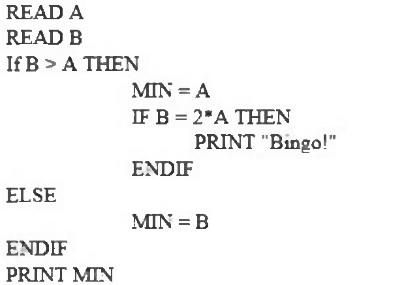
Consider the pseudo code provided below:

Given the following tests, what additional test(s) (if any) would be needed in order to achieve 100% statement coverage, with the minimum number of tests?

Test 1: A = 7, B = 7, Expected output: 7

Test 2: A = 7, B = 5, Expected output: 5

Correct Answer: D. No additional test cases are needed to achieve 100% statement coverage.
Explanation:

100% statement coverage means that every line of code is executed at least once during testing. Based on the provided pseudo-code and the test cases given:

Test 1 executes the MIN = B statement when A and B are equal.

Test 2 executes the MIN = A statement and skips the inner IF since B is not equal to 2*A.

All statements within the code have been executed by these two tests, hence no additional test cases are needed to achieve 100% statement coverage.


Question 4

What BEST describes how tools can support the practice of Model-Based Testing (MBT)?

Correct Answer: D. MBT tools can generate test cases using a model of the system under test, but they cannot reduce the very large number of possible paths that can be generated in the model
Explanation:

Analysis:

Model-Based Testing (MBT) tools are designed to generate test cases based on models of the system under test.

D . MBT tools can generate test cases using a model of the system under test, but they cannot reduce the very large number of possible paths that can be generated in the model:

MBT tools create test cases from models, but managing the large number of possible test paths generated remains a challenge. These tools help automate the generation of test cases but often require additional strategies to handle the complexity and volume of test paths.

Explanation of Incorrect Options:

A . MBT tools can help by generating a model of the system under test, based on the test results derived from both systematic and experience-based testing techniques:

MBT tools generate test cases from existing models, not create models from test results.

B . MBT tools can generate different levels of load on the system under test simulating predefined usage models for trial system:

This describes performance testing tools rather than MBT tools.

C . MBT tools can be used to generate large sets of distinct execution threads which can be saved and used as test cases:

While partially true, it does not capture the essence of the challenge with the large number of possible paths.


The ISTQB CTAL-TTA syllabus covers Model-Based Testing tools, emphasizing their capabilities and limitations in generating and managing test cases.

Sources:

ISTQB-CTAL-TTA Syllabus

General knowledge on Model-Based Testing tools.

Question 5

You have been assigned the task of defining the risk-based approach to testing the performance efficiency of a new application. Which of the following is an ISTQB defined technique to use for Identifying the risks?

Correct Answer: B. Analyzing the requirements to look for areas where performance efficiency requirements have not been well-defined
Explanation:

An ISTQB defined technique for identifying risks when defining a risk-based approach to testing the performance efficiency of a new application is to analyze the requirements to look for areas where performance efficiency requirements have not been well-defined. This technique ensures that testing efforts are focused on areas of the application that are critical for performance but may have insufficient coverage in terms of detailed requirements.


Question 6

You are working on project where re-use of software is an objective. You are involved in the project as a Technical Test Analyst and have been given the task to develop a checklist for code reviews.

Which question from the list below should you implement as part of the code review checklist?

Correct Answer: A. Are all modules, data, and interfaces uniquely identified?
Explanation:

For a project where the reuse of software components is a key objective, it is essential to ensure that all modules, data, and interfaces are uniquely identified. This facilitates the tracking, maintenance, and reuse of these components in different parts of the software or in other projects. Unique identification helps in preventing confusion and conflicts that may arise due to the reuse of components that have the same name but different functionalities or interfaces.


Question 7

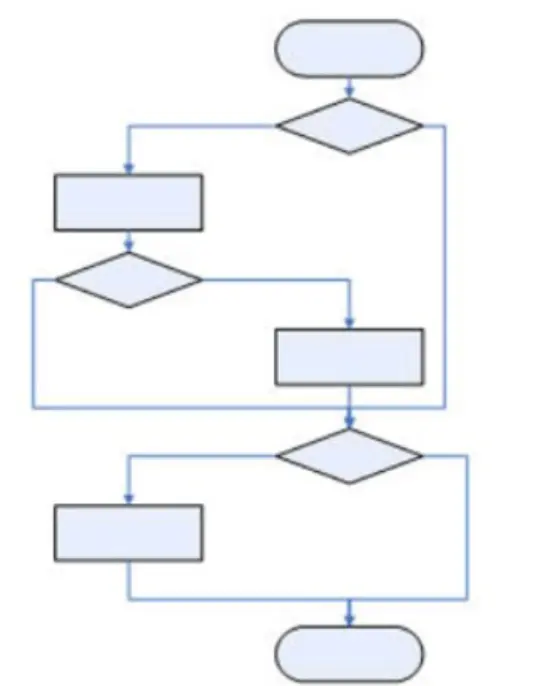
How many independent paths are shown in the control flow diagram below?

Correct Answer: C. 4
Explanation:

Upon analyzing the control flow diagram provided, there are four distinct paths through the program, considering the flow between decision points and actions. Each path represents a unique sequence of execution through the system logic, dictated by the decision outcomes at various points. This information is critical for ensuring comprehensive testing coverage, as each path may expose different behaviors or outcomes in the application.


Question 8

Consider the following pseudocode segment:

set a = 1

while a < 12

display ''this is loop", a

if a > 10 then

display "loop is > 10'

set a = 5

else

display ''loop is < 11*

endif

end while

display ''Final value of a is", a

Which of the following issues should be detected in the code review?

Correct Answer: A. Loop termination is not achievable
Explanation:

The pseudocode provided includes a while loop that adjusts the loop variable a within the loop's conditional code block. This adjustment, set a = 5, occurs when a > 10. Because the loop checks a < 12 as its continuation condition, and a is reset to 5 repeatedly once it exceeds 10, the loop will execute indefinitely, preventing termination. This creates an infinite loop situation since the condition a < 12 will perpetually remain true once a exceeds 10. This is a critical logic error needing correction for proper execution flow.


Question 9

You are involved in testing a system in the medical domain. Testing needs to comply with the FDA requirements and is rated as being safety critical. A product risk assessment has been performed and various mitigation actions have been identified. Reliability testing is one of the test types that needs to be performed throughout the development lifecycle.

Based on the information provided, which of the following activities would need to be addressed in the test plan?

Correct Answer: B. Design and execution of specific tests that evaluate the software's tolerance to faults in terms of handling unexpected input values.
Explanation:

In the context of safety-critical systems, particularly in the medical domain, reliability is of utmost importance. For such systems, it is crucial to ensure that the software can handle unexpected input values and continue to operate without failure. This is essential to ensure patient safety and compliance with FDA requirements. Vulnerability scans (option A) are more related to security testing, whereas scalability (option C) and installation/de-installation (option D) are important but not specifically related to the reliability and safety criticality of the system in the medical domain.


Question 10

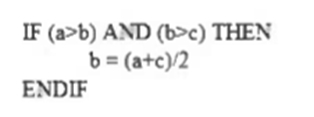
Consider the pseudo code provided below:

Which of the following options provides a set of test cases that achieves 100% decision coverage for this code fragment, with the minimum number of test cases?

Assume that in the options, each of the three numbers in parenthesis represent the inputs for a test case, where the first number represents variable ''a'', the second number represents variable ''b'', and the third number represents variable ''c''.

Correct Answer: B. (5. 3, 2); (6, 4, 2); (5, 4, 0)
Explanation:

To achieve 100% decision coverage with the minimum number of test cases, we need to ensure that every branch of the decision is taken at least once. For the code provided:

The first condition (a>b) is true for the first two test cases and false for the third.

The second condition (b>c) is true for the first test case, false for the second, and does not matter for the third since the first condition is false.

Therefore, with these three test cases, we cover all possible outcomes of the decision, ensuring 100% decision coverage.


Question 11

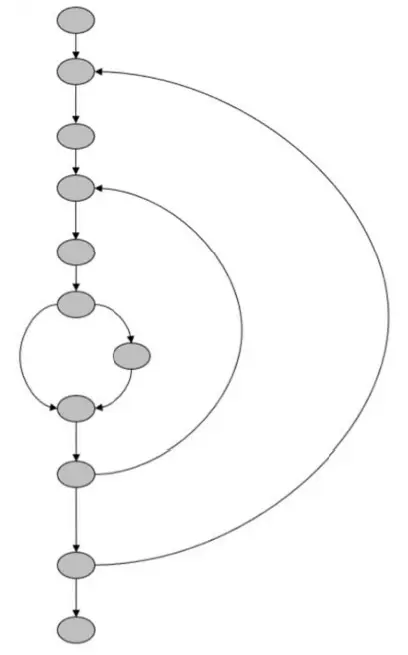
Consider the following control flow graph:

The control flow represents a software component of a car navigation system. Within the project the maximum cyclomatic complexity to be allowed is set at 5.

Which of the following statements is correct?

Correct Answer: D. A defect needs to be reported since the cyclomatic complexity of the component is calculated at 6.
Explanation:

Cyclomatic complexity is a measure of the number of linearly-independent paths through a program's source code, which is often used as a measure of the complexity of a program. The control flow graph provided represents the logic of a software component and has more than 5 nodes with decision points, indicating that the complexity would exceed the maximum allowed value of 5. The calculation for cyclomatic complexity is V(G) = E - N + 2P, where E is the number of edges, N is the number of nodes, and P is the number of connected components. In this case, the calculated cyclomatic complexity exceeds the allowed threshold, thus a defect should be reported.


Question 12

The requirements specification of a product begins with this sentence:

"The xyz system will provide many new user functions. These must be easy for our operators to use and tolerant of user input errors. These new functions must also be easy to learn. Because of very high transaction rates and limited processing power, the software design must be very efficient. The system must be available as close to 24x7 as possible.

Which three ISO 25010 major quality characteristics should be tested for possible defects with this implementation?

Correct Answer: D. Reliability, usability, performance efficiency
Explanation:

The requirements specify a need for ease of use, high efficiency due to high transaction rates and limited processing power, and near-continuous availability. Therefore, the three ISO 25010 major quality characteristics most relevant are:

Usability: Ensures the system is easy to learn and use.

Performance Efficiency: Ensures the system manages its processing power and transaction rates efficiently.

Reliability: Ensures the system is available and functioning correctly as close to 24x7 as possible.


Question 13

A component has been analysed during a risk-assessment and rated as highly critical. Which of the following white-box test techniques provides the highest level of coverage and could therefore be used to test this component?

Correct Answer: D. Modified condition/decision testing
Explanation:

Modified condition/decision testing (MC/DC) provides a higher level of coverage compared to other white-box testing techniques because it requires each condition in a decision to be shown to independently affect that decision's outcome. It is more rigorous than both decision testing (which only requires each decision's possible outcomes to be tested) and statement testing (which requires only each executable statement to be executed). Therefore, for a highly critical component, MC/DC is more appropriate as it ensures a more thorough assessment of the logic in the software component.


Question 14

A new web site has been launched for a testing conference. There are a number of links to other related web sites for information purposes. Participants like the new site but complaints are being made that some (not all) of the links to other sites do not work.

Which type of test tool is most appropriate in helping to identify the causes of these failures?

Correct Answer: B. Hyperlink tool
Explanation:

When users complain about issues with links on a website, the most appropriate test tool to identify the causes of these failures is a hyperlink tool (answer B). Hyperlink tools are specifically designed to check the validity of links on web pages. They can automatically identify broken or dead links, which is essential for maintaining the quality and user experience of a website. Review tools, static analysis tools, and dynamic analysis tools do not primarily focus on hyperlink verification.


Question 15

Given the following decision: IF X < 5 OR Y > 10 THEN

Which of the following sets of test inputs will achieve full MC/DC coverage?

Correct Answer: B. X=4 and Y=11 X=7 and Y=10
Explanation:

To achieve full Modified Condition/Decision Coverage (MC/DC), each condition within a decision must be shown to independently affect the outcome of the decision. For the decision IF X < 5 OR Y > 10 THEN, the conditions are:

Condition 1: X < 5

Condition 2: Y > 10

We need to test these conditions in such a way that each condition independently influences the decision outcome. Let's analyze the options:

Option A:

X=4 and Y=7 (X < 5 is true, Y > 10 is false; overall decision true)

X=6 and Y=12 (X < 5 is false, Y > 10 is true; overall decision true)

X=5 and Y=10 (X < 5 is false, Y > 10 is false; overall decision false)

This set achieves full MC/DC coverage because each condition is shown to independently affect the outcome.

Option B:

X=4 and Y=11 (X < 5 is true, Y > 10 is true; overall decision true)

X=7 and Y=10 (X < 5 is false, Y > 10 is false; overall decision false)

This set achieves full MC/DC coverage because it demonstrates both conditions independently affecting the outcome.

Option C:

X=5 and Y=8 (X < 5 is false, Y > 10 is false; overall decision false)

X=2 and Y=12 (X < 5 is true, Y > 10 is true; overall decision true)

X=4 and Y=4 (X < 5 is true, Y > 10 is false; overall decision true)

This set does not fully achieve MC/DC coverage as it does not demonstrate the impact of Y > 10 being false while X < 5 is false.

Option D:

X=3 and Y=10 (X < 5 is true, Y > 10 is false; overall decision true)

X=5 and Y=15 (X < 5 is false, Y > 10 is true; overall decision true)

X=0 and Y=15 (X < 5 is true, Y > 10 is true; overall decision true)

This set does not achieve MC/DC coverage because it does not show the decision outcome when both conditions are false.

Therefore, the correct answer is B. X=4 and Y=11, X=7 and Y=10.