
Limited-Time Offer: Enjoy 50% Savings! Ends in 00h 00m 00s Coupon code: 50OFF
Skip to content

Free Juniper Mist AI Wired, Specialist JN0-460 Exam Questions

Page: 1 / 9 Total 84 questions

Want more questions? Get Premium Access.

Question 1

You are experiencing issues with your video streams. In this scenario, which SLE and classifier should you inspect to see if BUM traffic is a problem?

Correct Answer: C. Throughput Storm Control
Explanation:

According to Juniper Mist documentation, the Throughput Service Level Expectation (SLE) is the primary metric used to measure the ability of wired clients to pass traffic across the physical network without impedance. This SLE is critical for diagnosing issues with real-time, high-bandwidth applications such as video streams, which are highly sensitive to packet loss and latency. Within the Throughput SLE, the Storm Control classifier is specifically designed to identify 'bad user minutes' caused by the suppression of Broadcast, Unknown Unicast, and Multicast (BUM) traffic.

Storm control is a mechanism that enables the switch to monitor traffic levels and drop BUM packets when a specified traffic level---known as the storm control level---is exceeded. This prevents a 'traffic storm' from proliferating and degrading the overall performance of the LAN. While this is a vital security feature to prevent network meltdowns, it can inadvertently impact legitimate traffic. For instance, if multicast-based video streams or other heavy BUM traffic exceed the configured bandwidth percentage on a port, the switch will drop those packets to protect the rest of the network.

When troubleshooting video stream issues, network administrators should inspect the Storm Control classifier to see if it is triggering 'bad user minutes'. If the Mist dashboard indicates failures under this classifier, it signifies that the switch hardware is actively dropping packets because the BUM traffic limit has been reached. This provides immediate root-cause evidence, allowing the administrator to determine if they need to adjust the storm control thresholds within the Port Profile or investigate the source of the excessive broadcast traffic. By correlating these hardware-level events with the end-user experience, Mist AI simplifies the resolution of complex performance problems that traditional 'up/down' monitoring would miss.

Question 2

What are three ways that data is collected from the Mist backend?(Choose three.)

Correct Answer: A. RESTful API; B. Webhook; C. WebSocket
Explanation:

Juniper Mist uses open, cloud-native APIs to providereal-time telemetry and integration.

Data is collected and streamed from the backend using:

RESTful APIs-- for configuration, automation, and reporting.

Webhooks-- to push events, alerts, or SLE changes to third-party systems.


Question 3

What is the purpose of an EPVN Type 4 route?

Correct Answer: D. to provide a designated forwarder election
Explanation:

According to Juniper Networks' EVPN documentation, an EVPN Type 4 route, also known as an Ethernet Segment route, is a critical component of the BGP EVPN control plane used specifically in multihoming scenarios. When a Customer Edge (CE) device is connected to two or more Provider Edge (PE) routers via a Link Aggregation Group (LAG), these PE routers must coordinate to manage traffic flow and prevent network loops.

The primary purpose of the Type 4 route is to enable Designated Forwarder (DF) election. In a multihomed Ethernet Segment (identified by a unique Ethernet Segment Identifier or ESI), only one PE router---the Designated Forwarder---is permitted to forward Broadcast, Unknown unicast, and Multicast (BUM) traffic from the EVPN core to the CE device. Without this election process, multiple PE routers would forward the same BUM packets to the CE, leading to traffic duplication and potential broadcast storms.

The workflow begins when a PE router is configured with an ESI on a physical or logical interface; it then generates and advertises a Type 4 route to all other PE routers in the network. This route carries the ESI and an 'ES-import' extended community, which allows other PEs connected to the same segment to automatically discover their peers. Once these 'peering' PEs are discovered, they collectively execute a DF election algorithm---such as the default modulo-based algorithm or the newer preference-based algorithm---to select the DF and Backup Forwarder (BDF) for each VLAN or bridge domain. By ensuring a deterministic and synchronized selection of the forwarder, Type 4 routes provide the foundational stability required for active-active and active-standby multihoming in modern campus and data center fabrics.


Question 4

When is a virtual routing and forwarding (VRF) instance typically used?

Correct Answer: B. It separates networks into routing instances.1
Explanation:

According to Juniper Networks' documentation on campus fabric and EVPN-VXLAN architectures, a Virtual Routing and Forwarding (VRF) instance---conceptually referred to within the Junos OS as a routing instance---is typically used to provide macro-segmentation by logically separating a single physical network into multiple, isolated virtual networks.2 In the context of a modern campus fabric managed by Juniper Mist, VRFs allow network administrators to create distinct routing domains that maintain their own independent routing and forwarding tables.3

This separation is essential for multitenancy and security.4 For example, an organization might use one VRF for 'Corporate_IT' and another for 'Guest_WiFi' or 'IoT_Devices'. Because each VRF operates with its own routing table, traffic belonging to one instance is completely isolated from traffic in another by default; packets cannot travel between VRFs unless an administrator explicitly configures 'route leaking' or directs the traffic through a stateful firewall for security inspection. This architectural approach also permits the use of overlapping IP address spaces, as the routing decisions for one tenant do not interfere with the address entries of another.5

In a Juniper Mist-driven campus fabric (such as Core-Distribution or IP Clos), the Mist portal streamlines the creation of these VRF instances as part of the fabric workflow.6 Once a VRF is created, specific VLANs (and their corresponding IRB interfaces) are assigned to it, ensuring that Layer 3 gateways are placed in the correct logical domain. While the underlay network (Option D) is responsible for providing the physical reachability (loopback to loopback) between switches using a protocol like eBGP, the overlay network leverages VRFs to deliver the actual isolated user services.


Question 5

You are asked to apply the samesystem-level configurationacross all the devices in multiple sites usingMist AI.

According to Juniper Networks, which solution should you use in this scenario?

Correct Answer: C. Use an organization-level template in Mist AI.
Explanation:

Juniper Mist supports ahierarchical configuration model:

Organization level:global configuration templates applied across sites.

Site level:shared configuration for all devices in a site.

Individual device level:unique overrides.

To applycommon system-level settings(e.g., NTP, SNMP, DNS, syslog) across multiple sites, the correct method is to use anorganization-level template.

''Organization-level templates provide a consistent configuration framework that can be applied across multiple sites, ensuring uniform system settings for all switches.''

Option A:Incorrect --- manual CLI configuration defeats automation.

Option B:Incorrect --- applies only to one site, not multiple.

Option C:Correct--- organization-level templates provide centralized configuration for all sites.

Option D:Incorrect --- individual configuration is for unique settings only.


Juniper Mist AI for Wired -- Configuration Hierarchy and Templates

Juniper Mist AI for Wired -- Multi-Site Configuration Guide

Juniper Mist AI Cloud -- Organization and Site Management

Question 6

What is a limitation of Layer 2 network segmentation?

Correct Answer: A. There is support for only 4094 VLANs.
Explanation:

According to Juniper Networks technical documentation regarding 'Bridging and VLANs,' Layer 2 network segmentation is primarily achieved through the implementation of Virtual Local Area Networks (VLANs). While VLANs provide critical segmentation services by grouping related devices into independent logical networks and containing broadcasts within specific domains, they are bound by the architectural constraints of the IEEE 802.1Q standard.

A fundamental limitation of this traditional Layer 2 approach is the address space of the VLAN identifier. The 802.1Q header allocates exactly 12 bits for the VLAN ID (VID). This mathematical constraint limits the total number of possible VLANs to 4,096 ($2^{12}$). Within the Junos operating system, VLAN IDs 0 and 4,095 are strictly reserved for system internal functions and cannot be assigned to user traffic, resulting in a maximum of 4,094 usable VLANs for network segmentation.

In modern enterprise environments---especially those involving large-scale multitenancy, cloud services, or high-density campus deployments---this 4,094 limit often becomes a significant bottleneck. Network administrators can exhaust this pool when attempting to provide granular isolation for thousands of unique device types, departments, and guest users. To overcome this specific limitation, Juniper recommends moving toward EVPN-VXLAN campus fabrics. VXLAN technology replaces the 12-bit VLAN tag with a 24-bit VXLAN Network Identifier (VNI), which theoretically supports over 16 million unique segments. This vast increase in scalability allows for the creation of administrative domains that far exceed the capabilities of traditional Layer 2 Ethernet bridging. While Layer 2 domains also face challenges related to Spanning Tree Protocol (STP) complexity and large broadcast diameters, the numeric exhaustion of the VLAN ID space remains the most definitive hardware-level limitation of standard Layer 2 segmentation.


Question 7

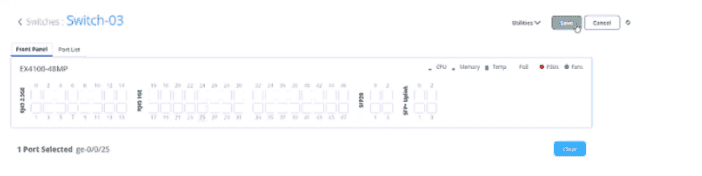
Referring to the exhibit, what is the purpose of theSavebutton in the upper-right corner of the Mist dashboard?

Correct Answer: D. It applies the port configuration changes to the switch.
Explanation:

In theJuniper Mist AI for Wired dashboard, administrators can select one or more switch ports (as shown in the exhibit, e.g., port ge-0/0/25 on an EX4100-48MP). Once configuration changes are made --- such as VLAN assignment, port profiles, PoE settings, or administrative state --- theSave buttonmust be clicked to confirm and apply those changes to the device.

''When making configuration changes in the Mist switch interface, the Save button must be used to confirm the modifications. Clicking Save applies the selected port settings to the switch through Mist Cloud.''

Option Ais incorrect: saving does not create a backup. Backups and snapshots are handled through Mist's configuration archive, not via the Save button.

Option Bis incorrect: Save does not reset configuration; instead, it commits changes.

Option Cis incorrect: there is no preview function tied to Save.

Option Dis correct: the Save button is explicitly forapplying configuration changesto the selected switch or port(s).


Juniper Mist AI for Wired -- Switch Port Configuration Guide

Juniper Mist AI for Wired -- Wired Assurance Administration Guide

Juniper Mist Documentation -- Managing Switch Interfaces

Question 8

Which two elements are required for a brownfield adoption?(Choose two.)

Correct Answer: A. DNS resolution; B. Internet connectivity
Explanation:

Abrownfield adoptionin Mist AI refers to onboarding existing Juniper switches (with existing configurations) into the Mist Cloud for management and monitoring. For the switch to connect successfully, it must be able to reach Mist Cloud services usingDNSandInternet connectivity.

''To onboard existing (brownfield) switches into Mist Cloud, the device must have outbound Internet connectivity and DNS resolution to discover Mist Cloud service endpoints.''

Option A:Correct--- DNS is required for the switch to resolve Mist Cloud URLs.

Option B:Correct--- Internet access is required for registration and telemetry exchange.

Option C:Incorrect --- templates can be applied later but are not required for adoption.

Option D:Incorrect --- Mist uses TCP ports 2200 or 443, not UDP 1280.


Juniper Mist AI for Wired -- Brownfield Adoption Guide

Juniper Mist AI for Wired -- Cloud Connectivity Requirements

Juniper Mist Cloud -- Device Onboarding Workflow

Question 9

Which statement is correct about Juniper Mist Wired Assurance capabilities?

Correct Answer: A. Juniper Mist delivers operational visibility, sets service level expectations (SLEs), and monitors throughput, successful connects, and switch health using pre-connection and post-connection performance metrics.
Explanation:

Juniper Mist Wired AssuranceprovidesAI-driven operational visibilityfor EX and QFX switches. It defines and tracksService Level Expectations (SLEs)across multiple performance areas including connectivity, throughput, and switch health.

''Wired Assurance uses AI and telemetry to deliver operational visibility, track service level expectations (SLEs), and monitor throughput, successful connects, and switch health through pre- and post-connection metrics.''

Option A:Correct--- accurately describes the full scope of Wired Assurance.

Option B:Incorrect --- Wired Assurance provides SLEs specifically for EX and QFX switches.

Option C:Incorrect --- both pre- and post-connection SLEs are monitored.

Option D:Incorrect --- Wired Assurance monitors both connectivity and device health.


Juniper Mist AI for Wired -- Wired Assurance Overview

Juniper Mist AI for Wired -- Service Level Expectations (SLEs) Guide

Juniper Mist Cloud Documentation -- Switch Insights and Health Metrics

Question 10

Which two statements are correct about theEVPN-VXLAN control plane?(Choose two.)

Correct Answer: B. The control plane learns the MAC addresses of end-user devices.; C. The control plane learns the IP addresses of end-user devices.
Explanation:

In anEVPN-VXLAN fabric, thecontrol planeoperates overBGP EVPNand is responsible for distributing endpoint reachability information (MAC and IP) among VTEPs. Thedata plane, by contrast, performs encapsulation and forwarding.

''The EVPN control plane uses BGP to exchange MAC and IP address reachability information between VTEPs, enabling efficient forwarding and loop prevention without relying on flood-and-learn behavior.''

Option A:Incorrect --- encapsulation occurs in thedata plane, not the control plane.

Option B:Correct --- the control plane distributesMAC-to-VTEP mappings.

Option C:Correct --- the control plane also distributesIP-to-MAC associations(Type 2 and Type 5 EVPN routes).

Option D:Incorrect --- the control plane does not alter packet headers.


Juniper Mist AI for Wired -- EVPN-VXLAN Overview

Juniper Validated Design -- EVPN Control and Data Plane Operation

Junos OS EVPN-VXLAN Implementation Guide