Limited-Time Offer: Enjoy 50% Savings! Ends in 00h 00m 00s Coupon code: 50OFF
Skip to content

Free Juniper Data Center Professional JN0-683 Exam Questions

Page: 1 / 7 Total 65 questions

Want more questions? Get Premium Access.

Question 1

Exhibit.

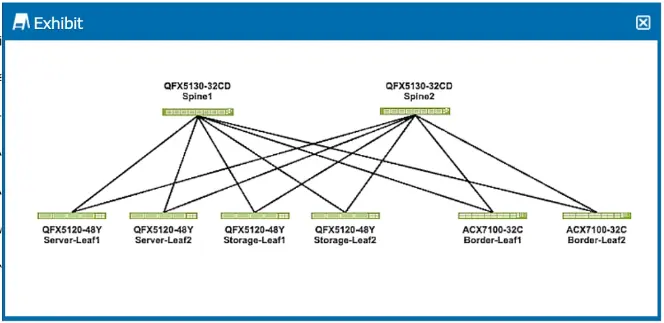
You are deploying a VXLAN overlay with EVPN as the control plane in an ERB architecture.

Referring to the exhibit, which three statements are correct about where the VXLAN gateways will be placed? (Choose three.)

Correct Answer: B. All leaf devices will have L2 VXLAN gateways.; C. All leaf devices will have L3 VXLAN gateways.; E. Spine devices will have no VXLAN gateways.
Explanation:

Understanding ERB Architecture:

ERB (Edge Routed Bridging) architecture is a network design where the routing occurs at the edge (leaf devices) rather than in the spine devices. In a VXLAN overlay network with EVPN as the control plane, leaf devices typically act as both Layer 2 (L2) and Layer 3 (L3) VXLAN gateways.

Placement of VXLAN Gateways:

Option B: All leaf devices will have L2 VXLAN gateways to handle the bridging of VLAN traffic into VXLAN tunnels.

Option C: All leaf devices will also have L3 VXLAN gateways to route traffic between different VXLAN segments (VNIs) and external networks.

Option E: Spine devices in an ERB architecture generally do not function as VXLAN gateways. They primarily focus on forwarding traffic between leaf nodes and do not handle VXLAN encapsulation/decapsulation.

Conclusion:

Option B: Correct---All leaf devices will have L2 VXLAN gateways.

Option C: Correct---All leaf devices will have L3 VXLAN gateways.

Option E: Correct---Spine devices will not act as VXLAN gateways

Question 2

Which two statements are true about a pure IP fabric? (Choose two.)

Correct Answer: A. Devices in an IP fabric function as Layer 3 routers.; D. An IP fabric does not support Layer 2 protocols.
Explanation:

Understanding Pure IP Fabric:

A pure IP fabric is a network design where all devices operate at Layer 3, meaning that each device in the fabric is a router that makes forwarding decisions based on IP addresses.

Layer 2 Support:

In a pure IP fabric, traditional Layer 2 protocols such as Spanning Tree Protocol (STP) or VLANs are not supported. Instead, the network relies entirely on Layer 3 routing protocols to manage traffic between devices.

Routing Functionality:

Since devices in an IP fabric operate as Layer 3 routers, they handle IP routing and provide network services based on IP addresses, not on MAC addresses or Layer 2 switching.

Conclusion:

Option A: Correct---Devices in an IP fabric function as Layer 3 routers.

Option D: Correct---A pure IP fabric does not support traditional Layer 2 protocols, making it a purely routed environment.


Question 3

Your organization is implementing EVPN-VXLAN and requires multiple overlapping VLAN-IDs. You decide to use a routing-instance type mac-vrf to satisfy this request.

Which two statements are correct in this scenario? (Choose two.)

Correct Answer: A. Host-facing interfaces must be configured using a service-provider style configuration.; D. The routing-instance service type can be VLAN-based.
Explanation:

Understanding the Scenario:

EVPN-VXLAN deployments often involve scenarios where multiple tenants or applications require overlapping VLAN IDs, which can be managed using the mac-vrf routing instance type. This allows you to segregate traffic within the same VLAN ID across different tenants.

Host-facing Interface Configuration:

A . Host-facing interfaces must be configured using a service-provider style configuration: This is correct. In mac-vrf configurations, host-facing interfaces (those connecting end devices) typically follow a service-provider style configuration, where each customer or tenant's traffic is isolated even if overlapping VLAN IDs are used.

B . Host-facing interfaces must be configured using enterprise-style configuration: This is incorrect for mac-vrf instances because enterprise-style configurations are more common in simpler, less segmented networks.

Routing Instance Service Type:

D . The routing-instance service type can be VLAN-based: This is correct. The service type in mac-vrf can indeed be VLAN-based, which is particularly useful in scenarios where VLAN ID overlap is needed between different tenants or services.

Data Center Reference:

The mac-vrf instance type is powerful for handling complex multi-tenant environments in EVPN-VXLAN, especially when dealing with overlapping VLAN IDs across different segments of the network.


Question 4

Exhibit.

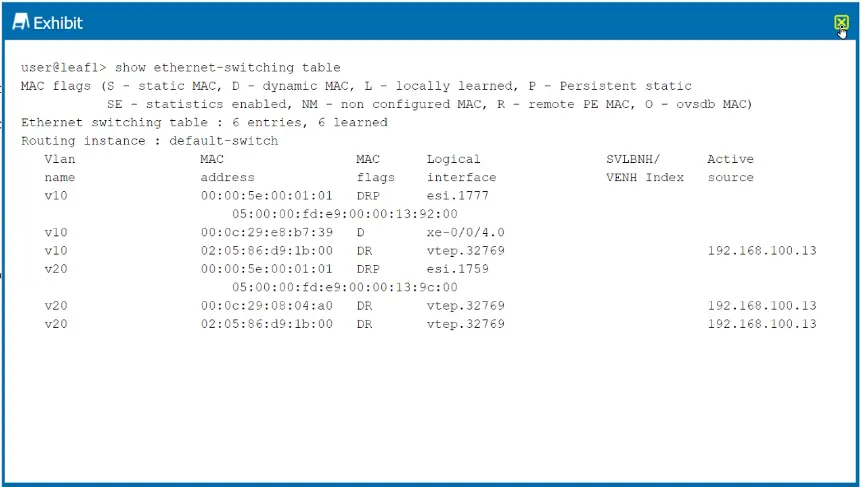
Referring to the exhibit, why is the active source field blank for the entry that uses the 00:0c:29:e8:b7:39 MAC address?

Correct Answer: A. The EVPN route for this host does not have a valid next hop.
Explanation:

In this scenario, the active source field is blank for the MAC address 00:0c:29:e8:b7:39, indicating an issue with how this MAC entry is being processed within the EVPN/VXLAN environment.

Step-by-Step Analysis:

Understanding the MAC Entry:

The active source field should normally indicate the source of the route advertisement for a specific MAC address within the EVPN. If it is blank, it suggests that there is a problem with how this entry is being learned or propagated.

Possible Issues:

Option A: If the EVPN route for this MAC address does not have a valid next hop, the entry might exist in the MAC table, but it will not have a valid path for forwarding, leading to a blank active source.

Option B: If the ARP lookup had failed, the entry might not even appear in the MAC table. However, the entry does exist, suggesting that ARP is not the primary issue here.

Option C: If the host were locally connected, the active source should reflect a local interface, but the field is blank, ruling out local connection as the cause.

Option D: Multicast EVPN routes typically do not appear in this manner in the MAC table, and this would not cause the active source to be blank.

Conclusion: The most logical explanation is that the EVPN route for this host exists but does not have a valid next hop, leading to the absence of an active source. This is consistent with how EVPN routing tables work in a VXLAN environment, where the lack of a valid next hop would prevent proper route advertisement and forwarding for the specific MAC address.


Question 5

You are selling up an EVPN-VXLAN architecture (or your new data center. this initial deployment will be less than 50 switches: however, it could scale up to 250 switches over time supporting 1024 VLANs. You are still deciding whether to use symmetric or asymmetric routing.

In this scenario, which two statements are correct? (Choose two.)

Correct Answer: C. Symmetric routing supports higher scaling numbers.; D. Asymmetric routing routes traffic on the egress switch.
Explanation:

Symmetric vs. Asymmetric Routing in EVPN-VXLAN:

Symmetric Routing: Traffic enters and exits the VXLAN network through the same VTEP, regardless of the source or destination. This approach simplifies routing decisions, especially in large networks, and is generally more scalable.

Asymmetric Routing: The routing occurs on the egress VTEP. This method can be simpler to deploy in smaller environments but becomes complex as the network scales, particularly with larger numbers of VNIs and VLANs.

Correct Statements:

C . Symmetric routing supports higher scaling numbers: Symmetric routing is preferred in larger EVPN-VXLAN deployments because it centralizes routing decisions, which can be more easily managed and scaled.

D . Asymmetric routing routes traffic on the egress switch: This is accurate, as asymmetric routing means the routing decision is made at the final hop, i.e., the egress VTEP before the traffic reaches its destination.

Incorrect Statements:

A . Symmetric routing needs an extra VLAN with an IRB interface for each L3 VRF instance: This is not accurate. Symmetric routing does not require an extra VLAN per VRF; rather, it uses the same VLAN/VNI across the network, simplifying routing and VLAN management.

B . Asymmetric routing is easier to monitor because of the transit VNI: Asymmetric routing is not necessarily easier to monitor; in fact, it can add complexity due to the split routing logic between ingress and egress points.

Data Center Reference:

The choice between symmetric and asymmetric routing in an EVPN-VXLAN environment depends on network size, complexity, and specific operational requirements. Symmetric routing is generally more scalable and easier to manage in large-scale deployments.


Question 6

Which three statements are correct about symmetric IRB routing with EVPN Type 2 routes? (Choose three.)

Correct Answer: A. An L3 interface (IRB) is required for each local VLAN.; B. Symmetric routing requires MAC-VRF.; D. Symmetric routing requires an extra transit VNI for each VRF.
Explanation:

Symmetric IRB Routing with EVPN Type 2 Routes:

Symmetric Routing: In symmetric IRB (Integrated Routing and Bridging), routing occurs in both directions at the ingress and egress leaf nodes using the same routing logic. This is contrasted with asymmetric routing, where different routing logic is used depending on the direction of the traffic.

Required Components:

Option A: An L3 IRB interface is necessary for each VLAN that participates in routing, as it handles the Layer 3 processing for the VLAN.

Option B: MAC-VRF is required for symmetric routing to maintain a mapping of MAC addresses to the appropriate VRF, ensuring correct forwarding within the EVPN.

Option D: A transit VNI (Virtual Network Identifier) is required for each VRF to encapsulate the Layer 3 traffic as it traverses the network, allowing the IP traffic to be appropriately forwarded.

Conclusion:

Option A: Correct---Each local VLAN needs an IRB interface for L3 processing.

Option B: Correct---MAC-VRF is necessary for handling MAC address resolution in symmetric routing.

Option D: Correct---Transit VNIs are required for routing VRF-specific traffic across the network.

Options C and E are incorrect because:

C: Symmetric routing can work with various VLAN models, including single or multiple VLANs within an EVPN instance.

E: Symmetric routing is generally more efficient than asymmetric routing as it uses consistent routing logic in both directions.


Question 7

Which parameter is used to associate a received route with a local VPN route table?

Correct Answer: A. route-target community
Explanation:

Understanding VPN Route Table Association:

In MPLS/VPN and EVPN networks, the route-target community is a BGP extended community attribute used to control the import and export of VPN routes. It associates received routes with the appropriate VPN route tables on the PE (Provider Edge) routers.

Function of Route-Target Community:

The route-target community tag ensures that routes are imported into the correct VRF (Virtual Routing and Forwarding) instance, allowing them to be correctly routed within the VPN.

Conclusion:

Option A: Correct---The route-target community is used to associate received routes with a local VPN route table.


Question 8

Exhibit.

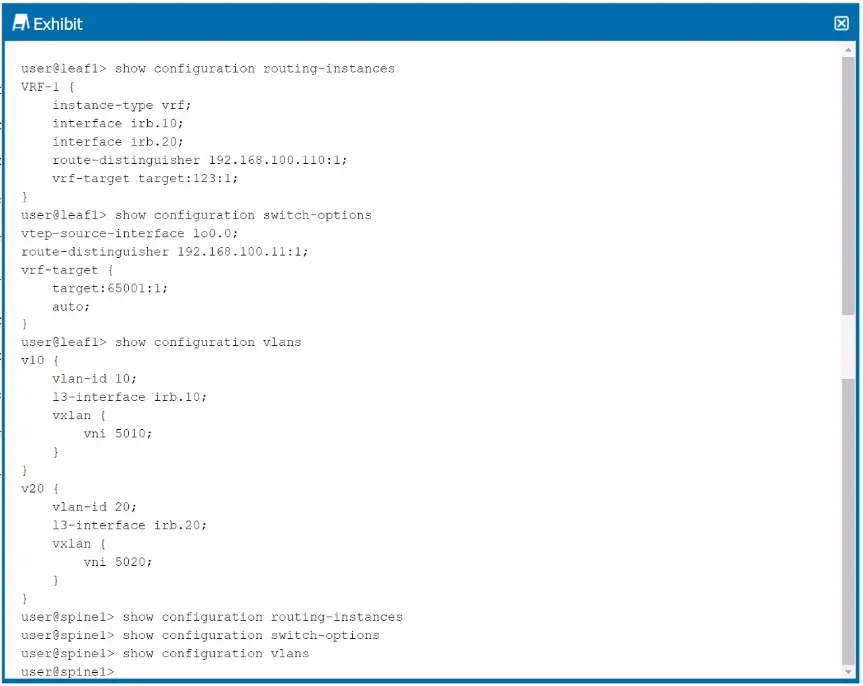
Referring to the exhibit, which statement Is true?

Correct Answer: B. An ERB architecture is being used.
Explanation:

Understanding Network Architectures:

ERB (Edge Routed Bridging) architecture involves routing at the network's edge (leaf nodes), while traffic between leaf nodes is switched. This is commonly used in VXLAN-EVPN setups.

Analysis of the Exhibit:

The exhibit shows configurations related to routing instances, VXLAN, and VLANs, with VNIs being used for each VLAN. This setup is characteristic of an ERB architecture where each leaf device handles Layer 3 routing for its connected devices.

Conclusion:

Option B: Correct---The configuration shown corresponds to an ERB architecture where routing occurs at the network's edge (leaf devices).


Question 9

You are deploying an IP fabric with an oversubscription ratio of 3:1.

In this scenario, which two statements are correct? (Choose two.)

Correct Answer: C. The oversubscription ratio increases when you remove leaf devices.; D. The oversubscription ratio remains the same when you add leaf devices.
Explanation:

Understanding Oversubscription Ratio in IP Fabrics:

The oversubscription ratio in an IP fabric typically refers to the ratio of the available bandwidth at the edge of the network (leaves) to the available bandwidth at the core or spine. A 3:1 oversubscription ratio means that for every 3 units of bandwidth at the leaves, there is 1 unit of bandwidth at the spine.

Impact of Adding or Removing Leaf Devices:

Removing Leaf Devices: When you remove leaf devices, the amount of total edge bandwidth decreases while the bandwidth in the spine remains constant. This causes the oversubscription ratio to increase because there is now less total bandwidth to distribute across the same amount of spine bandwidth.

Adding Leaf Devices: Conversely, when you add leaf devices, the total edge bandwidth increases. Since the spine bandwidth remains the same, the oversubscription ratio would remain the same if the additional leaves consume their share of the available bandwidth proportionally.

Conclusion:

Option C: Correct---Removing leaf devices increases the oversubscription ratio.

Option D: Correct---Adding leaf devices typically maintains the oversubscription ratio assuming uniform bandwidth distribution.


Question 10

You are using E8GP peering in an underlay IP fabric. Which two statements are correct in this scenario? (Choose two.)

Correct Answer: B. EBGP peering does not require an IGP protocol tor adjacency establishment.; C. Every leaf node has one peering session to every spine node.
Explanation:

Understanding EBGP in an IP Fabric:

EBGP (External Border Gateway Protocol) is commonly used in IP fabrics to establish peering between routers, such as leaf and spine nodes, without relying on an Interior Gateway Protocol (IGP) like OSPF or IS-IS.

IGP Requirement for EBGP:

Option B: EBGP peering does not require an IGP for adjacency establishment. This is because EBGP peers are typically directly connected, and BGP establishes its own sessions without needing an underlying IGP.

Leaf-to-Spine Peering:

Option C: In a typical IP fabric, each leaf node establishes an EBGP session with every spine node. This ensures full connectivity between leaves and spines, facilitating efficient routing and forwarding within the fabric.

Conclusion:

Option B: Correct---EBGP does not require an IGP for establishing peering sessions.

Option C: Correct---Each leaf node peers with every spine node, which is a standard practice in IP fabrics to ensure connectivity and redundancy.