Free Microsoft Designing Microsoft Azure Infrastructure Solutions AZ-305 Exam Questions
Page: 1 / 26Total 379 questions
Want more questions? Get Premium Access.
Question 1
Your company has the divisions shown in the following table.
Sub1 contains an Azure App Service web app named App1. Appl uses Azure AD for single-tenant user authentication. Users from contoso.com can authenticate to App1.
You need to recommend a solution to enable users in the fabrikam.com tenant to authenticate to App1.
What should you recommend?
Correct Answer:B. Configure Supported account types in the application registration and update the sign-in endpoint.
Explanation:
PIM controls privileged role activation; it does not convert a single-tenant application into a multitenant application.
Question 2
You are designing an order processing system in Azure that will contain the Azure resources shown in the following table.
The order processing system will have the following transaction flow:
A customer will place an order by using App1.
When the order is received, App1 will generate a message to check for product availability at vendor 1 and vendor 2.
An integration component will process the message, and then trigger either Function1 or Function2 depending on the type of order.
Once a vendor confirms the product availability, a status message for App1 will be generated by Function1 or Function2.
All the steps of the transaction will be logged to storage1.
Which type of resource should you recommend for the integration component?
D18912E1457D5D1DDCBD40AB3BF70D5D
Which type of resource should you recommend for the integration component?
Correct Answer:A. an Azure Data Factory pipeline
Explanation:
A data factory can have one or more pipelines. A pipeline is a logical grouping of activities that together perform a task.
The activities in a pipeline define actions to perform on your data.
Data Factory has three groupings of activities: data movement activities, data transformation activities, and control activities.
Azure Functions is now integrated with Azure Data Factory, allowing you to run an Azure function as a step in your data factory pipelines.
You have an Azure Functions microservice app named Appl that is hosted in the Consumption plan. App1 uses an Azure Queue Storage trigger.
You plan to migrate App1 to an Azure Kubernetes Service (AKS) cluster.
You need to prepare the AKS cluster to support Appl. The solution must meet the following requirements:
* Use the same scaling mechanism as the current deployment.
* Support kubenet and Azure Container Netwoking Interface (CNI) networking.
Which two actions should you perform? Each correct answer presents part of the solution. NOTE: Each correct answer is worth one point.
Correct Answer:C. Configure the AKS cluster autoscaler.; E. Install Kubemetes-based Event Driven Autoscaling (KEDA).
Explanation:
KEDA supplies the queue-driven scaling behavior. The cluster autoscaler adds nodes when the resulting pods cannot be scheduled.
Question 4
You have an Azure subscription.
You need to deploy an Azure Kubernetes Service (AKS) solution that will use Windows Server 2019 nodes.
The solution must meet the following requirements:
Minimize the time it takes to provision compute resources during scale-out operations.
Support autoscaling of Windows Server containers.
Which scaling option should you recommend?
Correct Answer:A. cluster autoscaler
Explanation:
AKS virtual nodes support Linux pods only, not Windows Server containers. The cluster autoscaler is the valid node-scaling option.
Question 5
You have an on-premises line-of-business (LOB) application that uses a Microsoft SQL Server instance as the backend.
You plan to migrate the on-premises SQL Server instance to Azure virtual machines.
You need to recommend a highly available SQL Server deployment that meets the following requirements:
* Minimizes costs
* Minimizes failover time if a single server fails
What should you include in the recommendation?
Correct Answer:A. an Always On availability group that has premium storage disks and a distributed network name (DNN)
Explanation:
You should recommend <strong>SQL Server Always On Availability Groups</strong> deployed on Azure VMs. Here's why:
<ul><li><strong>Minimize costs</strong>: Availability Groups use database-level replication rather than requiring multiple separate SQL Server licenses. With Azure Hybrid Benefit, you can use existing SQL Server licenses, significantly reducing costs compared to other HA solutions.</li><li><strong>Minimize failover time</strong>: Always On Availability Groups provide automatic failover with minimal data loss (RPO near zero). Failover is typically very fast (within seconds) for synchronous replicas.</li><li><strong>Highly available deployment</strong>: Availability Groups provide synchronous or asynchronous replication between nodes, with automatic failover capabilities.</li><li><strong>Flexibility</strong>: Can be deployed across multiple VMs on Azure or a mix of on-premises and Azure.</li></ul>
Alternative options like log shipping or manual failover would result in longer failover times. Azure SQL Database managed instance might be considered but requires migration effort and potentially higher costs depending on licensing model.
Question 6
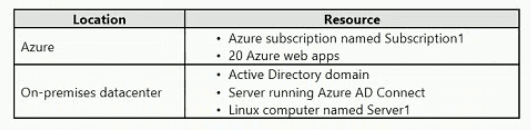
Your company has the infrastructure shown in the following table.
The on-premises Active Directory domain syncs to Azure Active Directory (Azure AD).
Server1 runs an application named Appl that uses LDAP queries to verify user identities in the on-premises Active Directory domain.
You plan to migrate Server1 to a virtual machine in Subscription1.
A company security policy states that the virtual machines and services deployed to Subscription1 must be prevented from accessing the on-premises network.
You need to recommend a solution to ensure that Appl continues to function after the migration. The solution must meet the security policy.
What should you include in the recommendation?
Correct Answer:A. Azure AD Domain Services (Azure AD DS)
Azure Active Directory Domain Services (Azure AD DS) provides managed domain services such as domain join, group policy, lightweight directory access protocol (LDAP), and Kerberos/NTLM authentication
Azure AD Domain Services (Azure AD DS) - This one could work since AAD DS will bring in the existing accounts from Azure AD which in turn are synchronised from on-premise AD over AD connect. However, you would probably need to reconfigure the app and update the LDAP connection
Azure Active Directory (Azure AD) supports LDAP Authentication via Azure AD Domain Services (AD DS). https://docs.microsoft.com/en-us/azure/active-directory/fundamentals/auth-ldap
A company is planning on deploying an application onto Azure. The application will be based on the .Net core programming language. The application would be hosted using Azure Web apps. Below is part of the various requirements for the application
Give the ability to correlate Azure resource usage and the performance data with the actual application configuration and performance data
Give the ability to visualize the relationships between application components
Give the ability to track requests and exceptions to specific lines of code from within the application Give the ability to actually analyse how uses return to an application and see how often they only select a particular drop-down value
Which of the following service would be best suited for fulfilling the requirement of
''Give the ability to correlate Azure resource usage and the performance data with the actual application configuration and performance data''
Correct Answer:C. Azure Log Analytics
Explanation:
Azure Application Insights is the best service for correlating Azure resource usage and performance data with actual application configuration and performance data. It provides comprehensive application performance monitoring (APM) that connects infrastructure metrics with application-level insights. Application Insights collects telemetry about how your application performs and behaves in production, allowing you to correlate resource utilization with application performance, identify bottlenecks, and understand the impact of your infrastructure decisions on application behavior. This capability is essential for connecting the dots between Azure resource consumption and application performance outcomes.
Question 8
You have an application that is used by 6,000 users to validate their vacation requests. The application manages its own credential
Users must enter a username and password to access the application. The application does NOT support identity providers.
You plan to upgrade the application to use single sign-on (SSO) authentication by using an Azure Active Directory (Azure AD) application registration.
Which SSO method should you use?
Correct Answer:A. password-based
Explanation:
SAML (Security Assertion Markup Language) is the correct SSO method for this scenario. Since the application manages its own credentials and does not support identity providers, you need to implement a SAML-based application registration in Azure AD. SAML allows the application to delegate authentication to Azure AD without requiring the application itself to support multiple identity providers. The application only needs to be configured to trust Azure AD as a SAML identity provider, enabling single sign-on while maintaining the application's existing credential management structure.
Question 9
You need to recommend a data storage strategy for WebApp1.
What should you include in in the recommendation?
Correct Answer:B. a vCore-based Azure SQL database
Question 10
You need to recommend a solution to meet the database retention requirement. What should you recommend?
Correct Answer:A. Configure a long-term retention policy for the database.
In Azure SQL Database, you can configure a database with a long-term backup retention policy (LTR) to automatically retain the database backups in separate Azure Blob storage containers for up to 10 years
Question 11
You are designing a microservices architecture that will support a web application.
The solution must meet the following requirements:
Allow independent upgrades to each microservice
Deploy the solution on-premises and to Azure
Set policies for performing automatic repairs to the microservices
You are developing an app that will use Azure Functions to process Azure Event Hubs events. Request processing is estimated to take between five and 20 minutes. You need to recommend a hosting solution that meets the following requirements:
* Supports estimates of request processing runtimes
* Supports event-driven autoscaling for the app
Which hosting plan should you recommend?
Correct Answer:D. Premium
Explanation:
You should recommend the <strong>Premium plan</strong> (or Dedicated plan) for Azure Functions.
The Premium plan meets both requirements:
<ul><li><strong>Supports estimated processing runtimes:</strong> Premium plan allows function timeout configurations up to 60 minutes (vs. 10 minutes for Consumption plan), accommodating the 5-20 minute processing window</li><li><strong>Event-driven autoscaling:</strong> Automatically scales based on Event Hubs trigger events, adding more instances as event volume increases</li><li><strong>Predictable performance:</strong> Reserved instances ensure consistent performance for processing long-running events</li></ul>
Why other options don't meet requirements:
<ul><li><strong>Consumption plan:</strong> Limited to 10-minute timeout (insufficient for 20-minute processing) and less predictable scaling behavior for sustained workloads</li><li><strong>App Service plan:</strong> Manual scaling required; not event-driven autoscaling</li><li><strong>Dedicated plan:</strong> Supports long timeouts and autoscaling but requires more configuration than Premium</li></ul>
Premium plan provides the optimal balance of long-running function support and event-driven autoscaling for this Event Hubs processing scenario.
Question 13
You are designing a message application that will run on an on-premises Ubuntu virtual machine. The application will use Azure Storage queues.
You need to recommend a processing solution for the application to interact with the storage queues. The solution must meet the following requirements:
Create and delete queues daily.
Be scheduled by using a CRON job.
Upload messages every five minutes.
What should developers use to interact with the queues?
You plan to deploy an application named App1 that will run in containers on Azure Kubernetes Service (AKS) clusters. The AKS clusters will be distributed across four Azure regions.
You need to recommend a storage solution to ensure that updated container images are replicated automatically to all the Azure regions hosting the AKS clusters.
You should recommend <strong>Azure Container Registry (ACR)</strong> with <strong>geo-replication</strong> enabled.
This solution meets all requirements:
<ul><li><strong>Container image storage:</strong> ACR securely stores container images used by AKS clusters</li><li><strong>Automatic geo-replication:</strong> When enabled, ACR automatically replicates images to multiple regional replicas, synchronizing updates across all regions instantly</li><li><strong>Regional AKS clusters:</strong> Each AKS cluster can pull images from its nearest regional ACR replica, reducing latency</li><li><strong>Centralized management:</strong> Push image updates once; ACR handles distribution to all regions</li></ul>
Key features:
<ul><li>Geo-replication occurs automatically and transparently</li><li>AKS clusters pull images from the nearest ACR replica for optimal performance</li><li>No manual replication steps required</li><li>Supports both public and private images</li></ul>
Alternative solutions like Azure DevOps or manual Docker Hub replication would require more effort and lack the tight AKS integration that ACR provides.
Question 15
The accounting department at your company migrates to a new financial accounting software. The accounting department must keep file-based database backups for seven years for compliance purposes. It is unlikely that the backups will be used to recover data.
You need to move the backups to Azure. The solution must minimize costs.
Where should you store the backups?
Correct Answer:A. Azure Blob storage that uses the Archive tier
Explanation:
Azure Front Door enables you to define, manage, and monitor the global routing for your web traffic by optimizing for best performance and instant global failover for high availability. With Front Door, you can transform your global (multi-region) consumer and enterprise applications into robust, high-performance personalized modern applications, APIs, and content that reaches a global audience with Azure.
Front Door works at Layer 7 or HTTP/HTTPS layer and uses anycast protocol with split TCP and Microsoft's global network for improving global connectivity.