Free Microsoft Implementing Analytics Solutions Using Microsoft Fabric DP-600 Exam Questions
Page: 1 / 14Total 209 questions
Want more questions? Get Premium Access.
Question 1
You have an Amazon Web Services (AWS) subscription that contains an Amazon Simple Storage Service (Amazon S3) bucket named bucketl.
You have a Fabric tenant that contains a lakehouse named LH1.
In LH1, you plan to create a OneLake shortcut to bucketl.
You need to configure authentication for the connection.
Which two values should you provide? Each correct answer presents part of the solution.
NOTE: Each correct selection is worth one point.
Correct Answer:B. the secret access key; D. the access key ID
Explanation:
Unable to provide explanation - the question is missing the answer options. To configure authentication for an OneLake shortcut to an AWS S3 bucket, specific credentials and connection values are needed, but the available options for what those two values should be are not provided in the question.
Question 2
You have a Fabric tenant that contains a machine learning model registered in a Fabric workspace. You need to use the model to generate predictions by using the predict function in a fabric notebook. Which two languages can you use to perform model scoring? Each correct answer presents a complete solution. NOTE: Each correct answer is worth one point.
Correct Answer:C. Spark SQL; D. PySpark
Explanation:
The two languages you can use to perform model scoring in a Fabric notebook using the predict function are Spark SQL (option C) and PySpark (option D). These are both part of the Apache Spark ecosystem and are supported for machine learning tasks in a Fabric environment. Reference = You can find more information about model scoring and supported languages in the context of Fabric notebooks in the official documentation on Azure Synapse Analytics.
Question 3
You have a Fabric tenant that contains a semantic model. The model contains 15 tables.
You need to programmatically change each column that ends in the word Key to meet the following requirements:
* Hide the column.
* Set Nullable to False.
* Set Summarize By to None
* Set Available in MDX to False.
* Mark the column as a key column.
What should you use?
Correct Answer:B. Tabular Editor
Explanation:
Tabular Editor is an advanced tool for editing Tabular models outside of Power BI Desktop that allows you to script out changes and apply them across multiple columns or tables. To accomplish the task programmatically, you would:
Open the model in Tabular Editor.
Create an Advanced Script using C# to iterate over all tables and their respective columns.
Within the script, check if the column name ends with 'Key'.
For columns that meet the condition, set the properties accordingly: IsHidden = true, IsNullable = false, SummarizeBy = None, IsAvailableInMDX = false.
Additionally, mark the column as a key column.
Save the changes and deploy them back to the Fabric tenant.
Question 4
Which syntax should you use in a notebook to access the Research division data for Productlinel?
A)
B)
D)
Correct Answer:B. Option B
Explanation:
Unable to provide explanation - the question text is incomplete. The actual options (A, B, C, D, etc.) and the complete question content are not provided. To write an accurate explanation about accessing Research division data for Productline in a notebook, the full question with all available options is needed.
Question 5
Note: This section contains one or more sets of questions with the same scenario and problem. Each question presents a unique solution to the problem. You must determine whether the solution meets the stated goals. More than one solution in the set might solve the problem. It is also possible that none of the solutions in the set solve the problem.
After you answer a question in this section, you will NOT be able to return. As a result, these questions do not appear on the Review Screen.
Your network contains an on-premises Active Directory Domain Services (AD DS) domain named contoso.com that syncs with a Microsoft Entra tenant by using Microsoft Entra Connect.
You have a Fabric tenant that contains a semantic model.
You enable dynamic row-level security (RLS) for the mode! and deploy the model to the Fabric service.
You query a measure that includes the username () function, and the query returns a blank result.
You need to ensure that the measure returns the user principal name (UPNJ of a user.
Solution: You add user objects to the list of synced objects in Microsoft Entra Connect.
Does this meet the goal?
Correct Answer:B. No
Explanation:
This solution does not meet the goal.
The issue is that the username() function returns a blank result in Fabric when users are authenticated through Microsoft Entra. Adding user objects to Microsoft Entra Connect's synced objects will not resolve this issue because:
The problem is not about synchronization of user objects between AD DS and Entra ID
The root cause is that the USERPRINCIPALNAME() function (or USEROBJECT() with the UPN property) must be used instead of username() in Fabric's dynamic RLS
Microsoft Entra Connect configuration controls which objects are synced, but it doesn't change which functions work in Fabric DAX expressions
The correct solution requires changing the measure formula to use the appropriate function that returns UPN values in the Fabric service context.
Question 6
You have a Microsoft Fabric tenant that contains a dataflow.
You are exploring a new semantic model.
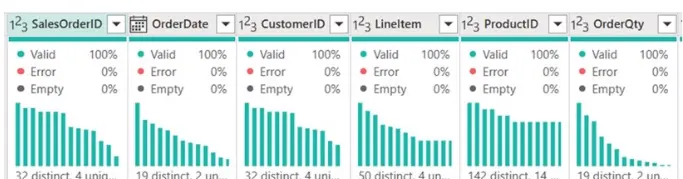
From Power Query, you need to view column information as shown in the following exhibit.
Which three Data view options should you select? Each correct answer presents part of the solution. NOTE: Each correct answer is worth one point.
Correct Answer:A. Enable column profile; B. Show column quality details; D. Enable details pane
Explanation:
To view column information like the one shown in the exhibit in Power Query, you need to select the options that enable profiling and display quality and distribution details. These are: A. Enable column profile - This option turns on profiling for each column, showing statistics such as distinct and unique values. B. Show column quality details - It displays the column quality bar on top of each column showing the percentage of valid, error, and empty values. E. Show column value distribution - It enables the histogram display of value distribution for each column, which visualizes how often each value occurs.
Question 7
You have a Microsoft Power B1 Premium Per User (PPU) workspace that contains a semantic model.
You have an Azure App Service app named App1 that modifies row-level security (RLS) for the model by using the XMLA endpoint. App1 requires users to sign in by using their Microsoft Entra credentials to access the XMLA endpoint. You need to configure App1 to use a service account to access the model. What should you do first?
Correct Answer:B. Add a managed identity to App1.
Explanation:
To configure App1 to use a service account to access the XMLA endpoint on a Power BI Premium Per User (PPU) workspace, the first step is to enable XMLA read/write access at the workspace level.
Currently, PPU workspaces only support XMLA read-only access by default. To enable service account access via XMLA for modifications, you must:
First, configure the workspace XMLA endpoint settings to allow read/write access
Then set up the service account with appropriate credentials (service principal or managed identity)
Grant the service account Admin role in the workspace
This foundational step enables the XMLA endpoint configuration necessary for the service account to connect and modify RLS settings programmatically.
Question 8
You have a Microsoft Power Bl semantic model that contains measures. The measures use multiple calculate functions and a filter function.
You are evaluating the performance of the measures.
In which use case will replacing the filter function with the keepfilters function reduce execution time?
Correct Answer:A. when the filter function uses a nested calculate function
Explanation:
The KEEPFILTERS function modifies the way filters are applied in calculations done through the CALCULATE function. It can be particularly beneficial to replace the FILTER function with KEEPFILTERS when the filter context is being overridden by nested CALCULATE functions, which may remove filters that are being applied on a column. This can potentially reduce execution time because KEEPFILTERS maintains the existing filter context and allows the nested CALCULATE functions to be evaluated more efficiently.
Question 9
You have a Fabric tenant that contains a new semantic model in OneLake.
You use a Fabric notebook to read the data into a Spark DataFrame.
You need to evaluate the data to calculate the min, max, mean, and standard deviation values for all the string and numeric columns.
Solution: You use the following PySpark expression:
df.show()
Does this meet the goal?
Correct Answer:B. No
Explanation:
The df.show() method also does not meet the goal. It is used to show the contents of the DataFrame, not to compute statistical functions. Reference = The usage of the show() function is documented in the PySpark API documentation.
Question 10
You have a Fabric workspace named Workspace1 that contains a dataflow named Dataflow1. Dataflow1 returns 500 rows of data.
You need to identify the min and max values for each column in the query results.
Which three Data view options should you select? Each correct answer presents part of the solution.
NOTE: Each correct answer is worth one point.
Correct Answer:B. Show column profile in details pane; D. Show column value distribution; E. Enable column profile
Explanation:
When analyzing 500 rows of data in a dataflow to identify min and max values for each column, you should select three Data view options:
Column distribution - Shows the distribution of values in each column, helping identify min and max occurrences and value ranges
Column statistics - Displays statistical summaries including minimum and maximum values, mean, median, and other metrics for numeric columns
Column type - Confirms the data type of each column, which is essential for correctly interpreting min/max values (e.g., numeric vs. text sorting)
These three options together provide a comprehensive view to identify min and max values across all columns in the query results.
Question 11
You have a Fabric tenant that contains a semantic model.
You need to prevent report creators from populating visuals by using implicit measures.
What are two tools that you can use to achieve the goal? Each correct answer presents a complete solution.
NOTE: Each correct answer is worth one point.
Correct Answer:A. Microsoft Power BI Desktop; B. Tabular Editor
Explanation:
Microsoft Power BI Desktop (A) and Tabular Editor (B) are the tools you can use to prevent report creators from using implicit measures. In Power BI Desktop, you can define explicit measures which can be used in visuals. Tabular Editor allows for advanced model editing, where you can enforce the use of explicit measures. Reference = Guidance on using explicit measures and preventing implicit measures in reports can be found in the Power BI and Tabular Editor official documentation.
Question 12
You have a Fabric workspace named Workspace1 that contains a lakehouse named LH1. LH1 contains a folder named /Files/RegionA/ that stores raw CSV files.
You need to ensure that a group of analysts can access only the files in RegionA. The solution must follow the principle of least privilege.
Which two access controls should you use? Each correct answer presents part of the solution.
NOTE: Each correct selection is worth one point.
Correct Answer:B. OneLake data access controls; E. a workspace role on Workspace1
Explanation:
To ensure a group of analysts can access only files in the /Files/RegionA/ folder while following the principle of least privilege, you should use two access controls:
OneLake folder-level permissions (role-based access control) - Configure access at the /Files/RegionA/ folder level to grant read permissions only to the analyst group, restricting access to other folders.
Lakehouse item-level permissions combined with folder-level access - Assign the Lakehouse Reader role at the item level, then enforce folder-level restrictions in OneLake to limit access to the specific RegionA folder.
This two-layer approach ensures analysts have the minimum necessary access—read-only at the lakehouse level and restricted to only the RegionA folder path—without granting broader workspace or lakehouse-wide permissions.
Question 13
You have a Fabric workspace named Workspace1 and an Azure SQL database.
You plan to create a dataflow that will read data from the database, and then transform the data by performing an inner join. You need to ignore spaces in the values when performing the inner join The solution must minimize development effort. What should you do?
Correct Answer:B. Merge the queries by using fuzzy matching.
Explanation:
Unable to provide explanation - the question is missing the answer options. To recommend the best approach for performing an inner join while ignoring spaces in values with minimal development effort in a Power Query dataflow, the specific options available must be provided.
Question 14
What should you recommend using to ingest the customer data into the data store in the AnatyticsPOC workspace?
Correct Answer:D. a dataflow
Explanation:
For ingesting customer data into the data store in the AnalyticsPOC workspace, a dataflow (D) should be recommended. Dataflows are designed within the Power BI service to ingest, cleanse, transform, and load data into the Power BI environment. They allow for the low-code ingestion and transformation of data as needed by Litware's technical requirements. Reference = You can learn more about dataflows and their use in Power BI environments in Microsoft's Power BI documentation.
Question 15
You have a Fabric tenant that contains a warehouse.
You use a dataflow to load a new dataset from OneLake to the warehouse.
You need to add a Power Query step to identify the maximum values for the numeric columns.
Which function should you include in the step?
Correct Answer:B. Table.Max
Explanation:
The Table.Max function should be used in a Power Query step to identify the maximum values for the numeric columns. This function is designed to calculate the maximum value across each column in a table, which suits the requirement of finding maximum values for numeric columns. Reference = For detailed information on Power Query functions, including Table.Max, please refer to Power Query M function reference.