
Limited-Time Offer: Enjoy 50% Savings! Ends in 00h 00m 00s Coupon code: 50OFF
Skip to content

Free Microsoft Implementing Data Engineering Solutions Using Microsoft Fabric DP-700 Exam Questions

Page: 1 / 15 Total 142 questions

Want more questions? Get Premium Access.

Question 1

Note: This question is part of a series of questions that present the same scenario. Each question in the series contains a unique solution that might meet the stated goals. Some question sets might have more than one correct solution, while others might not have a correct solution.

After you answer a question in this section, you will NOT be able to return to it. As a result, these questions will not appear in the review screen.

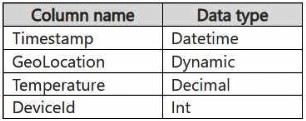
You have a KQL database that contains two tables named Stream and Reference. Stream contains streaming data in the following format.
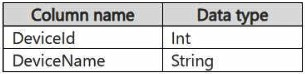
Reference contains reference data in the following format.
Both tables contain millions of rows.

You have the following KQL queryset.

You need to reduce how long it takes to run the KQL queryset.

Solution: You add the make_list() function to the output columns.

Does this meet the goal?

Correct Answer: B. No
Explanation:

Adding an aggregation like make_list() would require additional processing and memory, which could make the query slower.

Question 2

You have a Fabric workspace named Workspace1 that contains a warehouse named Warehouse1.

You plan to deploy Warehouse1 to a new workspace named Workspace2.

As part of the deployment process, you need to verify whether Warehouse1 contains invalid references. The solution must minimize development effort.

What should you use?

Correct Answer: C. a Python script
Explanation:

A deployment pipeline in Fabric allows you to deploy assets like warehouses, datasets, and reports between different workspaces (such as from Workspace1 to Workspace2). One of the key features of a deployment pipeline is the ability to check for invalid references before deployment. This can help identify issues with assets, such as broken links or dependencies, ensuring the deployment is successful without introducing errors. This is the most efficient way to verify references and manage the deployment with minimal development effort.


Question 3

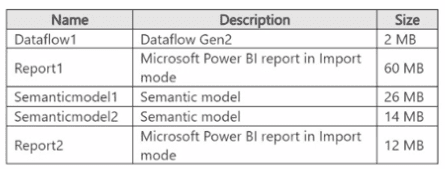
You have a Fabric workspace named Workspace1 that is connected to a GitHub repository named repo1. Workspace1 contains the items shown in the following table.

You modify Semantic model 1, Semanticmodel2, and Report2.

You need to commit the changes to repo1.

What is the minimum number of commits you should perform?

Correct Answer: C. 3
Explanation:

When committing changes to a GitHub repository from Fabric, you should commit by logical grouping or item type. Since you modified Semantic Model 1, Semantic Model 2, and Report2, you need a minimum of 2 commits: one for the semantic models (they are related model objects) and one for the report. However, if the two semantic models are dependent or considered a single logical unit, they could be in one commit. The minimum would be 2 commits to organize related changes logically.

Question 4

Note: This question is part of a series of questions that present the same scenario. Each question in the series contains a unique solution that might meet the stated goals. Some question sets might have more than one correct solution, while others might not have a correct solution.

After you answer a question in this section, you will NOT be able to return to it. As a result, these questions will not appear in the review screen.

You have a Fabric eventstream that loads data into a table named Bike_Location in a KQL database. The table contains the following columns:

BikepointID

Street

Neighbourhood

No_Bikes

No_Empty_Docks

Timestamp

You need to apply transformation and filter logic to prepare the data for consumption. The solution must return data for a neighbourhood named Sands End when No_Bikes is at least 15. The results must be ordered by No_Bikes in ascending order.

Solution: You use the following code segment:

Does this meet the goal?

Correct Answer: A. Yes
Explanation:

Filter Condition: It correctly filters rows where Neighbourhood is 'Sands End' and No_Bikes is greater than or equal to 15.

Sorting: The sorting is explicitly done by No_Bikes in ascending order using sort by No_Bikes asc.

Projection: It projects the required columns (BikepointID, Street, Neighbourhood, No_Bikes, No_Empty_Docks, Timestamp), which minimizes the data returned for consumption.


Question 5

You have a Fabric workspace that contains a write intensive warehouse named DW1. DW1 stores staging tables that are used to load a dimensional model. The tables are often read once, dropped, and then recreated to process new data.

You need to minimize load time of data from sources to staging tables in DW1.

What should you do?

Correct Answer: D. Disable V Order.
Explanation:

To minimize load time when writing data to staging tables in DW1 that are frequently dropped and recreated, you should use fast insert operations and disable non-clustered indexes during the bulk load. Fast insert bypasses certain overhead, and disabling indexes before loading large volumes of data significantly improves insert performance. After the load completes, you can recreate the indexes. This approach is specifically designed for write-intensive staging scenarios.

Question 6

You have a Fabric workspace named Workspace1 that contains a warehouse named DW1 and a data pipeline named Pipeline1.

You plan to add a user named User3 to Workspace1.

You need to ensure that User3 can perform the following actions:

View all the items in Workspace1.

Update the tables in DW1.

The solution must follow the principle of least privilege.

You already assigned the appropriate object-level permissions to DW1.

Which workspace role should you assign to User3?

Correct Answer: D. Contributor
Explanation:

To ensure User3 can view all items in Workspace1 and update the tables in DW1, the most appropriate workspace role to assign is the Contributor role. This role allows User3 to:

View all items in Workspace1: The Contributor role provides the ability to view all objects within the workspace, such as data pipelines, warehouses, and other resources.

Update the tables in DW1: The Contributor role allows User3 to modify or update resources within the workspace, including the tables in DW1, assuming that appropriate object-level permissions are set for the warehouse.

This role adheres to the principle of least privilege, as it provides the necessary permissions without granting broader administrative rights.


Question 7

You have a Fabric workspace named Workspace1 that contains a notebook named Notebook1.

In Workspace1, you create a new notebook named Notebook2.

You need to ensure that you can attach Notebook2 to the same Apache Spark session as Notebook1.

What should you do?

Correct Answer: A. Enable high concurrency for notebooks.
Explanation:

To ensure that Notebook2 can attach to the same Apache Spark session as Notebook1, you need to enable high concurrency for notebooks. High concurrency allows multiple notebooks to share a Spark session, enabling them to run within the same Spark context and thus share resources like cached data, session state, and compute capabilities. This is particularly useful when you need notebooks to run in sequence or together while leveraging shared resources.


Question 8

You have a Fabric workspace named Workspace1.

You plan to integrate Workspace1 with Azure DevOps.

You will use a Fabric deployment pipeline named deployPipeline1 to deploy items from Workspace1 to higher environment workspaces as part of a medallion architecture. You will run deployPipeline1 by using an API call from an Azure DevOps pipeline.

You need to configure API authentication between Azure DevOps and Fabric.

Which type of authentication should you use?

Correct Answer: A. service principal
Explanation:

When integrating Azure DevOps with Fabric (Workspace1), using a service principal is the recommended authentication method. A service principal provides a way for applications (such as an Azure DevOps pipeline) to authenticate and interact with resources securely. It allows Azure DevOps to authenticate API calls to Fabric without requiring direct user credentials. This method is ideal for automating tasks such as deploying items through a Fabric deployment pipeline.


Question 9

You have a Fabric workspace that contains a warehouse named Warehouse1. Data is loaded daily into Warehouse1 by using data pipelines and stored procedures.

You discover that the daily data load takes longer than expected.

You need to monitor Warehouse1 to identify the names of users that are actively running queries.

Which view should you use?

Correct Answer: E. sys.dm_exec_sessions
Explanation:

sys.dm_exec_sessions provides real-time information about all active sessions, including the user, session ID, and status of the session. You can filter on session status to see users actively running queries.


Question 10

You have a Fabric warehouse named DW1 that loads data by using a data pipeline named Pipeline1. Pipeline1 uses a Copy data activity with a dynamic SQL source. Pipeline1 is scheduled to run every 15minutes.

You discover that Pipeline1 keeps failing.

You need to identify which SQL query was executed when the pipeline failed.

What should you do?

Correct Answer: B. From Monitoring hub, select the latest failed run of Pipeline1, and then view the input JSON.
Explanation:

The input JSON contains the configuration details and parameters passed to the Copy data activity during execution, including the dynamically generated SQL query.

Viewing the input JSON for the failed pipeline run provides direct insight into what query was executed at the time of failure.