
Limited-Time Offer: Enjoy 50% Savings! Ends in 00h 00m 00s Coupon code: 50OFF
Skip to content

Free Microsoft Azure Data Fundamentals DP-900 Exam Questions

Page: 1 / 23 Total 341 questions

Want more questions? Get Premium Access.

Question 1

What are two benefits of platform as a service (PaaS) relational database offerings in Azure, such as Azure SQL Database? Each correct answer presents a complete solution. NOTE: Each correct selection is worth one point.

Correct Answer: B. access to the latest features; C. in-database machine learning services
Explanation:

Azure SQL Database is a fully managed platform as a service (PaaS) database engine that handles most of the database management functions such as upgrading, patching, backups, and monitoring without user involvement.

SQL Database delivers predictable performance with multiple resource types, service tiers, and compute sizes. It provides dynamic scalability with no downtime, built-in intelligent optimization, global scalability and availability, and advanced security options. These capabilities allow you to focus on rapid app development and accelerating your time-to-market, rather than on managing virtual machines and infrastructure.


https://docs.microsoft.com/en-us/azure/azure-sql/database/sql-database-paas-overview
Question 2

What can you use to create data ingestion pipelines?

Correct Answer: C. Azure Data Factory
Explanation:

Azure Data Factory is a cloud-based ETL and data integration service used to create data ingestion pipelines. It enables you to build, schedule, and orchestrate data workflows that extract data from various sources, transform it, and load it into target destinations, with visual pipeline design and monitoring capabilities.

Question 3

Which three actions are used when performing diagnostic analytics?

Correct Answer: A. * Identify data anomalies * Collect anomaly-related data * Discover relationships and trends that explain anomalies.
Explanation:

When performing diagnostic analytics, three key actions used are: Drill-down (exploring data at greater granularity to understand causes), Correlation analysis (identifying relationships between variables), and Comparison (comparing datasets to identify differences). These actions help answer 'why' questions by investigating relationships and patterns in historical data.

Question 4

Which three services support Apache Spark? Each correct answer presents a complete solution NOTE: Each correct selection is worth one point.

Correct Answer: A. Azure Data Explorer; B. Azure Synapse Analytics; C. Azure Databricks
Explanation:

Three Azure services that support Apache Spark are: (1) Azure Synapse Analytics - integrates Spark pools for big data processing, (2) Azure Databricks - a fully managed Spark platform with collaborative notebooks, and (3) HDInsight - Azure's managed Hadoop and Spark cluster service. All three enable distributed data processing using the Apache Spark framework.

Question 5

Your company needs to implement a relational database in Azure. The solution must minimize ongoing

maintenance.

Which Azure service should you use?

Correct Answer: B. Azure SQL Database

Question 6

Which property of a transactional workload guarantees that each transaction is treated as a single unit that either succeeds completely or fails completely?

Correct Answer: D. atomicity
Explanation:

Atomicity is the ACID property that guarantees each transaction is treated as a single, indivisible unit of work. It ensures that either all operations within a transaction complete successfully, or if any operation fails, the entire transaction is rolled back with no partial changes applied to the database. This all-or-nothing approach is fundamental to maintaining data consistency.

Question 7

Which Azure Cosmos DB API should you use for a graph database?

Correct Answer: A. Azure Cosmos DB for Apache Gremlin
Explanation:

The Gremlin API in Azure Cosmos DB is specifically designed for graph database scenarios. It allows you to store and query graph data structures with nodes, edges, and properties, making it ideal for applications that need to model relationships and network data.

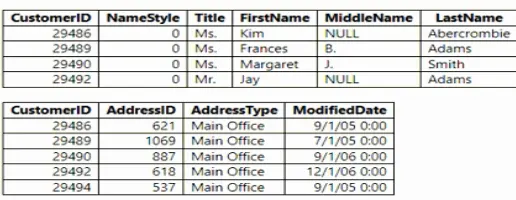
Question 9

You have the following two tables of customer data.

Which type of data do the tables contain?

Correct Answer: D. unstructured

Question 10

You have an Azure Cosmos DB account that uses the Core (SQL) API.

Which two settings can you configure at the container level? Each correct answer presents a complete

solution. (Choose two.)

NOTE: Each correct selection is worth one point.

Correct Answer: A. the throughput; C. the partition key

Question 12

You need to use Transact-SQL to query files in Azure Data Lake Storage from an Azure Synapse Analytics data warehouse.

What should you use to query the files?

Question 13

You plan to deploy an app. The app requires a nonrelational data service that will provide latency guarantees of less than 10-ms for reads and writes. What should you include in the solution?

Correct Answer: A. Azure Cosmos
Explanation:

Azure Cosmos DB is a globally distributed, non-relational database service that provides guaranteed latency of less than 10 milliseconds for both reads and writes at the 99th percentile. It is specifically designed for applications requiring ultra-low latency and high throughput, with automatic scaling and multi-region replication.

Question 14

Your company if designing an application that will write a high volume of JSON data and will have an application-defined schema.

Which type of data store should you use?

Correct Answer: B. document
Explanation:

A key/value store associates each data value with a unique key.

An application can store arbitrary data as a set of values. Any schema information must be provided by the application. The key/value store simply retrieves or stores the value by key.


https://docs.microsoft.com/en-us/azure/architecture/guide/technology-choices/data-store-overview

Question 15

You need to develop a solution to provide data to executives. the solution must provide an interactive graphic interface, depict various key performance indications, and support data exploration by using drill down.

What should you use in Microsoft Power BI?