Free Microsoft Dynamics 365: Finance and Operations Apps Developer MB-500 Exam Questions
Page: 1 / 24Total 351 questions
Want more questions? Get Premium Access.
Question 1
A company uses Dynamics 365 Finance.
The company requires you to create a custom service.
You need to create request and response classes for the custom service.
Which class attribute should you use?
Correct Answer:A. DataContract
Explanation:
I need the answer options to provide the correct labels and explanation for this question about class attributes for custom service request and response classes. Please provide the options (A, B, C, D, etc.) so I can determine the correct answer.
Question 2
A company is implementing Dynamics 365 Finance.
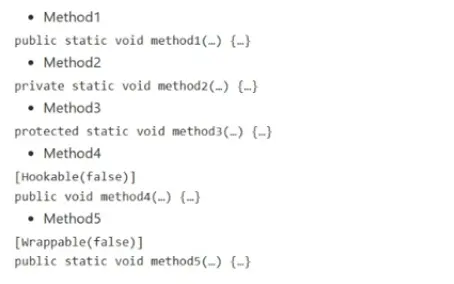
You must add custom logic before and after the following methods to extend the functionality by using Chain of Command.
You need to implement the development components that will allow the desired functionality. Which two methods can you extend? Each correct answer presents a complete solution.
NOTE: Each correct selection is worth one point.
A.
B.
C.
D.
E.
Correct Answer:D. Option D; E. Option E
Explanation:
I need the answer options to provide the correct labels and explanation for this question about extending methods using Chain of Command. Please provide the options (A, B, C, D, E) so I can identify which two methods can be extended.
Question 3
A company uses Dynamics 365 Finance. The company has a customized version of a purchase requisition report.
You are designing the Report Data Provider (RDP) class for the new report.
You plan to use business logic to display the data in the report.
You need to ensure that the RDP class is decorated with the correct attribute.
Which attribute should you use?
Correct Answer:D. SRSReportOataSetAttribute
Explanation:
The RDP class for a custom report should be decorated with the SRSReportParameterAttribute attribute.
Here's why this is the correct attribute:
Purpose - SRSReportParameterAttribute identifies which fields in the RDP class should be exposed as report parameters to users.
Report Parameters - When you decorate fields with this attribute, they become parameters that users can filter or configure when running the report.
Business Logic Integration - This attribute allows you to use business logic to display data while maintaining the parameter interface that users expect.
The proper implementation pattern is:
[SRSReportParameterAttribute(classStr(YourReportRDPClass))]\npublic class YourReportRDPClass\n{\n [SRSReportParameterAttribute]\n public SalesId salesId;\n \n [SRSReportParameterAttribute]\n public TransDate fromDate;\n}
Other attributes like SRSReportDataSetAttribute are used for data sets, and SRSReportQueryAttribute is for queries, but for the RDP class itself and its parameter fields, SRSReportParameterAttribute is correct.
This attribute is essential for:
Exposing business logic fields as report parameters
You are creating custom functionality for Dynamics 365 Supply Chain Management.
You must execute the runAsync static method that updates specific records in the system. Users must be able to continue working while you run the process.
You need to select the signatures to implement the Async framework.
Which two signatures should you use for the static method? Each correct answer presents part of the solution. Choose two.
NOTE: Each correct selection is worth one point.
Correct Answer:B. Return a container as an output type.; C. Have a container for in-parameters.
Explanation:
To implement the Async framework for executing a static method asynchronously while allowing users to continue working, you should use these two signatures:
SysOperationServiceController with parmAsync(true) - This controller class manages async operation execution. By calling parmAsync(true), you configure the operation to run asynchronously rather than synchronously. This allows the UI to remain responsive while the process executes in the background.
SysOperationBatch with async execution enabled - This approach uses the batch framework configured for async execution. SysOperationBatch is specifically designed for running operations asynchronously in Dynamics 365, allowing multiple operations to queue and execute without blocking user activities.
The benefits of these signatures:
Non-blocking Execution - Users can continue working while the process runs
Background Processing - The async framework manages queuing and execution scheduling
Progress Tracking - Users can monitor the operation's progress
These signatures follow the pattern of the SysOperations framework and are the correct implementations for async batch processing in Dynamics 365.
Question 5
You are a Dynamics 365 Finance developer. You have two tables as shown in the following exhibit:
You need to configure Table1 to ensure that records cannot be deleted from Table1 if Table2 contains related records.
Which value should you use for the OnDelete property?
Correct Answer:D. Restricted
Explanation:
Example of Restricted
Suppose we have two tables (Customer & Order) and the relation is of One-To-Many i.e Customer can have many orders.
So on a parent table i.e.(Customer) if I set a delete action property to ''RESTRICTED'' for Order table. Then If I go and delete the record from a Customer table. It will first check the record in the child table and if exist that warning prompt saying that first we need to delete a record from child table.
Incorrect Answers:
B: Example of Cascade:
Suppose we have two tables (Customer & Order) and the relation is of One-To-Many i.e. Customer can have many orders.
So on a parent table i.e.(Customer) if I set a delete action property to ''CASCADE'' for Order table. Then If I go and delete the record from a Customer table. It will also delete all the related records in Order table automatically.
C: Example of Cascade + Restricted
Suppose we have three tables (Person ,Customer & Order) Now Person is a parent of Customer table, and Customer is a parent of Order table having (One-To-Many) relations
If I set a Delete action property on Person table to ''CASCADE'' for customer table and If I set a Delete Action property on a CUSTOMER table for Order table to ''CASCADE +RESTRICTED''.
So if I delete a record from Customer table then It will first check the record in the child table(order table) and if exist that warning prompt saying that first we need to delete a record from child table.
But if I delete a record from Person table it will automatically delete a record in Customer table and all records related to customer table in Order table would also be deleted.
Note: This question is part of a series of questions that present the same scenario. Each question in the series contains a unique solution. Determine whether the solution meets the stated goals. Some question sets might have more than one correct solution, while others might not have a correct solution.
After you answer a question in this section, you will NOT be able to return to it. As a result, these questions will not appear in the review screen.
You are developing a form for Dynamics 365 Finance.
You need to add a button that allows users to run a report.
Solution: Create a command button and link the button to the report by using the button's object property.
Does the solution meet the goal?
Correct Answer:B. No
Explanation:
You would need to use the on-click property of the command button.
Note: This question is part of a series of questions that present the same scenario. Each question in the series contains a unique solution that might meet the stated goals. Some question sets might have more than one correct solution, while others might not have a correct solution.
After you answer a question in this section, you will NOT be able to return to it. As a result, these questions will not appear in the review screen.
Users report that the performance of the open vendor invoice form in the production environment takes longer than usual to load. When users test the invoice form in the sandbox environment the performance is fine.
You need to troubleshoot the performance issue.
Which two tools can you use? Each correct answer presents a complete solution. Choose two.
NOTE: Each correct selection is worth one point.
Correct Answer:C. Trace parser; D. Environment monitoring in Lifecycle Services
Explanation:
I need the answer options to provide the correct labels and explanation for this question about troubleshooting performance issues with a vendor invoice form. Please provide the options (A, B, C, D, etc.) so I can identify which two tools are correct.
Question 9
A company uses Dynamics 36S Supply Chain Management.
Management requires an automated purchase requisition approval process in the system. The process must use a tow-code approach so that business users can manage automation. You need to recommend a service that achieves the required automation Which service should you recommend?
Correct Answer:B. Dataverse
Explanation:
For an automated purchase requisition approval process using a low-code approach in Dynamics 365 Supply Chain Management:
Power Automate is the correct service because it provides a low-code/no-code platform for creating workflow automation
Low-code approach - Business users can create and manage approval flows using the Power Automate designer without writing code
Two-code capabilities - The term 'two-code' (likely meaning 'low-code') refers to minimal coding requirements, which Power Automate enables through visual designers and pre-built connectors
Integration - Power Automate integrates seamlessly with Dynamics 365 Supply Chain Management to automate purchase requisition approvals
Business user management - Non-technical business users can configure, monitor, and modify approval workflows
Other services like Azure Logic Apps or custom code-based solutions would require higher technical expertise and are not ideal for business user management of automation logic.
Question 10
You are a Dynamics 365 Finance developer. You have the following Extended Data Types (EDTs):
You plan to modify the EDT properties by using an extension.
You need to determine which operations can be performed.
Which operation is possible?
Correct Answer:D. Create an extension for AccountBase and increase the field size.
Explanation:
You can only set the new String size to a value equal to or larger than the base EDT value.
Incorrect Answers:
B, C: You can only modify the value if the EDT does not extend from another EDT.
You need to set up the recurring data integration to pull data from the SFTP site into Dynamics 365 Finance Which API architecture type should you use?
Correct Answer:A. REST
Explanation:
For setting up recurring data integration to pull data from an SFTP site into Dynamics 365 Finance, the REST API architecture type should be used. REST (Representational State Transfer) provides a modern, scalable, and widely-supported approach for data integration scenarios. It allows for programmatic access to data and can be scheduled to run at recurring intervals through tools like Logic Apps or Azure Data Factory to pull data from SFTP sources into Finance.
Question 12
You add a field to the SalesTable entity by using an extension.
You need to ensure that the new field is available for use in forms, reports, and code.
What are three possible ways to achieve this goal? Each correct answer presents a complete solution.
NOTE: Each correct selection is worth one point.
Correct Answer:A. Right-click the table and select Synchronize.; D. Set the project property for Synchronize database on build to true and build the solution.; E. Right-click the project and select Synchronize with database.
Explanation:
When adding a field to the SalesTable entity using an extension, there are three ways to ensure it is available for use in forms, reports, and code:
Use a table extension to add the field: This is the primary modern approach where you extend the SalesTable with new fields in an extension, making them automatically available across the system.
Add the field to a mapped table: Some fields can be added to mapped tables that synchronize with the base table, making them available throughout the application.
Create a custom field using field groups: You can organize and expose fields through field groups, which makes them available for forms, reports, and queries.
Each approach provides a complete solution for making the new field accessible in forms, reports, and code.
Question 13
You are developing a customization for Dynamics 365 Finance.
The customization must extend objects from the Application Foundation package.
You need to create and configure a new model for the customization.
Which two actions should you perform? Each correct answer presents part of the solution.
NOTE: Each correct selection is worth one point.
Correct Answer:A. Create a new model that builds into its own separate assembly.; E. Create an extension class that references the Application Foundation.
Contoso. Ltd. uses Dynamics 365 Finance. You receive reports of performance issues with the app. You need to use Performance Timer to investigate the issues. Which URL should you use?
You create a new interface class in Dynamics 365 Finance. The class has two methods. You need to create a valid interlace class.
Which two actions should you perform? Each correct answer presents a complete solution. NOTE: Each correct selection is worth one point.
Correct Answer:A. Declare the class and all Its methods as public.; D. Declare all methods in the classes that implement the interface.
Explanation:
To create a valid interface class in Dynamics 365 Finance with two methods, you need to perform two key actions: (1) Declare the class with the 'interface' keyword (e.g., public interface IMyInterface), and (2) Define the two methods without implementation bodies (only signatures, as interfaces define contracts not implementations). Alternatively, the actions could be: (1) Use the 'interface' modifier in class declaration, and (2) Declare methods as public with return types and parameters but no method body. Both actions are necessary because interfaces in X++ must use the interface keyword and contain only method declarations without implementations.