Limited-Time Offer: Enjoy 50% Savings! Ends in 00h 00m 00s Coupon code: 50OFF
Skip to content

Free NCMA Certified Professional Contract Manager CPCM Exam Questions

Page: 1 / 12 Total 180 questions

Want more questions? Get Premium Access.

Question 1

Learning goals should be __________.

Correct Answer: C. specific, measurable, action-oriented, realistic, and timely
Explanation:

The correct answer is C because NCMA CMBOK aligns learning goals with the widely accepted SMART framework, which emphasizes that goals should be specific, measurable, action-oriented, realistic, and timely. This structured approach ensures that learning is intentional, trackable, and aligned with both individual competency development and organizational objectives.

Within the Learn domain, CMBOK highlights that contract managers must take ownership of their professional development by setting clear and achievable learning goals. ''Specific'' ensures clarity of purpose; ''measurable'' allows progress tracking; ''action-oriented'' focuses on practical steps; ''realistic'' ensures feasibility given available resources; and ''timely'' establishes deadlines to maintain accountability.

This approach supports continuous improvement in leadership, management, and technical competencies, which are essential for effective contract management. By applying SMART-based learning goals, contract managers can systematically address skill gaps, adapt to evolving industry requirements, and enhance their performance across the contract lifecycle.

Option A, B, and D include terms that are not recognized within CMBOK or standard goal-setting methodologies. They lack the structured, outcome-driven characteristics required for effective learning and development.

Thus, consistent with CMBOK guidance, learning goals should follow the SMART principles, ensuring they are clear, measurable, and achievable, ultimately supporting sustained professional growth.


Question 2

__________ provides the oversight required to ensure that both parties comply with the contract requirements.

Correct Answer: C. Contract Administration
Explanation:

The correct answer is C (Contract Administration) because, according to NCMA Contract Management Body of Knowledge (CMBOK), contract administration is the process responsible for overseeing contract performance and ensuring that both the buyer and seller comply with all contractual requirements.

In the post-award phase, contract administration includes activities such as monitoring performance, enforcing contract terms, managing communications, ensuring compliance with deliverables and schedules, and addressing issues or disputes. It ensures that obligations defined in the contract are fulfilled and that both parties adhere to agreed-upon conditions.

CMBOK emphasizes that contract administration provides continuous oversight, including tracking performance metrics, verifying that goods and services meet quality standards, and ensuring that payments correspond to satisfactory performance. It also involves coordination between stakeholders and maintaining proper documentation for accountability and audit purposes.

Option A (Project Management) focuses on managing tasks and resources but does not specifically ensure contractual compliance. Option B (Contract Closeout) occurs at the end of the contract lifecycle. Option D (Financial Management) deals with budgeting and financial controls but not overall contract compliance.

CMBOK highlights that effective contract administration is essential for risk management, performance assurance, and successful contract outcomes, making it a core function in the post-award phase.


Question 3

To reach a consensus, the evaluation team should evaluate proposals __________.

Correct Answer: A. individually and then discuss their individual ratings as a team
Explanation:

The correct answer is A (individually and then discuss their individual ratings as a team) because, according to NCMA CMBOK, effective source selection requires both independent evaluation and collaborative consensus-building. This approach ensures objectivity while leveraging the collective expertise of the evaluation team.

CMBOK emphasizes that evaluators should first independently review and assess proposals against the stated evaluation criteria. This prevents bias, groupthink, or undue influence from dominant personalities within the team. Each evaluator develops their own ratings, findings, and assessments based on the proposal's merits.

After individual evaluations are completed, the team convenes to discuss their findings, reconcile differences, and develop a consensus evaluation. This discussion focuses on identifying strengths, weaknesses, deficiencies, and risks, leading to a unified and well-supported assessment of each proposal.

Option B is incorrect because simply averaging ratings does not ensure meaningful evaluation or discussion. Option C is incorrect because proposals should not initially be evaluated as a group without independent analysis. Option D is partially correct but incomplete, as it omits the critical step of independent evaluation.

CMBOK highlights that this structured process enhances fairness, transparency, and defensibility, ensuring that award decisions are based on thorough and unbiased evaluation practices.


Question 4

__________ is the measure of the probability of an event (a positive desired change) occurring and the desired impact of that event.

Correct Answer: D. Opportunity
Explanation:

The correct answer is D (Opportunity) because, within the NCMA Contract Management Body of Knowledge (CMBOK), opportunity is defined as a positive event or condition that, if it occurs, has a beneficial impact on contract objectives. Similar to risk, opportunity is assessed based on two key dimensions: probability of occurrence and magnitude of impact. However, unlike risk---which typically refers to negative outcomes---opportunity focuses specifically on favorable outcomes.

In contract management, identifying and managing opportunities is just as important as mitigating risks. Opportunities may include cost savings, process efficiencies, improved performance outcomes, or strategic advantages. Contract managers are encouraged to actively seek and evaluate opportunities throughout the contract lifecycle, particularly during planning and performance phases.

Option C (Risk) is closely related but generally refers to uncertain events that may have negative consequences, although in some frameworks risk can include both positive and negative outcomes. However, CMBOK distinguishes opportunity as the positive counterpart. Option A (Performance) relates to measuring results, not probability and impact. Option B (Contingency) refers to reserved resources set aside to address uncertainties, not the uncertainty itself.

Thus, opportunity represents the positive side of uncertainty, measured by likelihood and impact, and is a key concept in CMBOK's approach to proactive and value-driven contract management.


Question 5

Competitive analysis, comparative analysis, and market data are indicators of reasonableness in _________

_.

Correct Answer: A. Price Analysis
Explanation:

The correct answer is A (Price Analysis) because, according to NCMA CMBOK, price analysis is the process used to evaluate whether a proposed price is fair and reasonable without examining the individual cost elements that make up that price. It relies heavily on comparative techniques, such as competition, historical pricing, and market data.

CMBOK identifies competitive analysis (comparing multiple offers), comparative analysis (benchmarking against similar procurements), and market data (commercial pricing trends) as primary tools for determining price reasonableness. These techniques are particularly effective when adequate competition exists or when reliable external data is available. The goal is to ensure that the buyer is paying a price consistent with what the broader market would bear.

Option D (Cost Analysis) is incorrect because it involves a detailed review of individual cost elements (labor, materials, overhead, etc.) and is typically used when price competition is insufficient. Option B (Plan Negotiations) relates to strategy preparation, not evaluation of price reasonableness. Option C (Market Research) supports acquisition planning but is broader and not specifically focused on evaluating price fairness.

CMBOK emphasizes that price analysis is a key activity in the award phase, enabling contract managers to validate pricing efficiently while minimizing administrative burden, especially in competitive procurements.


Question 6

Scenario 4.0: 2 --- ''The Requirements of a Requirements Contract''

In 2019, the buyer awarded National Concrete Supply (NCS) the first of three consecutive contracts for concrete placement, asphalt surface treatments, and pavement markings at one of its facilities. The first one-year contract had an option to extend performance through April 30, 2022. The 2020 contract was a ''requirements type contract to be ordered on individual delivery orders.'' The scope of the contract required NCS to furnish all labor, materials, equipment, transportation, traffic control, and supervision for construction and repair services. The contract provided that services for concrete work would ''include, but not be limited to'' base course restoration, crack repair, joint repair, concrete headwalls, complete restoration, concrete curb and gutter, concrete porches, steps, and patios, slab jacking, concrete sidewalks, rapid-set concrete repair, culverts and drainage structures, repair or construction of roads, airfield surfaces, walkways, retaining walls, parking lots, and concrete footings.

The buyer reserved the right ''to have work falling within the scope of the contract performed by in-house personnel, job order contracting, or by another contract where concrete placement, asphalt surface treatment, or pavement marking is incidental to other work.''

The 2020 contract also included clauses stating, among other things, that this was a requirements contract and that the estimated quantities were not the buyer's total requirements, but only estimates of requirements exceeding quantities the buyer might furnish within its own capabilities.

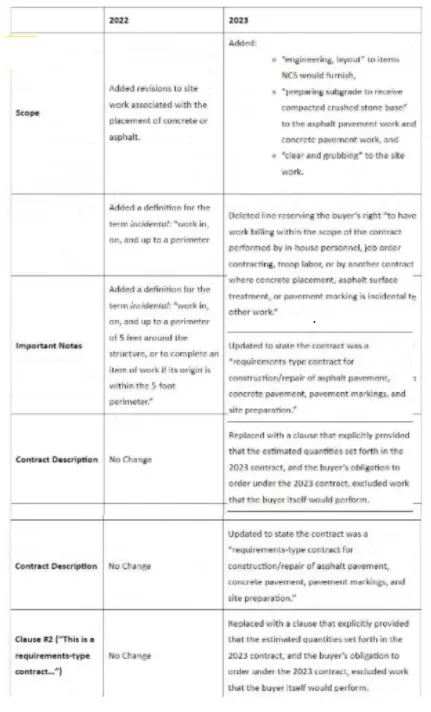
Following expiration of the 2020 contract, the buyer entered into additional one-year contracts in 2022 and 2023. Based on the comparison table provided, the key changes were:

2022: Added revisions to site work associated with the placement of concrete or asphalt; added a definition of ''incident'' as work in, on, and up to a perimeter of 5 feet around the structure or item to complete work if its origin is within that 5-foot perimeter; no change to contract description; no change to the clause stating the contract was a requirements-type contract.

2023: Added items NCS would furnish, including engineering/layout, preparing subgrade to receive compacted crushed stone base, and clear and grubbing; deleted the line reserving the buyer's right to have certain work performed by in-house personnel, job order contracting, or another contract where concrete placement, asphalt surface treatment, or pavement marking was incidental to other work; updated the contract description to state the contract was a ''requirements type contract for construction/repair of asphalt pavement, concrete pavement, pavement markings, and site preparation''; and replaced the clause with one stating that the estimated quantities set forth in the 2023 contract, and the buyer's obligation to order under the 2023 contract, excluded work that the buyer itself would perform.

NCS claimed that during performance of the 2020, 2022, and 2023 contracts, the buyer diverted substantial portions of work within the scope sections to other contractors and claimed lost profits under each contract.

When interpreting the contract, which of the following guidelines for contract interpretation should the court have relied on?

Correct Answer: A. Reading the contract as a whole.
Explanation:

The correct answer is A (Reading the contract as a whole) because, under NCMA CMBOK principles and standard legal interpretation rules, contracts must be interpreted holistically, giving meaning to all provisions in a way that avoids conflict and reflects the overall intent of the parties. This is a foundational rule of contract interpretation.

CMBOK emphasizes that when disputes arise, courts and contract managers should first attempt to reconcile all contract terms by examining the entire agreement, rather than isolating individual clauses. This ensures that no provision is interpreted in a way that renders another meaningless or contradictory. In the context of this scenario, determining whether the contract was truly a requirements-type contract depends on evaluating all relevant clauses together, including scope, ordering obligations, and any exceptions.

Option B is incorrect because prioritization rules (such as order of precedence clauses) are applied only when conflicts cannot be resolved through holistic interpretation. Option C (contra proferentem) applies only when ambiguity remains after all other interpretive methods are exhausted. Option D (parol evidence rule) limits the use of external evidence but does not replace the primary requirement to interpret the written contract itself.

CMBOK highlights that effective contract interpretation begins with integrating all provisions into a coherent understanding, ensuring fair and legally sound outcomes.


Question 7

A bilateral modification would be used for which of the following?

Correct Answer: A. Making negotiated equitable adjustments resulting from the issuance of a change order
Explanation:

The correct answer is A (Making negotiated equitable adjustments resulting from the issuance of a change order) because, according to NCMA Contract Management Body of Knowledge (CMBOK), a bilateral modification (supplemental agreement) is used when both parties agree to modify the terms of the contract. This type of modification requires the signatures and consent of both the buyer and the seller.

In the context of contract changes, when a change order is issued unilaterally by the buyer, it may initially direct the contractor to proceed with the change. However, any resulting equitable adjustment---such as changes to price, schedule, or other terms---must be negotiated and agreed upon by both parties, making it a bilateral modification.

Option B (administrative changes) is incorrect because these are typically handled through unilateral modifications that do not affect substantive rights (e.g., changes in address or payment office). Option C (termination notices) and D (issuing change orders) are also unilateral actions taken by the buyer.

CMBOK emphasizes that bilateral modifications are essential for maintaining mutual agreement, fairness, and contractual integrity when substantive changes occur. They ensure that both parties formally acknowledge and accept revised terms, which is critical during the post-award phase of contract management.


Question 8

Interest-based negotiation, mediation, mini-trial, nonbinding arbitration, and binding arbitration are all examples of what procedure to resolve issues in controversy?

Correct Answer: B. Alternative dispute resolution
Explanation:

The correct answer is B (Alternative dispute resolution) because, according to NCMA Contract Management Body of Knowledge (CMBOK), Alternative Dispute Resolution (ADR) encompasses a range of structured processes used to resolve disputes outside of traditional litigation. These methods are designed to be more efficient, cost-effective, and collaborative.

ADR includes techniques such as interest-based negotiation, mediation, mini-trials, nonbinding arbitration, and binding arbitration, all of which are explicitly listed in the question. These approaches allow parties to resolve disagreements while preserving business relationships and avoiding the time, expense, and adversarial nature of court proceedings.

CMBOK emphasizes that ADR is a critical tool in the post-award phase, where disputes may arise during contract performance. By using ADR, contract managers can address issues such as performance disagreements, interpretation disputes, or claims in a manner that promotes mutual understanding and timely resolution.

Option A (reconciliation) is not a formal dispute resolution framework. Option C (business counseling) is unrelated to dispute resolution processes. Option D (civil litigation) refers to formal court proceedings, which ADR seeks to avoid.

CMBOK highlights that effective use of ADR supports risk management, cost control, and relationship preservation, making it a preferred approach for resolving contractual disputes efficiently and professionally.


Question 9

Scenario 6.0: 1 --- ''When is a Commitment Not a Commitment?''

The buyer entered into a contract to lease 20,240 square feet of office space from Office Leasing Company (OLC). This space consisted of 8,545 square feet in Suite 1100 and 11,695 square feet in Suite 1106. The lease was for five years and provided the buyer with a renewal option as follows:

The buyer shall have the right to one renewal option for a five-year term. The renewal option shall become effective provided notice is given in writing to the lessor of the buyer's intent to exercise such option at least 270 days before the end of the original lease term; all other terms and conditions of this lease shall remain the same during any renewal term. Said notice shall be computed commencing with the day after the date of mailing.

The buyer also entered into Supplemental Lease Agreement Number 1 (SLA 1), which stated it was being issued to reflect an expansion of 6,431 square feet in Suite 300. SLA 1 amended the original lease to encompass the additional space, changing the space from 20,240 square feet to approximately 26,671 square feet, and increased the annual rent to $1,098,790.70. SLA 1 also amended the renewal option text to reflect the new annual rent of $1,156,935.80.

The lease, as amended by SLA 1, also contained a buyer clause regarding authority to make changes to the lease. As stated in the clause, the buyer's authorized agent may, by written order, make changes within the general scope of this lease to the amount of space, provided the lessor consents to the change.

The first lease was set to end on December 31, 2021. On February 28, 2020, the buyer's contract specialist sent an email to OLC stating the buyer ''hereby exercises its renewal option ... for a period of five years.'' The buyer's contract specialist noted that the email was ''official notification that the buyer exercises its renewal option right as provided under this lease,'' and indicated that ''this action will be followed up with a supplemental lease agreement in the near future.'' The email also stated that ''per SLA 1, [the buyer] would not like to renew the expansion space portion of the lease.'' At that time, the buyer was planning to vacate a good portion of its leased inventory and requested that OLC allow the buyer to terminate the Suite 300 portion of the lease effective March 1, 2021.

On March 1, 2020, OLC agreed to accept the long renewal of Suites 1100 and 1106 per the renewal option if the buyer agreed to renew the third-floor space for two weeks, from January 1, 2021, to January 15, 2021. If OLC found a new tenant for a term extending beyond January 15, 2021, it would waive any further liability for the third-floor space as of the date of the replacement lease. After discussion, the buyer agreed over the phone to a two-week extension of Suite 300 at no rent.

On August 2, 2020, OLC emailed the buyer's contract specialist to ask when the SLA would be prepared. The buyer's contract specialist did not respond. Several weeks later, on August 24, the buyer determined that it no longer needed to rent any of the suites under the lease and requested to be released at lease termination. On September 10, OLC once again emailed the buyer's contract specialist to follow up on the preparation of the SLA. This time, the buyer's contract specialist responded, apologized for the delay, and stated that he would try to get the SLA to OLC in the next couple of weeks.

However, on October 26, the buyer's contract specialist informed OLC that the buyer no longer intended to pursue the renewal option, reflecting the buyer's August 24 determination that it no longer required any of the suites under the lease. The following day, on October 27, OLC responded that the buyer had already exercised the renewal option and that it intended to hold the buyer to that agreement.

On June 21, 2021, the buyer notified OLC that its renewal option would not be exercised and that the buyer would not be responsible for any rent payments after the lease expiration date of December 31, 2021. Following a final decision from the buyer's authorized agent, which rejected the claims that the buyer had exercised the renewal option, OLC filed a claim.

In order to properly exercise an option:

o The option must be accepted;

o Such acceptance may not change, add to, or qualify the terms of the offer; and

o The buyer's acceptance has to be unconditional and in exact accord with the terms of the contract being renewed.

How could OLC have removed ambiguity from the renewal process?

Correct Answer: C. By including clear guidelines in the contract regarding how options are to be exercised.
Explanation:

The correct answer is C because NCMA CMBOK emphasizes the importance of clear, precise, and unambiguous contract language, especially regarding critical rights such as option exercise. Ambiguity in contracts often arises when procedures, responsibilities, or authority are not explicitly defined. In this scenario, confusion occurred regarding who could exercise the option, how it should be communicated, and whether modifications were permissible during exercise. These issues could have been avoided by including explicit contractual guidelines detailing the exact process for exercising options, including required format, authorized parties, timelines, and conditions for validity.

CMBOK highlights that effective contract management begins in the pre-award phase, where well-structured terms reduce the risk of disputes during performance. By clearly defining option exercise procedures, both parties would have a shared understanding, minimizing the likelihood of misinterpretation or invalid actions.

Option A is incorrect because making option exercise bilateral contradicts the nature of most options, which are typically unilateral rights. Option B is not relevant, as debriefings are generally used in source selection, not contract execution clarity. Option D addresses documentation of changes but does not resolve ambiguity in the original contract terms.

Therefore, consistent with CMBOK principles, the most effective way to eliminate ambiguity is through clear and comprehensive contract drafting, particularly regarding option execution procedures.


Question 10

The personal competence of emotional intelligence is comprised of self-management and __________.

Correct Answer: C. self-awareness
Explanation:

The correct answer is C (self-awareness) because, within the NCMA Contract Management Body of Knowledge (CMBOK), emotional intelligence is structured into two primary domains: personal competence and social competence. Personal competence specifically includes self-awareness and self-management, which together define how individuals understand and regulate their own emotions.

Self-awareness is the foundation of emotional intelligence. It involves recognizing one's emotions, strengths, limitations, and the impact of one's behavior on others. Without self-awareness, a contract manager cannot effectively apply self-management, as they would lack insight into what needs to be controlled or improved. Self-management, on the other hand, refers to the ability to regulate emotions, maintain composure, and act appropriately in various situations.

Option A (relationship management) and Option D (social awareness) are components of social competence, not personal competence. These focus on understanding others and managing relationships. Option B (vision) is unrelated to emotional intelligence structure.

In the context of contract management, strong emotional intelligence enhances negotiation effectiveness, stakeholder relationships, and conflict resolution. By developing self-awareness alongside self-management, contract managers can improve decision-making, maintain professionalism under pressure, and build trust---key elements emphasized in CMBOK leadership competencies.


Question 11

A(n) __________ contract comprises obligations imposed by law to prevent the unjust enrichment of one person at another's expense.

Correct Answer: B. quasi
Explanation:

The correct answer is B (quasi) because a quasi contract is not an actual contract formed by mutual agreement between parties, but rather a legal obligation imposed by law to prevent unjust enrichment. This concept is recognized in contract law principles referenced within the NCMA Contract Management Standard and reflected in CMBOK foundational knowledge.

A quasi contract arises when one party receives a benefit at the expense of another in circumstances where it would be unfair to retain that benefit without compensation. Even though no formal offer, acceptance, or mutual assent exists, the law creates an obligation to ensure equity and fairness. For example, if services are provided unintentionally or without a formal agreement, but the receiving party benefits, the court may impose a quasi contract to require payment.

Option A (unilateral contract) involves a promise exchanged for performance and requires voluntary agreement, making it a true contract. Option C (implied contract) is inferred from the conduct or actions of the parties, indicating mutual intent, unlike quasi contracts which lack such intent. Option D (express contract) involves clearly stated terms agreed upon by both parties, either orally or in writing.

Thus, within the CMBOK framework, quasi contracts are important for understanding legal remedies and risk considerations, even though they fall outside standard contract formation processes.


Question 12

When a contractor submits a claim to the buyer, the buyer reviews the facts and prepares a written decision. What must the contractor do while the buyer is considering the claim?

Correct Answer: C. Continue performance pending a final resolution of the claim
Explanation:

The correct answer is C (Continue performance pending a final resolution of the claim) because, according to NCMA Contract Management Body of Knowledge (CMBOK) and standard contract principles, a contractor is generally required to continue contract performance while a claim is being reviewed and decided by the buyer or contracting authority.

This requirement is often referred to as the ''Disputes clause'' principle, which ensures that contract performance is not disrupted while disagreements are being resolved. CMBOK emphasizes that maintaining continuity of performance is critical to avoid delays, additional costs, or mission failure, especially in government and complex service contracts.

While the contractor may be pursuing a claim for additional compensation, time, or other relief, they must still fulfill their contractual obligations unless formally directed otherwise (e.g., through a stop-work order or termination). This protects the buyer's interests and ensures that contract objectives are achieved.

Option A and B may be good internal practices but are not mandatory requirements. Option D is incorrect because stopping work without authorization could itself constitute a breach of contract.

CMBOK highlights that proper handling of claims includes continuing performance, maintaining documentation, and pursuing resolution through appropriate channels, ensuring both compliance and effective contract execution during the post-award phase.


Question 13

__________ are the phases of the contract life cycle.

Correct Answer: A. Pre-Award, Award, and Post-Award
Explanation:

The correct answer is A (Pre-Award, Award, and Post-Award) because these are the three standardized phases of the contract lifecycle as defined by the NCMA Contract Management Standard and reflected throughout the CMBOK framework. These phases provide the structural foundation for organizing all contract management activities.

The Pre-Award phase focuses on planning and developing the acquisition strategy. It includes requirements definition, market research, solicitation development, and evaluation of offers. This phase ensures that the organization is properly prepared to enter into a contract.

The Award phase involves the formal formation of the contract. Key activities include negotiations, finalizing terms and conditions, and executing the agreement between the parties. This phase establishes the legal relationship and obligations.

The Post-Award phase encompasses contract performance, administration, and closeout. Activities include monitoring performance, managing changes, ensuring compliance, handling payments, resolving disputes, and completing contract closeout.

Option B and C describe partial or reworded activities within the lifecycle but do not represent the standardized phase structure defined by NCMA. Option D refers to essential elements of contract formation, not lifecycle phases.

Thus, the three-phase lifecycle model---Pre-Award, Award, and Post-Award---is fundamental in CMBOK and is used to organize competencies, processes, and best practices across contract management.


Question 14

A __________ is a contract in which the personnel providing the services are not subject, either by the contract's terms or the manner in which it is administered, to the supervision and control usually prevailing in the relationships between employers and employees.

Correct Answer: D. nonpersonal services contract
Explanation:

The correct answer is D (nonpersonal services contract) because, as defined in NCMA CMBOK and aligned with federal acquisition principles, a nonpersonal services contract is one in which the contractor's personnel are not subject to the direct supervision and control of the buying organization. Instead, the contractor maintains responsibility for managing its employees and delivering the required outcomes.

This distinction is critical in contract management. In a nonpersonal services contract, the government or buyer specifies what results are required, but not how the work is performed or how contractor personnel are supervised. The contractor retains full control over hiring, supervision, and performance management of its staff. This preserves the independent contractor relationship and avoids creating an implied employer-employee relationship.

Option B (personal services contract) is the opposite scenario, where contractor personnel are subject to supervision and control similar to government employees, which is generally restricted unless specifically authorized by law. Option A (performance-based acquisition) is a procurement method focused on outcomes and performance standards, not personnel relationships. Option C is not a standard term in CMBOK.

CMBOK emphasizes that proper contract structuring and administration in the post-award phase must ensure that nonpersonal services contracts are not inadvertently managed in a way that creates unauthorized personal services relationships, which can lead to legal and compliance risks.


Question 15

Scenario 6.0: 1 --- ''When is a Commitment Not a Commitment?''

The buyer entered into a contract to lease 20,240 square feet of office space from Office Leasing Company (OLC). This space consisted of 8,545 square feet in Suite 1100 and 11,695 square feet in Suite 1106. The lease was for five years and provided the buyer with a renewal option as follows:

The buyer shall have the right to one renewal option for a five-year term. The renewal option shall become effective provided notice is given in writing to the lessor of the buyer's intent to exercise such option at least 270 days before the end of the original lease term; all other terms and conditions of this lease shall remain the same during any renewal term. Said notice shall be computed commencing with the day after the date of mailing.

The buyer also entered into Supplemental Lease Agreement Number 1 (SLA 1), which stated it was being issued to reflect an expansion of 6,431 square feet in Suite 300. SLA 1 amended the original lease to encompass the additional space, changing the space from 20,240 square feet to approximately 26,671 square feet, and increased the annual rent to $1,098,790.70. SLA 1 also amended the renewal option text to reflect the new annual rent of $1,156,935.80.

The lease, as amended by SLA 1, also contained a buyer clause regarding authority to make changes to the lease. As stated in the clause, the buyer's authorized agent may, by written order, make changes within the general scope of this lease to the amount of space, provided the lessor consents to the change.

The first lease was set to end on December 31, 2021. On February 28, 2020, the buyer's contract specialist sent an email to OLC stating the buyer ''hereby exercises its renewal option ... for a period of five years.'' The buyer's contract specialist noted that the email was ''official notification that the buyer exercises its renewal option right as provided under this lease,'' and indicated that ''this action will be followed up with a supplemental lease agreement in the near future.'' The email also stated that ''per SLA 1, [the buyer] would not like to renew the expansion space portion of the lease.'' At that time, the buyer was planning to vacate a good portion of its leased inventory and requested that OLC allow the buyer to terminate the Suite 300 portion of the lease effective March 1, 2021.

On March 1, 2020, OLC agreed to accept the long renewal of Suites 1100 and 1106 per the renewal option if the buyer agreed to renew the third-floor space for two weeks, from January 1, 2021, to January 15, 2021. If OLC found a new tenant for a term extending beyond January 15, 2021, it would waive any further liability for the third-floor space as of the date of the replacement lease. After discussion, the buyer agreed over the phone to a two-week extension of Suite 300 at no rent.

On August 2, 2020, OLC emailed the buyer's contract specialist to ask when the SLA would be prepared. The buyer's contract specialist did not respond. Several weeks later, on August 24, the buyer determined that it no longer needed to rent any of the suites under the lease and requested to be released at lease termination. On September 10, OLC once again emailed the buyer's contract specialist to follow up on the preparation of the SLA. This time, the buyer's contract specialist responded, apologized for the delay, and stated that he would try to get the SLA to OLC in the next couple of weeks.

However, on October 26, the buyer's contract specialist informed OLC that the buyer no longer intended to pursue the renewal option, reflecting the buyer's August 24 determination that it no longer required any of the suites under the lease. The following day, on October 27, OLC responded that the buyer had already exercised the renewal option and that it intended to hold the buyer to that agreement.

On June 21, 2021, the buyer notified OLC that its renewal option would not be exercised and that the buyer would not be responsible for any rent payments after the lease expiration date of December 31, 2021. Following a final decision from the buyer's authorized agent, which rejected the claims that the buyer had exercised the renewal option, OLC filed a claim.

In order to properly exercise an option:

o The option must be accepted;

o Such acceptance may not change, add to, or qualify the terms of the offer; and

o The buyer's acceptance has to be unconditional and in exact accord with the terms of the contract being renewed.

Did the buyer's contract specialist have the authority to exercise the option?

Correct Answer: B. No, because SLA 1 specifically stated that only the buyer's authorized agent could make changes to the lease.
Explanation:

The correct answer is B because CMBOK emphasizes that contract authority must be explicitly defined and exercised only by individuals with delegated authority. In this scenario, the Supplemental Lease Agreement (SLA 1) clearly states that only the buyer's authorized agent has the authority to make changes within the scope of the lease. Exercising an option is a binding contractual action, not merely an administrative or exploratory communication, and therefore requires proper authority.

The buyer's contract specialist sent communication indicating the exercise of the renewal option; however, there is no evidence that this individual was the designated authorized agent. Under CMBOK principles, actions taken by personnel without proper authority may be considered unauthorized commitments, which are not legally binding unless later ratified by an authorized official.

Option A is incorrect because the absence of specific language in the renewal clause does not override the explicit authority provisions defined elsewhere in the contract. Option C is incorrect because implied authority does not apply to formal contract modifications or option exercises, which require clear, delegated authority. Option D is less precise because apparent authority depends on the perception of the other party, but the contract explicitly defines who holds authority, making this argument secondary.

Thus, consistent with CMBOK guidance on authority and governance, the contract specialist did not have the authority to exercise the option.