Limited-Time Offer: Enjoy 50% Savings! Ends in 00h 00m 00s Coupon code: 50OFF
Skip to content

Free Nokia Multiprotocol Label Switching 4A0-103 Exam Questions

Page: 1 / 17 Total 249 questions

Want more questions? Get Premium Access.

Question 1

Click on the exhibit.
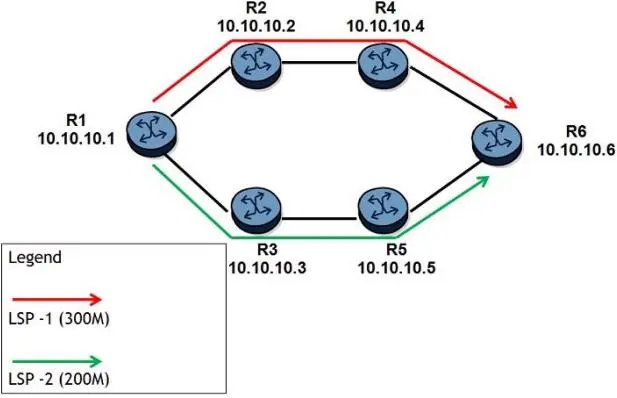
All links have 1 Gbps unreserved bandwidth initially and all LSPs have the least-fill feature enabled. After the two LSPs have been signaled as shown, two additional LSPs are configured.

LSP-3 is signaled first with 50Mbps reserved. LSP-4 is signaled after with 400Mbps reserved.

Which paths will CSPF choose for LSP-3 and LSP-4?

Correct Answer: B. Both LSP-3 and LSP-4 take R1-R3-R5-R6.
Question 2

Which of the following is NOT an advantage of RSVP-TE compared to LDP?

Correct Answer: B. RSVP-TE enables simplified configuration of LSPs.

Question 3

Which of the following devices inspects the MPLS header in the received packet, and exchanges it for a new MPLS header?

Correct Answer: C. LSR

Question 4

Click on the exhibit button.

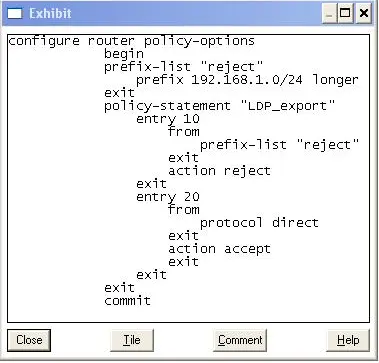
The policy on router R2 is applied as an LDP export policy. What FECs now appear in router R2's LIB?

Correct Answer: A. Local FECs, not including those in the 192.168.1.0/24 address space.

Question 5

If an Alcatel-Lucent 7750 LSR receives a labeled packet with a outer label TTL of 250 and an inner label TTL of 251, which of the following statements is true?

Correct Answer: B. The packet will be label switched; the outer label TTL will be 249 and the inner label TTL will be 251.

Question 6

Which of the following best describes downstream unsolicited label distribution?

Correct Answer: B. An LSR may advertise label mappings to all peers for which it might be a next-hop for a given FEC

Question 7

All links have 1Gbps unreserved bandwidth initially and all LSPs have the least-fill feature enabled. After the two LSPs have been signaled as shown, two new LSPs are configured. LSP-3 is signaled first with 600Mbps reserved. LSP-4 is signaled after with 800Mbps reserved. All LSPs have the same setup and hold priorities. Which paths will CSPF choose for LSP-3 and LSP-4?

Correct Answer: C. LSP-3 takes R1-R3-R5-R6 and LSP-4 has no available path.

Question 8

Consider a device that uses per-platform label space; which of the following fields is NOT contained in the LFIB?

Correct Answer: C. Incoming interface

Question 9

Which approach to LSP path diversity provides the most control, but the least flexibility?

Correct Answer: C. Strict hop LSP paths

Question 10

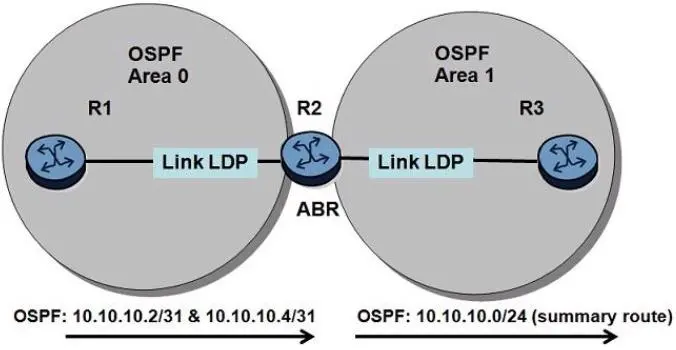
Click on the exhibit.

Router R2 advertises the aggregate prefix 10.10.10.0/24 into Area 1. Why would LDP aggregate-prefix-match be enabled on router R3?

Correct Answer: C. To bypass the LDP exact prefix match rule

Question 11

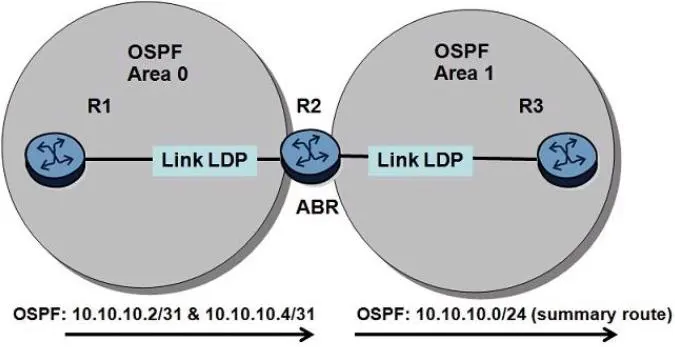
Click on the exhibit.

Router R2 advertises an OSPF summary route 10.10.10.0/24 into Area 1. Router R3 receives labels for individual FECs 10.10.10.2/32 and 10.10.10.4/32. These two FECs are installed in router R3's LIB but not in the LFIB. What needs to be done on router R3 to install these labels into its LFIB?

Correct Answer: B. Enable LDP aggregate prefix match.

Question 12

Which of the following statements best describe MPLS fast reroute characteristics? (Choose two)

Correct Answer: B. Fast reroute provides path protection close to the failure point; C. Fast reroute performs automatic path calculation and signaling.

Question 13

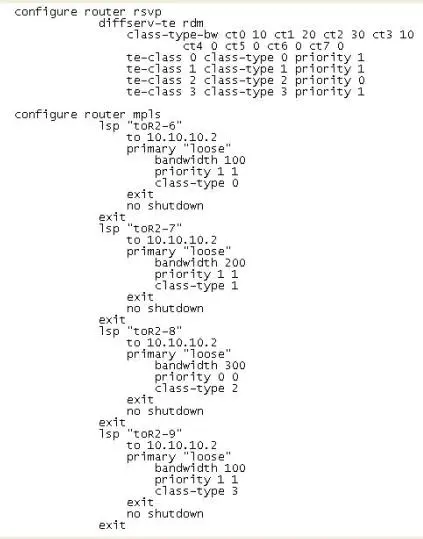
Click on the exhibit button below.

If the four LSPs shown use the shared-explicit reservation style, how much bandwidth does CSPF request across a single 1Gbps link?

Correct Answer: E. 700Mbps

Question 14

Which of the following prerequisites must you configure on a router to enable LDP-over-RSVP support? (Choose two)

Correct Answer: A. Configure the T-LDP peers for tunneling.; C. Enable Idp-over-rsvp in the IGP configuration on the PEs and ABRs

Question 15

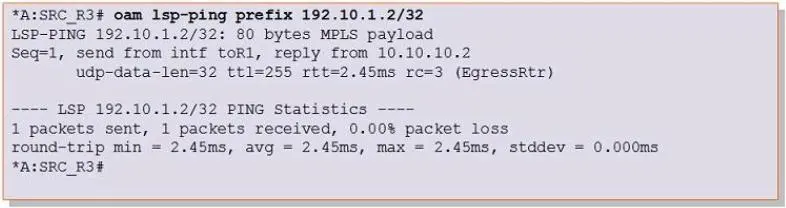
Click on the exhibit.

Which of the following is FALSE?

Correct Answer: A. The router can reach prefix 192.10.1.2/32 through a RSVP-TE tunnel.