
Limited-Time Offer: Enjoy 50% Savings! Ends in 00h 00m 00s Coupon code: 50OFF
Skip to content

Free Nokia IS-IS Routing Protocol 4A0-112 Exam Questions

Page: 1 / 7 Total 40 questions

Want more questions? Get Premium Access.

Question 1

What do the address resolution protocol (ARP) for IPv4 and the neighbor discovery procedures for IPv6 have in common?

Correct Answer: C. Both resolve a host device's MAC address using its IP address.
Explanation:

ARP for IPv4 and Neighbor Discovery Protocol (NDP) for IPv6 are both used to map a device's IP address to its MAC address. This is essential for communication within a local network.

ARP is used in IPv4 networks, and NDP performs a similar function in IPv6 networks, ensuring devices can communicate effectively on the same network segment.

Question 2

Two IS-IS routers are exchanging Hello packets. One is configured to use authentication and the other is not. Which of the following statements is TRUE?

Correct Answer: D. An adjacency will not be established.
Explanation:

IS-IS routers must have matching authentication settings to establish an adjacency. If one router is configured with authentication and the other is not, the routers will not be able to establish an adjacency because their authentication parameters do not match.


Question 3

Which of the following statements about the IP forwarding process on a router is TRUE?

Correct Answer: B. It uses the routing table to find a match for the destination IP address.
Explanation:

During the IP forwarding process, routers use the routing table to determine the next hop based on the destination IP address. The source IP address is not directly involved in the lookup process for forwarding.

The ARP table is used to map IP addresses to MAC addresses, specifically for resolving the MAC address of the next hop (destination MAC address) for forwarding packets within the local network.


Question 4

A router is trying to establish an IS-IS adjacency with the DIS on a broadcast link. What event causes the adjacency to change from ''Initializing'' to ''UP''?

Correct Answer: B. Receiving the first CSNP packet from the DIS that lists the LSPs in the DIS's link-state database.
Explanation:

The process of establishing an IS-IS adjacency on a broadcast link involves several steps, and the transition from the Initializing state to the UP state occurs when both routers exchange sufficient information to confirm they have a consistent view of the link-state database.

The CSNP (Complete Sequence Number PDU) packet is used to advertise the list of LSPs in the router's link-state database. When a router receives the first CSNP from the DIS (Designated Intermediate System) that lists the LSPs in the DIS's database, it indicates that the router has enough information to establish the adjacency and synchronize its database.


Question 5

There are several differences between IS-IS Hello packets used on broadcast interfaces and on point-to-point interfaces.

Which of the following statements is FALSE?

Correct Answer: C. The neighbors are identified using their interface MAC addresses on broadcast Hello messages and using their system IDs on point-to-point Hello messages.
Explanation:

In both broadcast and point-to-point interfaces, IS-IS routers identify neighbors using system IDs, not interface MAC addresses. The system ID is a unique identifier assigned to each router, and it is used to identify neighbors in both types of interfaces.


Question 6

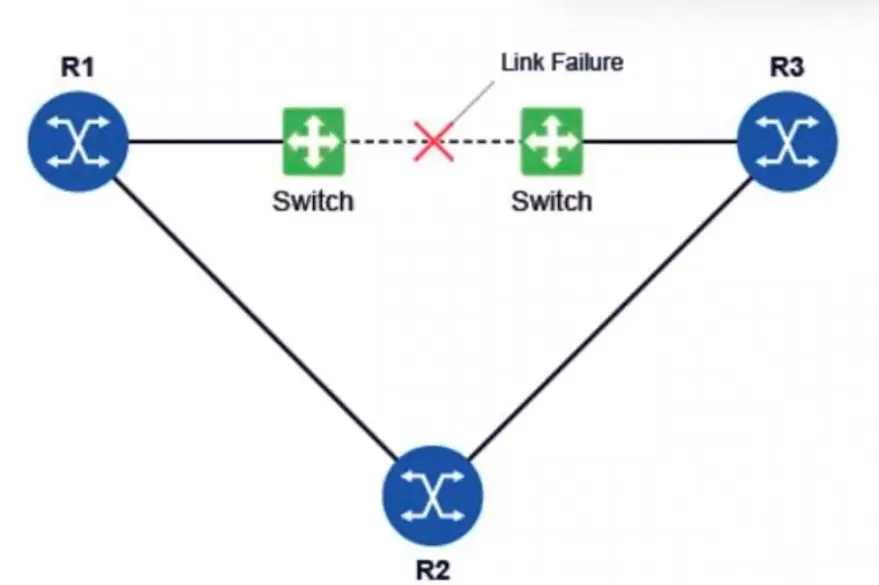
Refer to the exhibit.

All routers in the diagram are running a link-state routing protocol. Before the link failure, all routers have operational adjacencies with each other and there is a BFD session between routers R1 and R3. After the link failure, which of the following affects the routing protocol's convergence time?

Correct Answer: C. The value of the BFD transmit interval, receive interval and multiplier settings on routers R1 and R3.
Explanation:

BFD (Bidirectional Forwarding Detection) is used to detect link failures quickly and helps improve convergence time in link-state routing protocols. The BFD session between routers R1 and R3 allows them to detect the failure of the link between them more quickly than the regular routing protocol hello timers. The transmit interval, receive interval, and multiplier settings determine how fast BFD detects a failure and triggers the routing protocol to converge, which directly impacts the convergence time.