
Question 1
With reference to the image, where is the OPS card placed to provide the OMSP protection?
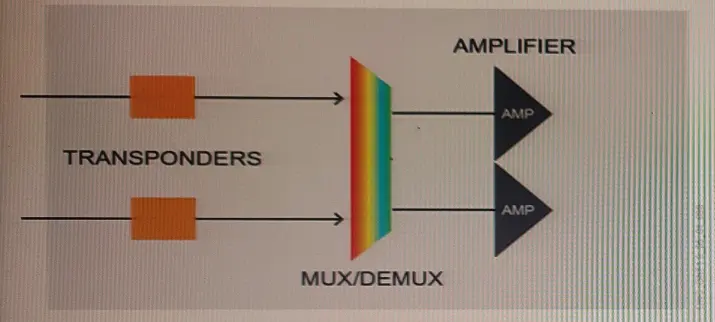
Correct Answer:
D. Before the transponder, on the client side, towards the external device
With reference to the image, where is the OPS card placed to provide the OMSP protection?
What is the function of the express channel interface?
Comprehensive and Detailed Explanation From Nokia Optical Networking Fundamentals:
In the context of WDM (Wavelength Division Multiplexing) node architecture, an express channel interface (often associated with OADMs or ROADMs) is specifically designed to handle 'through' traffic. In a multi-node optical network, not every wavelength (channel) needs to be processed or terminated at every site it passes. To maintain signal integrity and reduce latency, these wavelengths are kept in the optical domain.
The express interface allows these optical channels---those not terminated or 'dropped' at the local node---to bypass the local transponders and multiplexers, flowing directly to the downstream node. This photonic bypass avoids unnecessary O-E-O (Optical-Electrical-Optical) conversions, which would otherwise require expensive hardware and increase power consumption. By utilizing express paths, the Nokia 1830 PSS can scale to support massive core network capacities while ensuring that only the relevant traffic is diverted to the local client-facing ports.
Which of the following is an example of optical protection mechanism?
It can be implemented through the use of a Y-cable or an optical protection switch (OPS) card, which allows for the switching of traffic to a secondary path in the event of a failure on the primary path. This type of protection is commonly used to protect against fiber cuts and other types of physical layer failures in the optical transport network.
Which mechanisms can be put in place to increase network survivability?
There are two main mechanisms that can be put in place to increase network survivability: protection and restoration. Protection involves pre-allocating and reserving backup resources so that they are ready in case of a failure. Restoration involves allocating backup resources upon failure and using a 1+1 protection mechanism to recover each trail. This ensures that the network is able to re-route traffic in the event of a failure, increasing the overall survivability of the network.
Which of the following statements is true about chromatic dispersion (CD)?
Different wavelengths propagate at different speeds within the same media and therefore different colors travel in the fiber with different speed. This phenomenon is known as chromatic dispersion and causes light to spread out as it travels through the fiber over distance, leading to signal attenuation and distortion. The fiber attenuation does not introduce inter-channel interference, but it can cause attenuation of the signal. Different channels have different bandwidths, but this does not affect CD performance.
Where can the user set the long-haul WT decoder parameter, when designing a network with EPT?
The long-haul WT decoder parameter can be set in the NE parameters when designing a network with EPT. This parameter is used to adjust the sensitivity of the decoder and can help to improve the accuracy of the measurements for long-haul WTs.
The Network Element (NE) parameters in EPT (Element Planning Tool) are used to configure various settings and options for the network elements in the network. The long-haul WT decoder parameter is one such setting that can be configured in the NE parameters section. The user can access the NE parameters by navigating to the NE Parameters menu within the EPT interface. The user can then select the appropriate network element and modify the settings as needed. This information can be found in the Nokia guide for EPT.
Which of the following statements about the ODUk unit is TRUE?
Comprehensive and Detailed Explanation From Nokia Optical Networking Fundamentals:
In the Optical Transport Network (OTN) hierarchy, the ODUk (Optical Data Unit of order k) is the fundamental unit for electronic grooming and switching. Unlike the OTUk layer, which is tied to a specific physical optical interface and includes the Forward Error Correction (FEC), the ODUk layer is 'path-oriented.' This means that in a switched WDM system like the Nokia 1830 PSS-24x, the ODUk containers can be switched across a backplane from one line card to another without needing to deconstruct the entire optical signal.
To clarify the other options: Option A is false because FEC is part of the OTUk (Transport Unit) layer. Option C is false because ODUk processing is entirely electrical (O-E-O must occur to access the ODUk overhead). Option D is false because the OPU (Optical Payload Unit) is actually the 'first' container where the client signal is mapped; the ODUk then wraps around the OPU to add path-level monitoring and maintenance signals. Therefore, the ODUk acts as the 'virtual container' that allows the network to manage services end-to-end across multiple optical spans.
Which sentence about NFM-T is correct?
NFM-T is a network management system designed to manage optical networks in a unified manner. It is used to design, manage, and provision optical services having IP nodes as extremities. It supports a variety of technologies, including optical and IP, and fully supports LO, LI, L2, and GMPLS applications. It is mainly focused on the Nokia 1830 PSS product family, as well as other older product families.
What is a trail?
A trail is a transparent transport of a client signal. A trail is a physical link between two points in an optical network, allowing for the transport of a client signal from one point to the other. It is a low-order signal, such as a 10G Ethernet or a Fibre Channel signal, encapsulated into a high-order container, such as a 40G or 100G signal. This allows for the transport of the client signal over longer distances, increasing the power budget of the optical link.
What is a degree-1 node?
A degree-1 node is a node that only has one direction, and it is therefore a terminal node. This means that the node only has one input and one output port. It does not have any other ports to connect to other nodes or fibers. This is a common feature of some optical transport networks, such as ring networks, where a degree-1 node serves as the endpoint of the ring.