
Limited-Time Offer: Enjoy 50% Savings! Ends in 00h 00m 00s Coupon code: 50OFF
Skip to content

Free Nokia GMPLS-Controlled Optical Networks 4A0-220 Exam Questions

Page: 1 / 7 Total 40 questions

Want more questions? Get Premium Access.

Question 1

Which of the following is not a GMPLS protocol?

Correct Answer: C. SFD
Explanation:

SFD is not a GMPLS protocol, but a term used in optical networks to refer to the Source Frequency Definition, which is a parameter that specifies the frequency of a wavelength channel4.GMPLS protocols are those that enable the control and management of different types of switching technologies, such as packet, wavelength, fiber, and time-slot switching5. Some examples of GMPLS protocols are OSPF-TE, RSVP-TE, and LMP.OSPF-TE is a routing protocol that advertises the topology and the link attributes of the network6. RSVP-TE is a signaling protocol that establishes, modifies, and releases LSPs. LMP is a link management protocol that verifies the connectivity and monitors the status of the links.Reference:

4: Source Frequency Definition (SFD) - ITU

5: Generalized Multi-Protocol Label Switching - Wikipedia

6: OSPF Extensions in Support of Generalized Multi-Protocol Label Switching (GMPLS) - RFC 4203

[7]: Generalized Multi-Protocol Label Switching (GMPLS) Signaling Resource Reservation Protocol-Traffic Engineering (RSVP-TE) Extensions - RFC 3473

[8]: Link Management Protocol (LMP) - RFC 4204

Question 2

What category of protocols is used by the ingress router to set up a new LSP?

Correct Answer: B. Signaling protocols
Explanation:

Signaling protocols are protocols that are used by the ingress router to set up a new LSP in an MPLS network. Signaling protocols are responsible for requesting, allocating, and releasing resources along the LSP, as well as establishing and maintaining the label bindings between the nodes.Some examples of signaling protocols are RSVP-TE, LDP, and CR-LDP34.Reference:

3: Nokia GMPLS-controlled Optical Networks Course | Nokia

4: MPLS Configuration Guide for Cisco NCS 5500 Series Routers, IOS XR Release 7.1.x - Implementing MPLS Label Distribution Protocol [Cisco IOS XR Software (End-of-Sale)] - Cisco


Question 3

Which of the following parameters is not considered when restoring an LSP?

Correct Answer: B. Equipment vendor
Explanation:

The equipment vendor is not a parameter that is considered when restoring an LSP. Restoration is the process of re-establishing an LSP after a failure by using an alternative path that meets the same constraints as the original LSP. The parameters that are considered when restoring an LSP include coloring, reservation priority, maximum latency, bandwidth, protection type, and other QoS attributes. The equipment vendor does not affect the restoration process as long as the nodes support GMPLS protocols and interoperate with each other.Reference:RFC 4427 - Recovery (Protection and Restoration) Terminology for Generalized Multi-Protocol Label Switching (GMPLS), [Nokia GMPLS-controlled Optical Networks Course | Nokia]


Question 4

What is the Link Maintenance window?

Correct Answer: B. A wizard with commands to set links and nodes to maintenance
Explanation:

The Link Maintenance window is a feature of NFM-T that allows the user to perform maintenance tasks on links and nodes in a GMPLS network. The Link Maintenance window is a wizard that provides commands to set links and nodes to maintenance mode, which prevents them from being used for routing new LSPs or carrying traffic. The user can also use the Link Maintenance window to reroute existing LSPs away from the links and nodes that are in maintenance mode, either manually or automatically.The Link Maintenance window helps the user to perform network maintenance operations without disrupting the service availability or quality12.Reference:

1: Nokia GMPLS-controlled Optical Networks Course | Nokia

2: Nokia Network Functions Manager for Transport User Guide | Nokia


Question 5

Which categories of protocols are included in the GMPLS technology?

Correct Answer: D. Routing, signaling, and link management
Explanation:

The GMPLS technology includes three categories of protocols: routing, signaling, and link management. Routing protocols are used to exchange information about the network topology, resources, and constraints among the nodes. Signaling protocols are used to establish, modify, and release Label Switched Paths (LSPs) across the network. Link management protocols are used to verify the connectivity and status of the links between adjacent nodes.Reference:Nokia GMPLS-controlled Optical Networks Course | Nokia,3. GMPLS - Nokia


Question 6

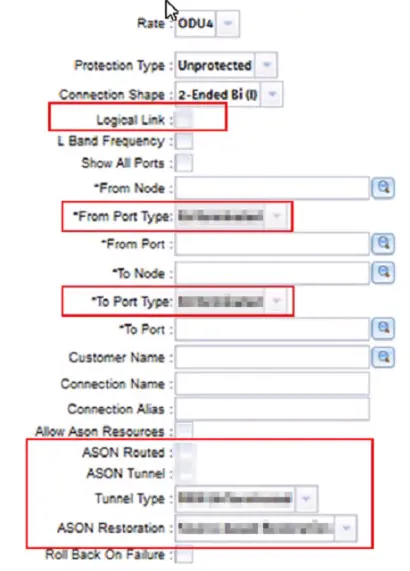
How do you configure the Trail template in NFM-T for an Uplink board (such as 2UC400) in an MRN network with LO and LI restoration capabilities?

Correct Answer: A. Check the Logical Link box Set the Port Type to Unterminated Check the ASON Routed box Uncheck the ASON Tunnel box
Explanation:

To configure the Trail template in NFM-T for an Uplink board (such as 2UC400) in an MRN network with LO and LI restoration capabilities, you need to check the Logical Link box, set the Port Type to Unterminated, check the ASON Routed box, and uncheck the ASON Tunnel box. This configuration allows you to create a logical link between two Uplink boards that can be used for LO or LI restoration. The logical link is not terminated at the Uplink board, but at the OTU board. The ASON Routed option enables the GMPLS control plane for the logical link, while the ASON Tunnel option is not applicable for Uplink boards.Reference:Nokia Advanced Optical Network Management with NFM-T Course | Nokia,Nokia 1830 PSS-4, PSS-8, PSS-16 and PSS-32 Platforms - NATO