Limited-Time Offer: Enjoy 50% Savings! Ends in 00h 00m 00s Coupon code: 50OFF
Skip to content

Free Nokia NSP IP Network Automation Professional Composite Exam 4A0-AI1 Exam Questions

Page: 1 / 8 Total 80 questions

Want more questions? Get Premium Access.

Question 1

Which of the following can only be viewed by making a RESTCONF call to query an existing intent?

Correct Answer: C. template-mappings
Explanation:

The template-mappings can only be viewed by making a RESTCONF call to query an existing intent.

The template-mappings are a set of key-value pairs that map the abstract YANG model attributes to concrete NFM-P templates and parameters. They are not exposed in the UI or the ibn:intent model, but they are stored internally in the NSP database.

For example, a template-mapping could be:/network=IP/service=VPN -> nsp-ip-vpn-template.

Question 2

Which of the following is NOT a benefit of Service Fulfilment API?

Correct Answer: D. Provides alarm monitoring
Explanation:

Service Fulfilment API does not provide alarm monitoring; rather, it allows customers to quickly and easily order and provision services from a single interface, allowing for increased service agility and reduced human error.

According to the Nokia NSP Service Fulfilment API User Guide, Service Fulfilment API offers the following benefits:

1. Increases service agility by providing a programmable interface for automated service provisioning and management, allowing network operators to quickly respond to customer demands and network changes.

2. Reduces human errors by automating the service provisioning process, which minimizes the risk of manual configuration errors and improves service quality.

3. Allows multi-vendor service provisioning by providing a vendor-agnostic interface that supports different types of network equipment and technologies, reducing vendor lock-in and enabling greater network flexibility.


Question 3

"The automated configuration, coordination, and management of large virtualized systems, middleware, and services" describes which of the following?

Correct Answer: B. Orchestrator
Explanation:

orchestrationis the automated configuration, coordination, and management of computer systems and software. Orchestration takes advantage of several tasks that are usually automated to create a more complex workflow.

An orchestrator is a software tool that is used to automate the configuration, coordination, and management of large virtualized systems, middleware, and services. The other three options are not related to the automated configuration, coordination, and management of large virtualized systems, middleware, and services.

Orchestrator is described as 'the automated configuration, coordination, and management of large virtualized systems, middleware, and services.' The orchestrator is a key component of network automation, enabling the automation and management of complex network functions across multiple devices and platforms.


Question 4

Which of the following HTTP methods are NOT supported in REST and RESTCONF?

Correct Answer: D. ADD
Explanation:

The HTTP methods that are supported by REST/RESTCONF are:

GET: Used to retrieve a representation of a resource.

PUT: Used to replace a resource or create it if it does not exist.

DELETE: Used to delete a resource.

PATCH: Used to apply a partial update to a resource.

The HTTP method ADD is not a standard HTTP method and is not supported by REST/RESTCONF.


Question 5

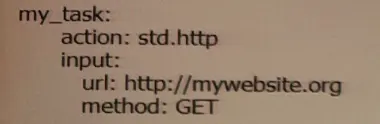
Convert the workflow full syntax to workflow simplified syntax. Which of the following is correct?

A)

B)

C)

D)

Correct Answer: D. Option D

Question 6

Which of the following is NOT an Intent Type life-cycle state?

Correct Answer: D. Created
Explanation:

Intent Types have four life-cycle states: Draft, Released, Phased-Out, and Deleted. The Created state is not a life-cycle state for Intent Types; instead, it is an intermediate state used to create an Intent before it is moved to a life-cycle state.


Question 7

Which of the following configures the network based on input provided by the user?

Correct Answer: A. Intent
Explanation:

Intent is a high-level description of the desired outcome or state of the network. It allows users to specify what they want to achieve rather than how to achieve it. The intent is then translated into network configurations and policies that are used to configure the network infrastructure. Intent-based networking provides a higher level of abstraction than traditional network configuration methods, making it easier for users to specify their requirements and automate the configuration process.


Question 8

Which directory or directories do the file actions provide accessto on the NSP server?

Correct Answer: B. all directories
Explanation:

file actions are NSP actions that provide access to files and folders on the NSP server. The file actions can accessall directorieson the NSP server, but they are restricted by the permissions of the user who runs them. For example, if a file action is run by a user who does not have write permission to a directory, the action will fail.


Question 9

What are the two main functionalities of the NSP REST API gateway services?

1. Versioning model

2. Create subscriptions

3. Location services

4. Authentication and termination services

Correct Answer: C. 1 and 4
Explanation:

the NSP REST Gateway API provides the entry point for API clients to locate and authenticate REST client requests to gain access to the various NSP modules that have registered API services.


Question 10

Which of the following NSP CLI actions uses the network element's NE ID to establish communication?

Correct Answer: B. nsp.sr_cli
Explanation:

nsp.sr_cliis a nodal communication action that uses the network element's NE ID to establish communication. It is one of the NSP actions and expression functions that can be used to design workflows for network automation