
Question 1
Choose the correct answer: What is a minimal reflexive metamodel?
Correct Answer:
A. a metamodel whose interpretation maps completely onto itself
Choose the correct answer: What is a minimal reflexive metamodel?
Choose the correct answer: Consider the following piece of UML definition:
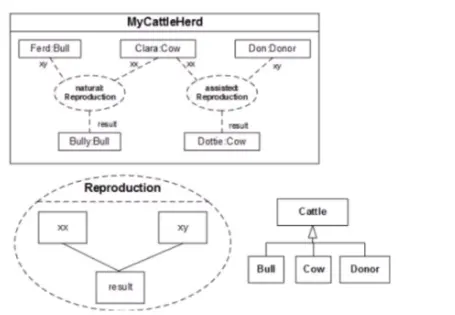
What is the typing of xx. xy and result?
The UML diagram illustrates two types of reproduction for cattle: natural and assisted. In natural reproduction, a bull (xy) and a cow (xx) result in a new cattle (result), which aligns with biological principles. The same principle applies to assisted reproduction, where the donor is also cattle (xy), and the result is a new cattle. Since both Ferd Bull and Don Donor are specialized types of Cattle, and the result of both reproductions is Cattle, it implies that both xx and xy are of type Cattle, but within the context, xx is specifically a Cow. Therefore, xx is a Cow, xy is Cattle (which can be a Bull or Donor), and the result is also Cattle. This interpretation aligns with the principles of UML where specific instances (like Ferd Bull and Don Donor) are instances of the more general classifier Cattle.
Choose the correct answer:
An organization has determined that they want to add the capability to create and add requirement elements to their UML models. They also want to create a unique relationship for tracing requirements to other model elements.
What is the appropriate approach to do this?
UML allows the introduction of new concepts that are not part of the standard UML metamodel by creating a profile. To add capabilities for modeling requirements and tracing relationships in UML, a profile can be created where a Class is stereotyped to represent a requirement, and a Dependency is stereotyped to represent the trace relationship. This approach is both practical and conforms to the UML standard's mechanisms for extending the language. It is a common practice to create such profiles for requirements engineering within the UML framework. This conforms to the UML 2 Superstructure Specification, which provides guidelines on creating and applying profiles and stereotypes.
Choose the correct answer:
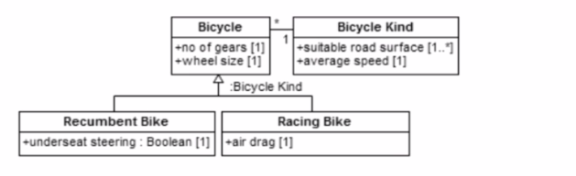
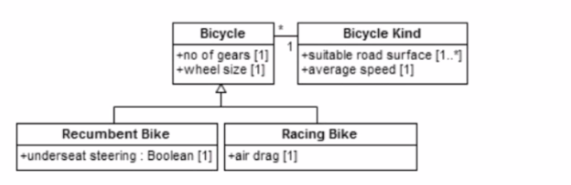
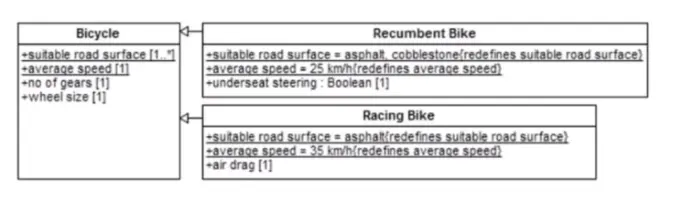
A developer wants to make sure that each specialization of Class Bicycle has its own unique set of values for the suitable road surface and average speed
Which diagram imposes these requirements?
A)
B)
C)
D)
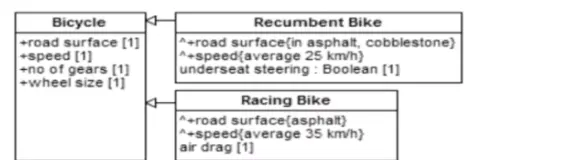
In Option C, the properties suitable road surface and average speed have been redefined in the subclasses Recumbent Bike and Racing Bike. The use of the {redefines} keyword in UML signifies that the subclass will provide its own specific values for these properties, overriding the general ones provided by the superclass Bicycle. This is the correct way to enforce that each specialization of Bicycle has a unique set of values for these attributes, as redefinition allows for the customization of inherited properties on a per-subclass basis. The use of {redefines} is specified in the UML 2.x Superstructure Specification, which describes how properties inherited from a superclass can be customized by subclasses.
Choose the correct answer:
Which input element does lexical analysis of Action Language for Foundational UML text discard?
Choose the correct answer:
What does "computationally complete" mean in the context of fUML?
Choose the correct answer:
A framework developer has been given a requirement to create an extensible utility for solution developers to use to create collections. The framework developer has submitted the following diagram fragment for review:
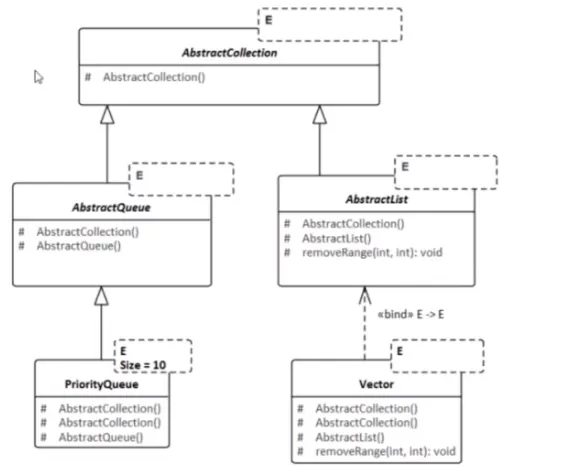
Which review comment is valid and applicable?
The other options can be evaluated as follows:
Option A:The upper limit for the size ofPhontyQueueis a design decision that should be based on the requirements and use cases of the application. It is not inherently incorrect in UML to have a specific upper limit.
Option C:The Generalization relationship is correctly used betweenPriorityQueueandAbstractQueueas it represents inheritance in UML.
Option D:While it is true that template parameters are typically defined at the top of the hierarchy, the statement is too absolute. In UML, template parameters can be added to specialized classes, but it depends on the specific design and requirements. Therefore, without additional context, this statement cannot be deemed universally valid.
In conclusion, the most applicable and valid review comment is option B, which correctly identifies the misuse of the bind relationship in the context of the class diagram provided.
Choose the correct answer:
What is the difference between a ValueSpecificattonActlon and a CreateObjectAction?
The difference between ValueSpecificationAction and CreateObjectAction in UML is fundamental to the kinds of results they produce:
A . Incorrect, as there is a fundamental difference between the outputs of these two actions.
B . Correct. A ValueSpecificationAction evaluates to a value but does not produce instances of Classifiers, whereas a CreateObjectAction is specifically designed to instantiate classifiers.
C . Incorrect, because it reverses the capabilities of the two actions.
D . Also incorrect, because it provides the wrong association of features with actions.
UML Specification: Action section, where both ValueSpecificationAction and CreateObjectAction are defined.
Further clarifications on these actions are provided in the UML 2.5 Documentation, especially in parts discussing Actions and Activities.
Choose the correct answer:
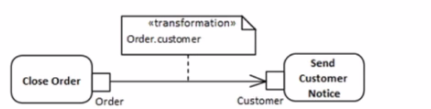
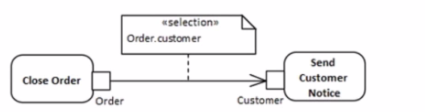
When an Order is closed, a Customer of that Order must be notified
Which diagram fragment correctly models this scenario?
A)
B)
C)
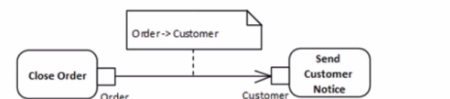
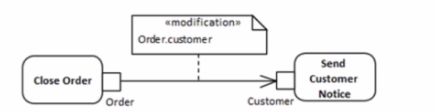
The correct answer is C, which uses a transformation edge to indicate that when an order is closed, information is transformed or processed to notify the customer. This is expressed in UML with an object flow that has a transformation property, which specifies how an object is transformed from one state to another as it flows along the edge. This is appropriate for a scenario where closing an order leads to the creation of a customer notice, implying some form of transformation or processing of the order information to generate the notice.
UML 2.5 Specification: The UML 2.5 specification details how object flows with transformations can be used to show that one piece of data is transformed into another as it flows from one action to another.
Choose the correct answer: What is the value of EMOF?