Limited-Time Offer: Enjoy 50% Savings! Ends in 00h 00m 00s Coupon code: 50OFF
Skip to content

Free OMG Certified UML Professional 2 (OCUP 2) - Foundation Level OMG-OCUP2-FOUND100 Exam Questions

Page: 1 / 9 Total 90 questions

Want more questions? Get Premium Access.

Question 1

Choose the correct answer:

Which category of stakeholders should have prime responsibility for making decisions on the contents of a domain model, and why?

Correct Answer: B. The users, as they will be using the system when it is operational.
Explanation:

In the development of a domain model, the prime responsibility for decision-making should ideally rest with the users, as they are the ones who will be using the system operationally. Users have the most direct and frequent interactions with the system, making them best positioned to provide relevant insights into what the system should do and how it should behave to meet their needs effectively. While other stakeholders such as customers, project managers, and developers play significant roles, the users' intimate knowledge of the domain processes and their requirements make them key contributors to ensuring that the domain model aligns closely with real-world application and utility.
Question 2

Choose the correct answer:

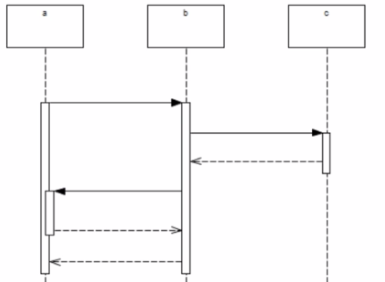
How many execution occurrence specifications are there in total on the diagram below?

Correct Answer: D. 3
Explanation:

An execution occurrence specification in UML sequence diagrams is represented by a thin rectangle on a lifeline. It shows that an instance is performing an action over a period of time.

In the provided sequence diagram, we can see three such thin rectangles on lifeline 'b', which indicates that there are three execution occurrence specifications.

One for the message that comes from 'a' to 'b'.

Another one for the message that 'b' sends to 'c'.

And the last one for the return message from 'c' to 'b'.

There are no execution occurrence specifications on lifelines 'a' and 'c'.

Therefore, the correct answer is:

D . 3


Question 3

Choose the correct answer:

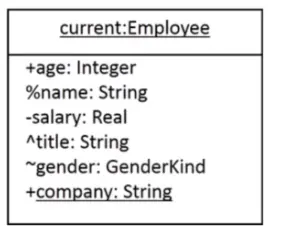
Consider the following diagram fragment:

Which slot's value is hidden outside of the current Employee9

Correct Answer: C. salary
Explanation:

The diagram fragment shows an instance specification for an Employee. The different prefixes before each attribute indicate the visibility of that attribute:

+ Public: Visible to everyone.

- Private: Visible only within the defining class.

# Protected: Visible to subclasses and package.

~ Package: Visible to all classes within the same package.

Given these visibility indicators, the attribute with the private visibility is -salary: Real. This means that the salary attribute is the one that is hidden outside of the current:Employee classifier and cannot be accessed by entities that do not belong to the Employee class.

Therefore, the correct answer is:

C . salary


Question 4

Choose the correct answer:

How is the abstract syntax of UML specified?

Correct Answer: A. using a MOF metamodel
Explanation:

The abstract syntax of UML is specified using the Meta-Object Facility (MOF) metamodel. MOF is a modeling language that provides a meta-meta-model at the top layer of the four-layer metadata architecture, which is used to define the metamodels, like the UML. The MOF specification defines the structure and semantics for constructing metamodels, including the UML. By using MOF, UML ensures that its structure is well-defined and can be processed by tools that understand MOF-based metamodels. The use of MOF to specify UML abstract syntax ensures a clear, structured, and standardized method of describing the semantics of UML components, enabling consistent interpretation and implementation across different modeling tools and environments.


Question 5

Choose the correct answer:

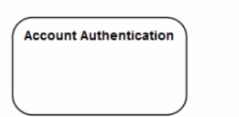
Consider the following Activity:

A)

B)

C)

Correct Answer: B. Option B
Explanation:

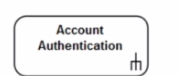
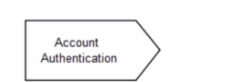
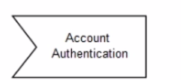
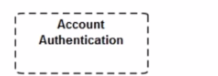
The diagram displays an activity labeled 'Account Authentication'.

There are two main paths branching from the start of the activity:

One path leads to an activity named 'Validate Password'.

The other path leads to an activity named 'Send OTP'.

Both paths converge into a decision diamond labeled 'Authentication Successful?'.

Depending on the outcome of the decision (Yes/No), the flow continues to either a 'Grant Access' or 'Deny Access' activity.

Explanation of why Option B is Correct:

This diagram accurately represents the scenario of account authentication where there are two alternative paths for validation: using a password or an OTP (One-Time Password). The decision point after these paths merges the flow for a final decision on granting or denying access based on successful authentication.

Comparison with Other Options:

Option A, C, and D show different activity sequences that don't align with the two initial validation paths (password vs. OTP) and the subsequent decision point based on authentication success.

Reference

UML 2.5.1 Specification (Superstructure): Sections on Activity Diagramshttps://www.omg.org/spec/UML/2.4/Superstructure/PDF


Question 6

Choose the correct answer:

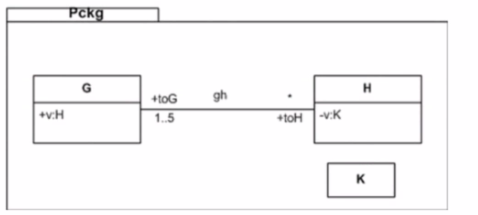
Consider the following diagram:

Which statement is always true about this diagram?

Correct Answer: D. There may be an G object which has no H object associated with it through gh.
Explanation:

The diagram shows a package Pckg that includes two classes G and H with a one-to-many association between them. The multiplicity '1..5' near class G on the 'gh' association end suggests that for each H object, there should be between 1 to 5 associated G objects. However, the '*' (multiplicity many) near class H on the 'gh' association end indicates that a G object can be associated with zero or more H objects. This implies that it's possible to have a G object that is not associated with any H object.


UML 2.x Superstructure Specification: Multiplicity notations and association rules are clearly defined in the UML specifications, which detail the semantics of multiplicities and their implications for object association.

UML 2.x Infrastructure Specification: Further explains the basic constructs of the UML metamodel, which underpin the interpretation of multiplicities in associations.

Question 7

Choose the correct answer:

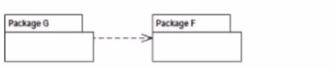
Which statement is correct regarding the diagram below?

Correct Answer: C. One or more of the elements in Package G depends on one or more of the elements in Package F.
Explanation:

The dashed arrow with an open arrowhead in the UML diagram represents a dependency relationship. In UML, a dependency is a relationship that signifies that one element, or set of elements, requires another element (or set of elements) for its specification or implementation. This means that changes to the target element(s) (the element(s) that the arrow points to) may cause changes to the source element(s).

The statement 'One or more of the elements in Package G depends on one or more of the elements in Package F' correctly describes the nature of a dependency relationship in UML. It indicates that there is at least one element in Package G that requires some element(s) from Package F. This does not necessarily imply that all elements from Package G depend on all elements from Package F.

Therefore, the correct answer is:

C . One or more of the elements in Package G depends on one or more of the elements in Package F.


Question 8

Choose the correct answer:

Which statement is correct regarding Enumeration Literals?

Correct Answer: A. EnumerationLiterals are immutable
Explanation:

Enumeration literals in UML are used within an enumeration to define a set of named constants. According to the UML specification:

A . This statement is correct. Enumeration literals are indeed immutable, which means once they are defined within an enumeration, their values cannot be changed.

B . Enumeration literals cannot be anonymous; they must be named so that they can be referenced unambiguously within the model.

C . Enumeration literals can be compared for equality. In fact, this is one of their primary uses, to allow for comparison between different values of an enumerated type to determine if they are the same.

D . Enumeration literal names must be unique within their enumeration. They cannot appear more than once as this would cause ambiguity in references to the literals.

The most accurate statement according to the UML 2 Foundation specification is A: EnumerationLiterals are immutable.


Question 9

Choose the correct answer:

What is a reason to have all the UML diagrams of a model have the same amount of detail?

Correct Answer: D. This is typically required by tools that automatically transform the model.
Explanation:

Having all the UML diagrams of a model maintain the same level of detail is typically required by tools that automatically transform the model into other forms, such as code or other types of models. Consistency in the level of detail across different diagrams ensures that automated tools can reliably interpret and convert the UML diagrams without encountering discrepancies that could lead to errors or misrepresentations in the generated outputs. This consistency is crucial for maintaining the integrity of the transformations and for ensuring that the resultant products accurately reflect the intended design and specifications.


Question 10

Choose the correct answer:

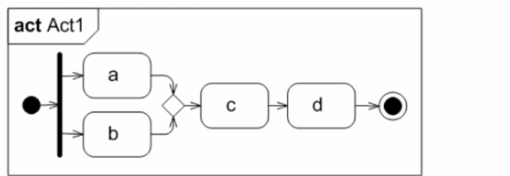
Consider the following diagram:

Which statement is true about the execution of Action c?

Correct Answer: C. It will get executed two times, since two tokens are offered to it
Explanation:

In the provided activity diagram, let's analyze the execution ofAction c:

Tokens and Control Flow:

Tokens represent the flow of control within an activity diagram.

Each control flow arrow represents a path along which tokens can move.

Tokens are offered to actions based on the incoming control flows.

Action c:

Action chastwo incoming control flows(fromAction aandAction b).

Since there aretwo tokensoffered toAction c, it will be executedtwice.

Parallel Flow:

The parallel flow fromAction aandAction bdoes not need synchronization because both tokens can independently reachAction c.

The diagram does not violate any synchronization rules for parallel flows.

Therefore, the correct statement is thatAction cwill get executedtwo times, as indicated by the presence of two tokens offered to it.

For further understanding, you can refer to UML 2 documentation on activity diagrams, which explains the semantics of tokens, control flows, and execution of actions1. Remember that tokens play a crucial role in determining the execution behavior of actions in parallel flows.