
Limited-Time Offer: Enjoy 50% Savings! Ends in 00h 00m 00s Coupon code: 50OFF
Skip to content

Free Oracle Upgrade to Oracle Solaris 11 System Administrator 1Z0-820 Exam Questions

Page: 1 / 14 Total 131 questions

Want more questions? Get Premium Access.

Question 1

You are going to use the- Automated installer (AI) to install a non global zone named zone1. You have created a custom manifest for the non-global zone and named it zone1manifest

Which command will you use to add this custom manifest to the s11-sparc install service and associate this custom manifest with the non-global zone?

Correct Answer: B. installadm create-manifest -n s11-sparc -f /tmp/zone1manifest.xml -m
Explanation:

installadm add-manifest

Associates manifests with a specific install

service, thus making the manifests available on

the network, independently from creating a

service. When publishing a non-default manifest,

it is required to associate criteria either via

criteria entered on the command line (-c) or

via a criteria XML file (-C).

Incorrect answers:

C: installadm create-client

Accomplishes optional setup tasks for a specified

client, in order to provide custom client

settings that vary from the default settings used

by the installadm create-service command.

D: installadm create-service

Creates an install service.

The command provides the following functionality:

- Takes an AI ISO image (<srcimage>), unpacks it,

and sets up a net image in a target directory

(<targetdir>. The net image enables client

installations.

- Creates an install service and makes it

available on the network.

Question 2

ServerA contains two ISO images of a package repository, named sol.repo.iso-a and sol.repo.iso-b respectively. You need to create a single local package repository on serverA that clients can connect to. The package repository will be stored in the /export/IPS file system and named repo. The prefered publisher will be named solans and the publisher URL will be http://serverA.example.com.

Which is correct procedure to perform on ServerA to create the local package repository?

Correct Answer: A. cat sol repo iso-a sol repo iso-b > sol fill iso Mount the ISO image and use the rsync command to extract the contents of the ISO file to the /export/IPS file system. Set the pkg/inst_root property to /export/IPS/repo and the pkg/readonly property to true Set the preferred publisher by using pkg set-publisher -G http://pkg oracle com/solaris/release/ -g http://serverA.example.com/ solans

Question 3

You are setting up an automated installer (AI) install server and issue the following command:

installadm create-service -n prod_ai -s /repo/prod_ai.iso \

-i 192.168.1.100 -c 5 -d /export/repo

Which four options describe the install server that you have configured?

Correct Answer: A. The service name is prod_ai.; B. DHCP base IP address is 192.168.1.100; D. Five IP addresses are allocated for DHCP clients, starting with 192.168.1.100.; F. The AI net image ISO file is located in /repo/prod and the net image ISO will be unpacked in /export/repo.
Explanation:

A: -n <svcname>

Uses this install service name instead of default

service name.

B: -i <dhcp_ip_start>

Sets up a new DHCP server. The IP addresses,

starting from dhcp_address_start, are set up.

D: -c <count_of_ipaddr>

Sets up a total number of IP addresses in the

DHCP table equal to the value of the

count_of_ipaddr. The first IP address is the

value of dhcp_ip_start that is provided by the

-i option.

F: -s <srcimage>

Specifies location of AI ISO image to use for

setting up the install service.

<targetdir>

Required: Specifies location to set up net image.


Question 4

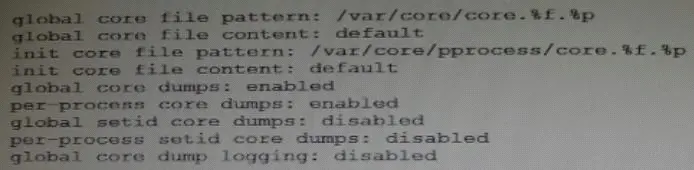
The core dump configuration in your non global zone is

A user is running a process in a non-global zone (testzone) and the process crashes. The process information is:

user1 2663 2618 0 17:46:42 pts/2 0:00 /usr/bin/bash

When the user's process crashes in testzone, a non-global zone, where will the core dump be saved?

Correct Answer: E. The file will be saved in non-global zone's directory: /var/core/core.bash.2663
Explanation:

The line

init core file pattern: /var/core/core.%f.%p

will be used for the non-global process to determine the destination of the dump file.

Note: When a process is dumping core, up to three core files can be produced: one in the per-process location, one in the system-wide global location, and, if the process was running in a local (non-global) zone, one in the global location for the zone in which that process was running.


Question 5

Which two accurately describe the Image Packaging System (IPS) components? (Choose two.)

Correct Answer: A. Every package is represented by an FMRI, consisting of a publisher, a name, and a version, with the scheme.; C. A publisher is an entity that develops and constructs packages.

Question 6

Review the zonestat command

zonestat -q -r physical-memory -R high -z dbzone -p -p "zones" 10 24h 60m

Select the option that correctly describes the information that is displayed by this command

Correct Answer: E. it is a sample of dbzone's physical memory usage taken every 10 seconds over a 24-hour period. Only peak memory usage is displayed each hour All other utilization data is eliminated.

Question 7

On server A, you enter the following command to add a static route to serverA

route -p add -host 192.168.1.101 192.168.1.101 -static

What is the purpose of this command?

Correct Answer: B. to specify an IPMP target IP address to in.mpathd
Explanation:

Note: # route -p add -host destination-IP gateway-IP -static

wheredestination-IPandgateway-IPare IPv4 addresses of the host to be used as a target.

For example, you would type the following to specify the target system 192.168.10.137, which is on the same subnet as the interfaces in IPMP group itops0:

$ route -p add -host 192.168.10.137 192.168.10.137 -static

This new route will be automatically configured every time the system is restarted. If you want to define only a temporary route to a target system for probe-based failure detection, then do not use the -p option.


Question 8

When you issue the ''gzip: zommand not found'' message is displayed. You need to install the gzip utility on your system.

Which command would you use to check if the gzip utility is available from the default publisher for installation?

Correct Answer: D. pkg search gzip
Explanation:

Searching for Packages

Use the pkg search command to search for packages whose data matches the specified pattern.

Like thepkg contentscommand, thepkg searchcommand examines the contents of packages. While thepkg contentscommand returns the contents, thepkg searchcommand returns the names of packages that match the query.

pkg search

search [-HIaflpr] [-o attribute ...] [-s repo_uri] query

Search for matches to the query, and display the results.

Which tokens are indexed are action-dependent, but may

include content hashes and pathnames.

Note: pkg is the retrieval client for the image packaging system. With

a valid configuration, pkg can be invoked to create locations for

packages to be installed, called 'images', and install packages

into those images. Packages are published by publishers, who may

make their packages available at one or more repositories. pkg,

then, retrieves packages from a publisher's repository and

installs them into an image.


Question 9

After installing the OS, you boot the system and notice that the syslogd daemon is not accepting messages from remote systems.

Which two options should you select to modify the syslogd daemon configuration so that it accepts syslog messages from remote systems? (Choose two.)

Correct Answer: D. svccfg -s svc /system/system-loq setprop config/log_from_remote=true Restart the syslogd daemon.; E. Set the following parameter in the /etc/default/syslogd file: LOG_FROM_REMOTE=YES Restart the syslogd daemon

Question 10

Before booting test zone a non-global zone, you want to connect to the zone's console so that you can watch the boot process.

Choose the command used to connect to testzone's console.

Correct Answer: E. zlogin -C testzone
Explanation:

The following options are supported:

-C

Connects to the zone console. Connects to the zone console.

Note:

After you install a zone, you must log in to the zone to complete its application environment. You might log in to the zone to perform administrative tasks as well. Unless the-Coption is used to connect to the zone console, logging in to a zone usingzloginstarts a new task. A task cannot span two zones

Incorrect answers:

B: No option -console.

C, D: No option -z.