
Limited-Time Offer: Enjoy 50% Savings! Ends in 00h 00m 00s Coupon code: 50OFF
Skip to content

Free Palo Alto Networks Network Security Analyst NetSec-Analyst Exam Questions

Page: 1 / 8 Total 74 questions

Want more questions? Get Premium Access.

Question 1

Which Strata Cloud Manager (SCM) feature provides a consolidated view of all high-priority security incidents across a global network, including those from firewalls and Prisma Access?

Correct Answer: B. Command Center
Explanation:

Comprehensive and Detailed 150 to 250 words of Explanation From Palo Alto Networks Network Security Analyst Knowledge:

The Command Center in Strata Cloud Manager (SCM) is the primary operational dashboard for high-level monitoring. Its objective is to provide a 'single pane of glass' view into the overall security and health of the organization.

The Command Center aggregates alerts and logs from all managed security components---including hardware firewalls, VM-Series firewalls, and Prisma Access---into a centralized incident list. This allows the analyst to quickly identify global trends, such as a widespread malware outbreak or a performance issue affecting multiple regional offices, without having to log into individual management consoles. By prioritizing incidents based on their potential impact, the Command Center helps the analyst focus their efforts on the most critical issues, improving incident response times and ensuring a consistent security posture across the entire distributed enterprise.

Question 2

What is an important consideration when defining custom data patterns for data loss prevention (DLP) on Palo Alto Networks platforms? (Choose one answer)

Correct Answer: C. They should be specific and tested to minimize false positives and false negatives.
Explanation:

Comprehensive and Detailed 150 to 250 words of Explanation From Palo Alto Networks Network Security Analyst Knowledge:

Custom data patterns allow organizations to extend the capabilities of Data Loss Prevention (DLP) beyond standard identifiers (like Credit Card numbers or SSNs) to include proprietary data such as internal project codes, intellectual property, or specialized legal documents. Because these patterns are typically defined using Regular Expressions (Regex), the most critical administrative consideration is ensuring they are specific and thoroughly tested.

If a custom pattern is defined too broadly (Option D), it will trigger a high volume of false positives, where legitimate, non-sensitive traffic is flagged or blocked. This 'noise' creates alert fatigue for the security team and can disrupt business operations. Conversely, a pattern that is not specific enough can result in false negatives, allowing sensitive data to exit the network undetected. A Network Security Analyst must test these patterns against a variety of sample data sets to confirm they correctly identify the intended information across different file formats and protocols. This iterative testing and refinement process is essential for maintaining the accuracy and reliability of the DLP solution, ensuring that protection is both effective and non-disruptive to the flow of valid business information.


Question 3

What are two valid pattern types in a Data Filtering profile? (Choose two.)

Correct Answer: C. File Properties; D. Regular Expression
Explanation:

Comprehensive and Detailed 150 to 250 words of Explanation From Palo Alto Networks Network Security Analyst Knowledge:

In the Palo Alto Networks ecosystem, specifically when utilizing Strata Cloud Manager (SCM) and Enterprise Data Loss Prevention (DLP), Data Filtering profiles are used to identify and protect sensitive information. When an analyst creates a custom data pattern to be used within these profiles, the system allows for two primary methods of identification: Regular Expressions (Regex) and File Properties.

Regular Expressions (D) allow the analyst to define a specific string or numerical pattern, such as a custom employee ID format or a proprietary project code. This is the most flexible and common way to catch sensitive text data within a file or data stream.

File Properties (C) allow the analyst to create patterns based on the metadata or attributes of a file rather than its contents. This includes identifying files based on the 'Author,' 'Title,' 'Company,' or even custom tags embedded in document properties (e.g., Microsoft Word or PDF metadata). By combining these two pattern types, a Network Security Analyst can create a highly granular detection engine. For instance, a policy could block any file where the 'Company' property is set to a competitor or any file containing text that matches a specific Regex-defined sensitive data format.

While 'Predefined' patterns (like Credit Card numbers) are also a core component, they are not listed as an option here. 'Proximity Patterns' are a feature used to reduce false positives by ensuring two patterns appear near each other, but the fundamental 'pattern types' for custom definitions are Regex and File Properties.


Question 4

An analyst wants to ensure that any traffic from the "Guest-Zone" to the "Internal-Zone" is always inspected, even if there is no explicit security rule defined. Which default behavior should the analyst be aware of?

Correct Answer: B. Interzone-default rules deny traffic by default.
Explanation:

Comprehensive and Detailed 150 to 250 words of Explanation From Palo Alto Networks Network Security Analyst Knowledge:

Palo Alto Networks firewalls operate on a Zero Trust principle by default. This is reflected in the Interzone-default rule, which is an implicit rule at the bottom of the security policy base that denies all traffic between different zones.

In this scenario, traffic from 'Guest-Zone' to 'Internal-Zone' will be blocked automatically unless the analyst creates an explicit 'Allow' rule. Conversely, the Intrazone-default rule allows traffic within the same zone. A key objective for the analyst is to monitor these default rules. Often, analysts will override the default settings to enable 'Logging' on the interzone-default rule to identify blocked connection attempts, providing critical data for troubleshooting or security audits. Understanding these implicit behaviors is fundamental to ensuring that no unauthorized traffic 'leaks' between network segments.


Question 5

A company requires that all encrypted traffic from the "Accounting" department be decrypted for inspection, while all other departments remain encrypted. How should the analyst configure the Decryption Policy?

Correct Answer: C. Use 'User-ID' in the Decryption Policy to target only members of the Accounting group.
Explanation:

Comprehensive and Detailed 150 to 250 words of Explanation From Palo Alto Networks Network Security Analyst Knowledge:

The most granular and efficient way to apply decryption to a specific department is by using User-ID within the Decryption Policy. This ensures that the policy follows the users themselves, regardless of which specific IP address or zone they are currently using.

By selecting the 'Accounting' group from the identity provider (e.g., Active Directory) in the 'Source User' column, the analyst ensures that only their SSL/TLS sessions are decrypted for threat inspection. This objective balances high-security requirements for sensitive departments with the privacy expectations and performance considerations of the rest of the organization. It is a key best practice for a Network Security Analyst to use identity as the primary factor in decryption decisions, as it provides the most persistent and accurate control over the security posture.


Question 6

A security analyst is using the Strata Cloud Manager (SCM) Policy Optimizer to create specific and focused rules. The analyst accepts the new rules from Policy Optimizer and updates the rule base, but the traffic does not hit these new rules.

Which action needs to be taken to resolve this issue?

Correct Answer: D. Perform a commit
Explanation:

Comprehensive and Detailed 150 to 250 words of Explanation From Palo Alto Networks Network Security Analyst Knowledge:

In the Palo Alto Networks management workflow---whether using a local firewall, Panorama, or Strata Cloud Manager (SCM)---there is a fundamental distinction between the Candidate Configuration and the Running Configuration. When an analyst uses the Policy Optimizer to identify applications and 'clones' or creates new App-ID based rules, these changes are initially written only to the Candidate Config.

The reason the traffic does not hit the new rules immediately is that the firewall's data plane is still operating based on the last successful Running Configuration. In the context of SCM or Panorama, even after 'accepting' the rules in the interface, the changes remain in a staged state. To move these changes from the management plane to the active inspection engine, the analyst must Perform a commit.

A commit validates the configuration syntax and compiles the new policy into the hardware's lookup tables. Without a commit, the new rules effectively do not exist in the eyes of the traffic processing engine. While 'Execute a push configuration' (Option A) is a valid step in a Panorama-to-Firewall workflow, the term Commit is the universal required action to activate local candidate changes. Furthermore, even if the rules are created, the firewall evaluates rules from top to bottom; however, the most common reason for new rules appearing 'invisible' to traffic immediately after creation in the GUI is the lack of a finalized commit.


Question 7

An organization needs to implement a security rule that allows users to access "Facebook" but prevents them from using "Facebook-Chat." What is the best way to achieve this?

Correct Answer: B. Create a security rule allowing the 'Facebook-base' App-ID and another rule blocking the 'Facebook-chat' App-ID.
Explanation:

Comprehensive and Detailed 150 to 250 words of Explanation From Palo Alto Networks Network Security Analyst Knowledge:

The power of App-ID lies in its ability to distinguish between different functions within the same web service. Palo Alto Networks provides specific App-IDs for various sub-functions of popular sites.

To achieve the requirement, the analyst should create two security rules (or one rule with a specific exclusion). The first rule, placed higher in the policy, would block the Facebook-chat App-ID. The second rule, placed below it, would allow the Facebook-base App-ID. Because the firewall evaluates rules from the top down, any attempt to use the chat function will hit the block rule first. This provides much higher security and granularity than URL Filtering (Option A), which might struggle to differentiate between the different elements of a dynamic, HTTPS-based site like Facebook. Using App-ID for this purpose ensures that the business can allow the useful parts of social media while mitigating the risks associated with unauthorized file transfers or interactive chat functions.


Question 8

What is the benefit of the Command Center's centralized dashboard in Strata Cloud Manager (SCM)?

Correct Answer: D. Monitoring and managing threats and operational health
Explanation:

Comprehensive and Detailed 150 to 250 words of Explanation From Palo Alto Networks Network Security Analyst Knowledge:

The Command Center in Strata Cloud Manager (SCM) is designed as the 'single pane of glass' for modern network security operations. Its primary benefit is providing a unified, centralized dashboard that aggregates data across the entire security estate, including Next-Generation Firewalls (NGFWs), Prisma Access, and Prisma SD-WAN.

By utilizing the Command Center, a Network Security Analyst can gain real-time visibility into two critical areas: security posture (threats, vulnerabilities, and risky applications) and operational health (device status, connectivity, and performance metrics). This centralized view eliminates the need for analysts to pivot between different management consoles to understand the global health of their network. The dashboard highlights critical threats that require immediate attention and provides health scores for devices, allowing for proactive troubleshooting of potential outages before they impact the business. While SCM does leverage AI (AIOps) for predictive analysis, the fundamental 'benefit' of the Command Center dashboard itself, as defined in Palo Alto Networks documentation, is the holistic monitoring and management of threats and health across the distributed enterprise.


Question 9

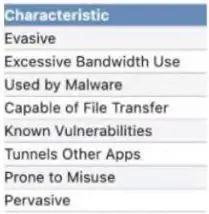
A security administrator is creating an internet of things (IoT) Security policy and needs to select behaviors for the traffic.

Which characteristic has the greatest impact to the risk level of applications?

Correct Answer: A. Used by Malware
Explanation:

Comprehensive and Detailed 150 to 250 words of Explanation From Palo Alto Networks Network Security Analyst Knowledge:

In the Palo Alto Networks ecosystem, App-ID utilizes specific characteristics to help administrators assess the risk profile of applications traversing the network. These characteristics---which include whether an application is evasive, prone to misuse, or capable of file transfer---are aggregated into a numerical Risk Score ranging from 1 (lowest risk) to 5 (highest risk).

Among the listed characteristics, 'Used by Malware' (A) typically has the greatest immediate impact on the assigned risk level. This characteristic indicates that the application is a known vector for Command and Control (C2) traffic, data exfiltration, or payload delivery, necessitating a high risk rating (often 4 or 5). While 'Known Vulnerabilities' (D) and 'Tunnels Other Apps' (C) certainly increase the risk level by providing an exploit surface or obscuring visibility, they represent potential risks. In contrast, an application being actively 'Used by Malware' represents a direct and validated threat to the environment.

'Pervasive' (B) refers to how common an application is and generally does not drive a high-risk score on its own. For an analyst building an IoT Security policy, prioritizing applications with the 'Used by Malware' characteristic is critical, as many IoT devices lack robust internal security and are frequently recruited into botnets via these specific communication channels.


Question 10

Which object type allows an analyst to group multiple IP addresses based on their geographical location (country) to simplify "Geo-blocking" policies?

Correct Answer: C. Regions
Explanation:

Comprehensive and Detailed 150 to 250 words of Explanation From Palo Alto Networks Network Security Analyst Knowledge:

Regions are specialized objects that use the firewall's internal database of IP-to-Country mappings. Instead of manually listing thousands of IP ranges for a specific country, an analyst can simply select the country name (e.g., 'China' or 'Brazil') as a Source or Destination in a security rule.

This objective is highly effective for reducing the attack surface by blocking traffic from countries where the organization has no legitimate business interests. The firewall's database is updated frequently via content updates to maintain the accuracy of these geographic mappings. Using Regions in a security policy simplifies the rulebase and provides an efficient layer of perimeter defense that is much easier to manage than manually-maintained static lists of foreign IP ranges.