
Limited-Time Offer: Enjoy 50% Savings! Ends in 00h 00m 00s Coupon code: 50OFF
Skip to content

Free Pegasystems Certified Pega Decisioning Consultant 25 PEGACPDC25V1 Exam Questions

Page: 1 / 11 Total 106 questions

Want more questions? Get Premium Access.

Question 1

U+ Bank wants to offer a Gold credit card to customers who have an annual income of more than USD150000. What do you configure in the Next-Best-Action Designer to achieve this outcome7

Correct Answer: A. Engagement policy condition
Explanation:

An engagement policy condition is a rule that determines whether a customer is eligible, applicable, or suitable for an offer. You can use engagement policy conditions to filter customers based on their attributes or behaviors. In this case, the bank wants to offer a Gold credit card to customers who have an annual income of more than USD150000, so creating an engagement policy condition based on the income attribute is the best option. Verified Reference: [Pega Decisioning Consultant | Pega Academy]

Question 2

MyCo, a telecom company, wants to Include offer-related images in the emails that they send to their qualified customers. As a decisioning architect, what best practice do you follow to include images in emails?

Correct Answer: A. Host images on an external server.

Question 3

U+ Bank, a retail bank, has recently implemented Pega Customer Decision Hub. The bank currently uses an external tool to design email content and a third-party email service provider to send emails to its customers.

As a decisioning architect, how do you recommend the bank implements this requirement?

Correct Answer: D. Create an external email treatment and use an external tool to design the email.

Question 4

U+ Bank's marketing department currently promotes various home loan offers to qualified customers. Now, the bank does not want to show offers on a customer's account page if the customer has already received three home loan offers in the last two weeks.

What do you need to define to implement the business requirement?

Correct Answer: C. Suppression policy
Explanation:

A suppression policy allows you to define conditions that prevent customers from receiving an action or a group of actions. You can use a suppression policy to implement the requirement that customers do not see home loan offers on their account page if they have already received three home loan offers in the last two weeks. You can configure the suppression policy to suppress the home loan group based on the number of times the customer received any action from that group in the past 14 days. Applicability rules are used to determine whether an action is relevant for a customer based on their profile or context, not based on the number of times they received an action. Customer contact limits are used to limit the number of times a customer can be contacted per channel per time period, not based on the number of times they received an action. Volume constraints are used to limit the number of times an action is presented to customers across one or more channels, not based on the number of times they received an action. Verified Reference: [Certified Pega Decisioning Consultant | Pega Academy], Suppression policies


Question 5

U+ Bank, a retail bank, has purchased Pega Customer Decision Hub. The bank currently uses an external tool to design email content and a third-party email service provider to send emails to its customers.

As a decisioning architect, how do you recommend the bank implements this requirement?

Correct Answer: A. Create an external email treatment and use an external tool to design the email.
Explanation:

To implement this requirement, you need to create an external email treatment and use an external tool to design the email. An external email treatment is a type of treatment that allows you to use a third-party email service provider to send emails to your customers. You can configure the external email treatment with the name of the provider, the authentication details, and the template ID that corresponds to the email content that you design using an external tool. This way, you can leverage your existing tools and processes for sending emails, while still using Customer Decision Hub to select the best actions and treatments for your customers. Verified Reference:Pega Academy - Decisioning Consultant - Creating external treatments


Question 6

U+Bank presents various credit card offers to Its customers on Its website. The bank uses AI to prioritize the offers according to customer behavior. After the introduction of the Gold credit card offer, the offer click-through propensity decreased to 0.42.

What does the decrease in the propensity value most likely indicate?

Correct Answer: C. Similar customers ignore the offer.

Question 7

U+ Bank, a retail bank, is facing an unforeseen technical issue with its customer care system. As a result, the bank wants to share the new temporary contact details with all customers over an SMS. All customers must receive this communication regardless of the engagement policy conditions and constraints.

Which type of communication do you configure to implement this requirement?

Correct Answer: A. One-time action

Question 8

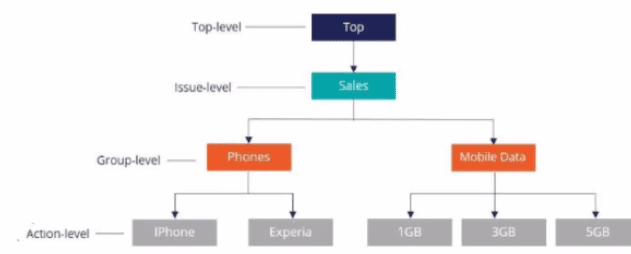
MyCo, a mobile company, uses Pega Customer Decision Hub to display offers to customers on its website. The company wants to present more relevant offers to customers based on customer behavior. The following diagram is the action hierarchy in the Next-Best-Action Designer.

The company wants to present offers from both the groups and arbitrate across the two groups to select the best offer based on customer behavior.

As a decisioning architect, what must you do to present offers from the two groups?

Correct Answer: B. Map a real-time container to the Top-level or Issue-level.
Explanation:

To present offers from the two groups, you must map a real-time container to the Top-level or Issue-level. A real-time container is a configuration that defines how to deliver offers and treatments to a specific channel, such as a website or a mobile app. By mapping a real-time container to the Top-level or Issue-level, you can enable all the offers under that level to be available for delivery through that channel. Verified Reference:Pega Academy - Decisioning Consultant - Configuring real-time containers


Question 9

U+ Bank uses a scorecard rule in a decision strategy to compute the mortgage limit for a customer. U+ Bank updated their scorecard to include a new property in the calculation: customer income.

What changes do you need to make in the decision strategy for the updated scorecard to take effect?

Correct Answer: C. The score calculation is independent of the strategy and no change is required.
Explanation:

The score calculation is independent of the strategy and no change is required. When you use a scorecard component in a decision strategy, you only need to specify the name of the scorecard rule and the output property that will store the score value. The scorecard rule itself defines how the score is calculated based on the input properties and factors. Therefore, if you update the scorecard rule to include a new property in the calculation, you do not need to make any changes in the decision strategy for the updated scorecard to take effect. Verified Reference: [Pega Academy - Decisioning Consultant - Using scorecards]


Question 10

U+ Bank wants to offer credit cards only to low-risk customers. The customers are divided into various risk segments from Good to Very Poor. The risk segmentation rules that the business provides use the Average Balance and the customer Credit Score.

As a decisioning architect, you decide to use a decision table and a decision strategy to accomplish this requirement in Pega Customer Decision Hub.

Using the decision table, which label is returned for a customer with a credit score of 240 and an average balance 35000?

Correct Answer: D. Poor
Explanation:

Using the decision table, you can find the label for a customer with a credit score of 240 and an average balance of 35000 by following these steps:

Start from the top row and check if the customer's credit score is less than 150. If yes, then the label is Very Poor. If no, then move to the next row.

Check if the customer's credit score is less than 175 and their average balance is less than 25000. If yes, then the label is Poor. If no, then move to the next row.

Check if the customer's credit score is less than 200 and their average balance is less than 50000. If yes, then the label is Fair. If no, then move to the next row.

Check if the customer's credit score is less than 250 and their average balance is less than 75000. If yes, then the label is Good. If no, then move to the last row.

The last row applies to all other cases that do not match any of the previous conditions. The label for this row is Very Poor.

In this case, the customer's credit score is not less than 150, so the first row does not apply. The customer's credit score is less than 175, but their average balance is not less than 25000, so the second row does not apply either. The customer's credit score is not less than 200, so the third row does not apply. The customer's credit score is less than 250 and their average balance is less than 75000, so the fourth row applies. Therefore, the label for this customer is Poor.