Free Pegasystems Certified Pega System Architect 23 PEGACPSA23V1 Exam Questions
Page: 1 / 18Total 256 questions
Want more questions? Get Premium Access.
Question 1
In a Credit Card Payment case type, you want to set the yearly fee to USD 75. How do you set the Yearly fee field?
Correct Answer:C. In the Data initialization page, set the Yearly fee field to 75.
Explanation:
To set a fixed yearly fee of USD 75 in a Credit Card Payment case type, the most straightforward and appropriate method is to use a data initialization configuration where the Yearly fee field is set to 75. This approach involves configuring the data model or the default value setting within the case type or relevant data transform to initialize the Yearly fee field at case creation. This ensures that the field is consistently set to the correct amount across all cases without requiring calculations or validations that are meant for data integrity or conditional logic.
Question 2
A door manufacturer offers a finite list of colors on all its doors. As part of the order, customers can select the color of the door. Select the data page definition configuration settings to source a color drop-down list to minimize memory usage.
Object Type ACME-Products-Data-Color or ACME-Products-Work-Color or ACME-Products-Work-ColorFeedback
Edit Mode Readonly Or Editable Or Savable Scope Thread Or Requestor Or Node
In Pega, when configuring data pages to source UI controls such as drop-down lists, it's crucial to select the configuration that optimally uses memory and efficiently serves the data to the users. For this scenario, the correct answer is Option F: List, ACME-Products-Data-Color, ReadOnly, Node.
List vs. Page: Choosing 'List' is appropriate because the requirement is to populate a drop-down list with multiple entries (colors in this case). 'Page' would be used for single record data, which is not the case here.
Object Type: 'ACME-Products-Data-Color' is chosen because the data represents a list of color options provided by the manufacturer, which is typically static reference data, fitting the 'Data' class layer rather than the 'Work' layer which is used for case management or the 'Work-ColorFeedback' which would be used for storing feedback or interactions specific to colors.
Edit Mode: 'ReadOnly' is the correct mode since users are selecting a color from a pre-defined list and are not expected to edit these values directly.
Scope: 'Node' is selected to minimize memory usage. By setting the scope to 'Node', the data page is loaded once per node (server instance) and shared across all requestors (users) on that node, which is memory efficient for data that doesn't change often and is applicable across all users, such as a list of colors.
This configuration ensures that the data page is loaded efficiently in a read-only list format at the node level, reducing the overall memory footprint while making the color selections available across the application.
Question 3
A company often receives multiple IT tickets for the same issue, such as ''the office Wi-Fi is down.You configure Search duplicate cases step to identify duplicate IT tickets. What is the basic condition for the Search duplicate cases step?
Correct Answer:B. Issue type is same
Explanation:
When configuring the 'Search duplicate cases' step in a Pega application, especially for IT ticketing systems, the primary aim is to identify multiple tickets raised for the same underlying issue. The most straightforward and effective criterion for identifying duplicates in this context is the issue type, such as 'the office Wi-Fi is down.'
B . Issue type is same: This option targets the core reason behind the creation of a ticket. Since multiple individuals can report the same issue from various departments or locations, filtering by the issue type ensures that all reports concerning a single problem (e.g., Wi-Fi outage) are identified as duplicates. This approach helps in consolidating the efforts to address and resolve the issue efficiently, avoiding redundant work.
Filtering by the name of the submitter, department, or office location (Options A, C, and D) might miss duplicates reported by different users or from different areas, making 'Issue type is same' the most logical and effective criterion for identifying duplicates in IT ticketing scenarios.
Question 4
A list report includes columns for purchase requests and regional cost centers. A manager wants there report to show the total number of purchase requests for each of the regional cost centers. How do you configure the report definition?
Correct Answer:C. Summarize the purchase requests column by count.
Explanation:
For a list report that includes columns for purchase requests and regional cost centers, and with a requirement to show the total number of purchase requests for each regional cost center, the correct approach is to summarize the relevant data in a way that aligns with the manager's needs.
C . Summarize the purchase requests column by count: This configuration aggregates the purchase requests data, providing a count of purchase requests per cost center. It effectively meets the manager's requirement by offering a clear and concise summary of the total number of purchase requests for each regional cost center, facilitating easy analysis and decision-making.
Using the purchase requests column to group the cost centers (A) might organize the data differently than required, focusing on purchase requests rather than summarizing them by count for each cost center. Filtering the results to include only cost center and purchase requests (B) simplifies the report but does not aggregate the data as
Question 5
How do you propagate data to a new child case in Pega Express?
Correct Answer:D. Configure the Create Case shape to copy specified properties.
Explanation:
In Pega Express, when creating a new child case, the 'Create Case' shape in the case designer is used to configure the propagation of data from a parent case to a child case. This shape can be configured to copy specified properties to the new child case, ensuring that necessary data is automatically carried forward. This configuration is essential for maintaining data consistency and relevance across related cases, facilitating seamless case management and data integrity.
Question 6
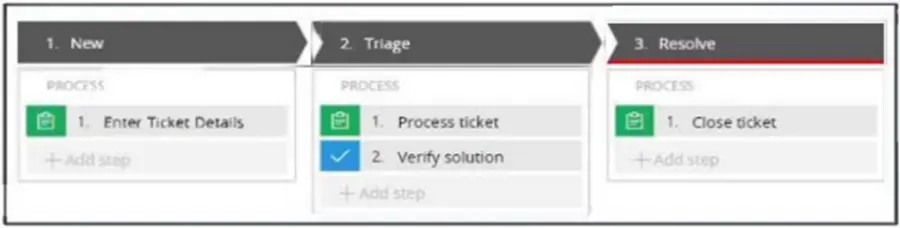
A help desk ticket case type is defined as follows:
If the Process ticket step is configured to set the status to Pending-Triage, when is the status of the case set to Pending-Triage?
Correct Answer:A. When the Process ticket step starts
Explanation:
In the context of the case life cycle displayed in the image:
A . When the Process ticket step starts. The status of the case is typically set to a new value at the beginning of a step where that status is configured. Therefore, when the Process ticket step begins, the case status would change to Pending-Triage, reflecting that the case is now in the process of being triaged. This status remains until the step is completed or until the status is explicitly changed by another step in the process.
Question 7
You configure a service level to adjust assignment urgency to 100 when the goal interval lapses. How does assignment urgency impact the deadline and passed deadline intervals?
Correct Answer:B. Urgency value continues to increment as configured.
Explanation:
When a service level's goal interval lapses and the urgency is adjusted to 100:
B . Urgency value continues to increment as configured. In Pega, urgency levels can continue to increase based on additional factors configured within the service level. This includes the urgency escalation that may occur at the deadline and passed deadline intervals. The adjustment to 100 does not cap the urgency; instead, it sets a new baseline from which further increments may occur as defined by the service level settings.
Question 8
In the first step in a case type, the user compares data on a form to the data on a customer account. If the data matches, the case is resolved. If the data does not match, the user advances the case to update the account.
Management only wants a record of the cases that update an account. What two configuration options do you use to implement this requirement ? (Choose Two)
Correct Answer:B. Configure the starting flow to instantiate the case type as a temporary case.; C. Apply a when condition to the first step to persist only cases requiring updates.
Explanation:
To meet management's requirement to only record cases that update an account, configuring the case type to start as a temporary case is essential. This configuration prevents the case from being permanently stored unless specific conditions are met. Additionally, applying a when condition after the first step to check if the case requires updating and then persisting it only if true ensures that only relevant cases are saved. This approach maximizes efficiency and data relevance by only retaining records of cases that lead to account modifications.
Question 9
As part of the case design, after someone completes a purchase, the application should send a confirmation email. How do you design the case life cycle to send the email?
Correct Answer:D. As a separate process step
Explanation:
To ensure that a confirmation email is sent after a purchase is completed within a case, incorporating this functionality directly into the case life cycle is crucial. The most straightforward and effective way to achieve this is by designing it as a distinct step in the process.
D . As a separate process step: Adding the action of sending a confirmation email as a separate process step immediately following the completion of a purchase allows for clear, logical sequencing in the case design. This approach ensures that the email is sent as an integral part of the case progression, directly linked to the purchase completion event.
Configuring it as part of the stage configuration (A) or as an alternate stage (B) might not provide the direct, immediate linkage to the purchase completion action that is necessary for timely email dispatch. Considering it as part of the general case configuration (C) is too broad and does not specify where in the case life cycle the email should be sent.
Question 10
Which device characteristics should be considered when designing a mobile app?
Correct Answer:B. Test applications in the mobile preview.; C. Design for finger taps.
Explanation:
When designing a mobile app, it's important to consider how users interact with the device and how the app will be presented across different devices:
B . Test applications in the mobile preview. Using the mobile preview feature allows designers to test how the application will look and operate on mobile devices, ensuring usability and optimal user experience.
C . Design for finger taps. Mobile interfaces should be designed for touch interaction, with controls that are sized and spaced to accommodate finger taps, which is the primary mode of interaction on mobile devices.
Question 11
An internet provider has a quiz that gives customers a recommended internet speed based on their typical internet use. The questions differ based on the selections that the customer makes, for example, whether they are seeking a recommendation for a residence or a business.
Once the customer completes the quiz, how do you determine the recommended internet speed?
Correct Answer:A. Configure a decision table
Explanation:
For an internet provider's quiz designed to recommend internet speeds based on varying customer usage profiles, including differentiating between residential and business needs, employing a decision mechanism that efficiently handles multiple input factors is key.
A . Configure a decision table: Decision tables are ideal for scenarios where the output (recommended internet speed) depends on multiple conditions (quiz answers about internet use). They offer a clear, concise way to map various combinations of inputs to their corresponding outputs, making it easy to update and manage as new conditions or outcomes are introduced. This configuration supports dynamic and nuanced decision-making based on customer responses.
Configuring a view with quiz questions (B) is necessary for collecting inputs but does not determine the outcome. A decision tree (C) could also be used but might become complex with multiple branching conditions. A process with multiple decision shapes (D) could handle the logic but may be less efficient and harder to maintain than a decision table.
Question 12
In a purchase request case type, you have the following requirement: Purchase requests should automatically go to a manager of an employee.
To meet this requirement, you design a case with a_________
Correct Answer:A. step that routes to the manager
Explanation:
For a purchase request case type where requests should automatically go to a manager of an employee, the most straightforward configuration is to design a step within the case lifecycle that specifically routes the case to the manager. This routing logic ensures that once an employee submits a purchase request, it is automatically forwarded to their manager for approval, streamlining the workflow and enforcing organizational approval hierarchies.
Question 13
A requirement states: The date of birth submitted for first grade students must be at least five years before September 1 of the current year.
Which three validation methods, when applied in combination, satisfy the requirement? (Choose Three)
Correct Answer:A. When rule; D. Validation rule; E. Edit validate rule
Explanation:
To ensure that the date of birth submitted for first-grade students meets the requirement of being at least five years before September 1 of the current year, a combination of validation methods is necessary for comprehensive and effective validation.
A . When rule: Can be used to determine if the provided date of birth satisfies the age condition relative to September 1 of the current year, serving as a condition in process flows or UI elements.
D . Validation rule: Enables the definition of broader validation criteria that can encompass complex logic, including checking the student's age based on their date of birth in relation to a specific cutoff date.
E . Edit validate rule: Provides a mechanism for implementing pattern-based validations or more intricate checks, including verifying that a date of birth makes a student eligible for first grade based on age.
Calendar control (B) facilitates user input but does not enforce the specific age requirement on its own. Using the Date data type (C) ensures the field accepts dates, but without additional validation logic, it doesn't guarantee compliance with the age requirement.
Question 14
You are testing an airline reservation case type that does not yet have a UI configured. You need to verify that changing the Purchase Insurance field in the Clipboard updates the TotalCost field.
In which category of the Clipboard tools would you expect to find the Purchase Insurance field?
Correct Answer:B. User Pages
Explanation:
To locate the 'Purchase Insurance' field used in testing the calculation of the 'TotalCost' field without a configured UI:
B . User Pages. In the Clipboard, User Pages typically hold data related to the current user session and case processing, including fields like 'Purchase Insurance' which are manipulated during a case session and influence other data calculations in the case, such as 'TotalCost'.
Question 15
An order fulfillment case type allows a customer to update user profile information during the order placement stage. The user profile consists of the following three pages:
Account ID and password Customer contact information A list of open orders with the status of each order.
How do you configure the case type to allow customers to update any of the user profile pages at any time during case processing?
Correct Answer:D. Add a set of optional actions to the case workflow
Explanation:
To enable customers to update any of the user profile pages (Account ID and password, Customer contact information, A list of open orders with the status of each order) at any time during case processing in an order fulfillment case type, flexibility and accessibility are key.
D . Add a set of optional actions to the case workflow: Optional actions provide a mechanism for incorporating activities that can be initiated by the user at their discretion, outside the primary progression of the case. By defining optional actions for updating each area of the user profile, customers are afforded the flexibility to make updates whenever necessary throughout the case lifecycle, without being constrained to specific stages or assignments.
Adding an optional process (A) could introduce the functionality but might be less direct than optional actions for specific updates. Adding a button for each profile page to each assignment (B) might unnecessarily complicate each assignment's UI. An alternate stage (C) typically represents a divergent path in the case lifecycle for handling exceptions or additional processes and might not provide the anytime accessibility characteristic of optional actions.