
Limited-Time Offer: Enjoy 50% Savings! Ends in 00h 00m 00s Coupon code: 50OFF
Skip to content

Free PMI Scheduling Professional PMI-SP Exam Questions

Page: 1 / 22 Total 326 questions

Want more questions? Get Premium Access.

Question 1

Which one of the following estimate types is a form of expert judgment?

Correct Answer: B. Analogous estimate
Explanation:

An analogous estimate is a form of expert judgment because it relies on historical information. The historical information, assuming that it is accurate, serves as the conduit to the expert that created the historical information. Answer option C is incorrect. A bottom-up estimate creates an activity duration estimate for each work package in the WBS. Answer option A is incorrect. Parametric estimating uses a parameter, such as 10 hours per fixture installation, as a base to predict the duration of the project. Answer option D is incorrect. A definitive estimate, also known as a bottom- up estimate, accounts for the cost of each work package.
Question 2

You are the project manager of the HGH Project. Thomas, your project sponsor, asked you to submit

status reports every week, but now he wants you to submit the status reports every other week.

What project management plan would you need to update to reflect this change

from Thomas?

Correct Answer: C. Communications management plan
Explanation:

The communications management plan needs to be updated whenever there is a

change in the frequency, type, or audience of

communication.

The communication management plan is a document that contains information that is required by

the stakeholders. It also documents when

and how the information should be distributed. It describes the information delivery needs, its

format and level of detail. The communication

management plan is contained in or is a subsidiary of the project management plan.

Answer option D is incorrect. The project management plan is a collection of subsidiary plans,

including the communications management plan.

Answer option A is incorrect. The scope of the project is not being changed in this example, so there

is no need to update the plan.

Answer option B is incorrect. There is no plan by the name of performance management plan, so this

choice is incorrect.


Question 3

You are the project manager of the HQQ Project. Your project is running late by ten percent of where you should be at this time. Management is concerned and they'd like to know what is your schedule performance index. Considering that the project has a BAC of $567,899, you are thirty percent complete, and you have spent $179,450, what is the SPI for this project?

Correct Answer: B. 0.75
Explanation:

The schedule performance index is found by dividing the earned value by the planned value. In this

instance, the planned value is ten percent more than where the project is forty percent of the

budget at completion.

Schedule performance index (SPI) is the measure of schedule efficiency on a project. It is used in

trend analysis to predict future performance.

SPI is the ratio of earned value to planned value. The SPI is calculated based on the following

formula:

SPI = Earned Value (EV) / Planned Value (PV)

If the SPI value is greater than 1, it indicates better than expected performance, whereas if the value

is less than 1, it shows poor

performance. The SPI value of 1 indicates that the project is right on target.

Answer option C is incorrect. 0.95 is the project's cost performance index.

Answer options A and D are incorrect. An index is a decimal value.


Question 4

Beth is the project manager of the KJH project. Sarah is Beth's administrative assistant and Ben is the project team leader. Beth's project has eight virtual teams throughout the world that will be working on the activities relevant to the deliverables in their locales. Thomas, the project sponsor, has told Beth that he is to be kept abreast of all communication between her project and the stakeholders. In this project, who is the lead person responsible for communication with all stakeholders?

Correct Answer: D. Beth
Explanation:

Beth, the project manager, is responsible for communication with all stakeholders. According to the

PMBOK, the project manager occupies the

center of the interactions between stakeholders and the project itself.

Answer option B is incorrect. Sarah may help with the communications, but she is not responsible

for the communications.

Answer option A is incorrect. Thomas, the project sponsor, just needs to be kept abreast of the

information.

Answer option C is incorrect. The project team leaders for the virtual sites are not responsible for

communicating with the project

stakeholders.


Question 5

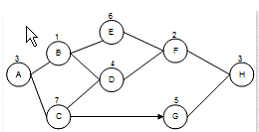
You are project manager of HHK project. Examine the network diagram given below:

A vendor reports that he will be four days late on the materials you'll need in order to complete Activity E. Based on the project network diagram, how many days can Activity E be delayed?

Correct Answer: A. Four days
Explanation:

Activity E has four days of float. The entire project will take 19 days to complete. Float,

also called slack, is the amount of time an activity can

be delayed without affecting any subsequent activities. There are two types of floats available:

Free Float: It is the amount of time a schedule activity can be delayed without delaying the early

start date of any immediately

following schedule activities.

Total Float: It is the total amount of time that a schedule activity may be delayed from its early start

date without delaying the project

finish date, or violating schedule constraint.

Float is calculated by using the critical path method technique.

Answer option D is incorrect. Activity E is not on the critical path.

Answer options C and B are incorrect. These are incorrect calculations of the amount float available

for Activity E.


Question 6

You are the project manager of the NHGQ project for your company. You must create and distribute performance reports every week to your key project stakeholders. What communication technique do you normally use to distribute reports?

Correct Answer: A. Push technique
Explanation:

Performance reports are distributed through the push technique. This means that the project manager distributes the reports regularly through a mechanism, such as email. Answer option C is incorrect. One-to-one technique describes a conversation between two people. Answer option B is incorrect. Many-to-many technique describes a conversation between many people. Answer option D is incorrect. A pull technique describes the recipients of the report 'pulling' the information, such as from a Website.


Question 7

Which of the following provides a method to track project progress during project execution against what was planned?

Correct Answer: C. Schedule baseline
Explanation:

A schedule baseline provides a method to track project progress during project

execution against what was planned.

What is schedule baseline?

Schedule baseline is a project schedule used in measuring project progress. It helps provide a

comparison with the actual

progress of work against the schedule and to determine if performance to date is within acceptable

parameters. Any

change caused by change in scope of the project invalidates the original schedule and requires a new

baseline schedule.

Answer options D, A, and B are incorrect. A detailed project budget, team members profile, and

benefit-cost ratio will not help you track

project progress.

What is BCR?

A benefit-cost ratio (BCR) is an indicator, used in the formal discipline of cost-benefit analysis, that

attempts to summarize

the overall value for money of a project or proposal. A BCR is the ratio of the benefits of a project or

proposal, expressed in

monetary terms, relative to its costs, also expressed in monetary terms. All benefits and costs should

be expressed in

discounted present values. For e.g., a BCR of $3.8 indicates a payback of $3.8 for each dollar

expended.


Question 8

John works as a project manager for BlueWell Inc. He is working on a high-profile project with 80 stakeholders and he needs to express to his project team and to the management the importance of communication in the project. He would like to show the number of stakeholder communication channels in the project. Based on this information how many communication channels exist within this project?

Correct Answer: D. 3160
Explanation:

Communication channels are paths of communication with stakeholders in a project. The number of communication channels shows the complexity of a project's communication and can be derived through the formula shown below: Total Number of Communication Channels = n (n-1)/2 where, n is the number of stakeholders. Hence, a project having five stakeholders will have ten communication channels. Putting the number of stakeholders in the formula we can get the required communication channel for the project. It is (80 x 79)/2 for 3,160 communication channels.


Question 9

There are seven inputs to the estimate activity durations process. Which one of the following is NOT an input to this process?

Correct Answer: A. Scope baseline
Explanation:

The scope baseline is not an input to the estimate activity durations process. The

project's scope statement is an input, but according to the

PMBOK, the scope baseline is not. The seven inputs to this process are: activity list, activity

attributes, activity resource requirements,

resource calendars, project scope statement, enterprise environmental factors, and organizational

process assets.

Answer options C, B, and D are incorrect. These all are an input to the estimate activity durations

process.


Question 10

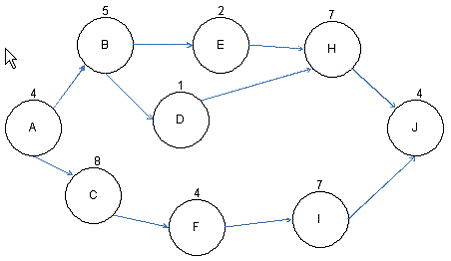
You are the project manager of the NHQ Project. You have created the project network diagram as shown in the figure:

Based on the project network diagram, how much float is available for Activity H if Activity B is delayed by four days and Activity D is delayed by two days?

Correct Answer: D. Zero
Explanation:

The path of ABDHJ will take 21 days to complete and cannot exceed 27 days or else the project will

be late. If Activity B takes four additional

days and Activity D takes two additional days, this adds (4+2= 6) six days to the path, bringing the

path's duration to exactly (21+6 = 27)

twenty seven days. There is no available float left for Activity E or H.

Float or total float (TF) is the total amount of time that a schedule activity may be delayed from its

early start date without delaying the

project finish date, or violating a schedule constraint. It is calculated by using the critical path

method technique and determining the

difference between the early finish dates and late finish dates.

Answer options A, C, and B are incorrect. There is no float available because the path's duration has

increased to 27 days.


Question 11

You are the project manager of a research project. Because much of the project work will be based on what is discovered in each stage of the project work, you are directing the project time to focus on creating time estimates for the most imminent research work and broad estimates for the project work that is coming later in the project. What type of planning are you using in this project?

Correct Answer: B. Rolling wave planning
Explanation:

This is an example of rolling wave planning. Rolling wave planning focuses on the most imminent

work in detail and creates estimates for the

whole project and later work in broad estimates. Rolling wave planning is a form of progressive

elaboration.

Rolling wave planning is a technique for performing progressive elaboration planning where the

work to be accomplished in the near future is

planned in detail at a low level of the work breakdown structure. The work to be performed within

another one or two reporting periods in the

near future is planned in detail as work is being completed during the current period.

Answer option D is incorrect. Decomposition describes the breakdown of the project scope into

work packages, and then the work packages

are broken down into project activities.

Answer option C is incorrect. Phase gates describe the review process associated with the end of

project phases.

Answer option A is incorrect. Milestone planning defines the project milestones, not the activities

required to reach the milestones.


Question 12

John is the project manager for his organization. Management has asked John to fast track his project in order to reach a particular date for the project completion. When John fast tracks the project what project management component must be updated to reflect this decision? Choose the best answer.

Correct Answer: D. Risk register
Explanation:

Fast tracking allows phases of the project to overlap and increases risk for the project. When new

risks are introduced into the project they

should be recorded in the risk register.

Risk register is a document that contains the results of the qualitative risk analysis, quantitative risk

analysis, and risk response planning.

Description, category, cause, probability of occurring, impact on objectives, proposed responses,

owner, and the current status of all identified

risks are put in the risk register.

Answer option B is incorrect. The costs do not change because of the new fast tracking requirement.

Answer option C is incorrect. Resource calendars show the availability of project resources.

Answer option A is incorrect. Organizational process assets are updated as a result of updating the

risk register when you consider that the

risk register will become part of the organizational process assets. However, this is not the best

answer for this question.


Question 13

You are the project manager for your organization. You are working with your virtual team to create activity duration estimates for your current project. This virtual team is comprised of team members from around the world. Much of this process will be completed by geographical locations though some conferences will require all the team members to participate and to coordinate the activities that will interact between the different sites. The project manager must consider all of the following when creating the activity duration estimates except for which one?

Correct Answer: B. Critical path
Explanation:

When it comes to creating the project's activity duration estimating, the critical path is

not yet a concern. The critical path will be determined

by the duration of the project activities and the sequencing of the project events.

A critical path is the sequence of project activities, which add up to the longest overall duration. This

determines the shortest time possible to

complete the project. Any delay of an activity on the critical path directly impacts the planned

project completion date (i.e. there is no float on

the critical path). A project can have several, parallel, near critical paths. An additional parallel path

through the network with the total

durations shorter than the critical path is called a sub-critical or non-critical path.

These results allow managers to prioritize activities for the effective management of project

completion, and to shorten the planned critical

path of a project by pruning critical path activities, by 'fast tracking' (i.e., performing more activities

in parallel), and/or by 'crashing the critical

path' (i.e., shortening the durations of critical path activities by adding resources).

Answer option C is incorrect. The resource calendar must be considered for the availability of the

project resource.

Answer option A is incorrect. The project calendar must be considered to determine when the

project work is allowed to take place in the

different sites.

Answer option D is incorrect. Time zone differences must be considered for communication

demands and coordination of events between the

geographical sites.


Question 14

John is the project manager for his organization. He has created a status dashboard for his stakeholders. What is a status dashboard?

Correct Answer: D. It is a report that reflects the overall performance of scope, schedule, quality, cost, or other project performance metrics.
Explanation:

Of all the choices, the best explanation is that a dashboard is a report for quick review of the project's performance metrics. While there are some software solutions, they still focus on the key performance criteria of the project. Answer option C is incorrect. This answer defines the definition of quality control, not the dashboard's review of project performance. Answer option B is incorrect. Dashboards focus on the performance of the project's key performance factors, not the project manager. Answer option A is incorrect. A status report could include the details of the project's risks and issues, but usually not the dashboard.


Question 15

You are the project manager for your organization. You want to record some details about the work that the project team has to complete. You want to document the level of effort, where the work is to be performed, and the person who will be responsible for completing the work. Which of the following is the best place to document this information?

Correct Answer: A. Activity attributes
Explanation:

The activity attributes initially include the Activity ID, WBS ID, and the Activity Name,

but it can evolve over time to include other components

about the work.

Activity attributes are an output of the Define Activity process. These attributes refer to the multiple

components that frame up an activity. The

components for each activity during the early stages of the project are the Activity ID, WBS ID, and

Activity name. At the later stages, the

activity attributes include Activity codes, Predecessor activity, activity description, logical

relationship, successor activity, leads and lags,

imposed dates, and constraints and assumptions. Activity attributes are used for schedule

development and for ordering, selecting, and

sorting the planned schedule activities in a number of ways within reports.

Answer option B is incorrect. A project management plan is a formal document that defines how the

project is being monitored, controlled, and

executed. It is not the best answer.

Answer option D is incorrect. The roles and responsibilities matrix records the work and the person

to record the work, but does not offer

additional information such as locale for the work, level of effort, and other information.

Answer option C is incorrect. The Schedule Management Plan defines how the schedule will be

created, executed, and controlled.