Limited-Time Offer: Enjoy 50% Savings! Ends in 00h 00m 00s Coupon code: 50OFF
Skip to content

Free Salesforce Marketing Cloud Intelligence Accredited Professional Marketing-Cloud-Intelligence Exam Questions

Page: 1 / 7 Total 63 questions

Want more questions? Get Premium Access.

Question 1

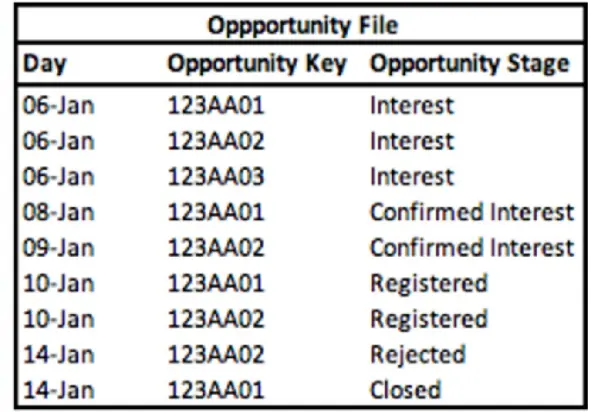
A technical architect is provided with the logic and Opportunity file shown below:

The opportunity status logic is as follows:

For the opportunity stages ''Interest'', ''Confirmed Interest'' and ''Registered'', the status should be ''Open''.

For the opportunity stage ''Closed'', the opportunity status should be closed

Otherwise, return null for the opportunity status
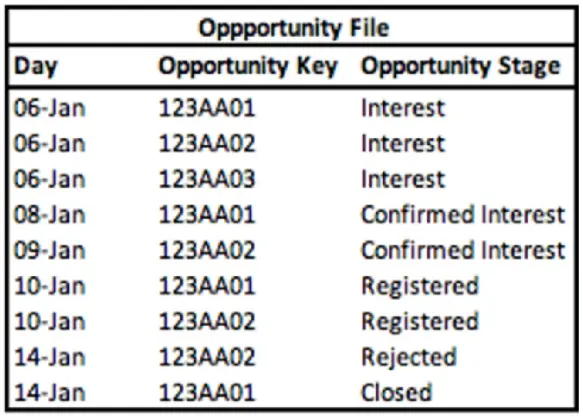
Given the above file and logic and assuming that the file is mapped in a GENERIC data stream type with the following mapping:

''Day'' --- Standard ''Day'' field

''Opportunity Key'' > Main Generic Entity Key

''Opportunity Stage'' --- Main Generic Entity Attribute

''Opportunity Count'' --- Generic Custom Metric

A pivot table was created to present the count of opportunities in each stage. The pivot table is filtered on Jan 11th. What is the number of opportunities in the Interest stage?

Correct Answer: D. 0
Explanation:

Since the pivot table is filtered on January 11th and the provided Opportunity file does not show any records dated January 11th, there are zero opportunities in the Interest stage for that date. Salesforce Marketing Cloud Intelligence allows users to create pivot tables and filter data based on specific criteria, such as dates. In this case, the filter would exclude all rows that do not match the specified date, resulting in a count of zero for the Interest stage. This would apply to any stage since there are no records for January 11th. Reference can be made to Salesforce Marketing Cloud Intelligence documentation on filtering and pivot tables.

Question 2

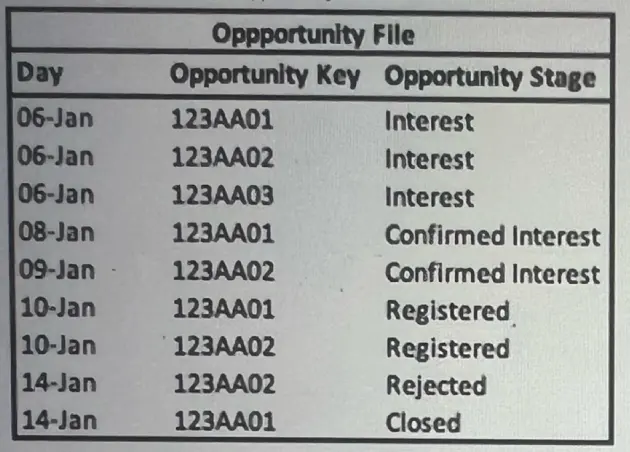
A technical architect is provided with the logic and Opportunity file shown below:

The opportunity status logic is as follows:

For the opportunity stages ''Interest'', ''Confirmed Interest'' and ''Registered'', the status should be ''Open''.

For the opportunity stage ''Closed'', the opportunity status should be closed.

Otherwise, return null for the opportunity status.

Given the above file and logic and assuming that the file is mapped in a GENERIC data stream type with the following mapping:

''Day'' --- Standard ''Day'' field

''Opportunity Key'' > Main Generic Entity Key

''Opportunity Stage'' --- Generic Entity key 2

A pivot table was created to present the count of opportunities in each stage. The pivot table is filtered on Jan 7th -11th.Which option reflects the stage(s) the opportunity key 123AA01 is associated with?

Correct Answer: A. Interest & Registered
Explanation:

Filtering the pivot table on January 7th-11th, we see that the Opportunity Key 123AA01 appears on January 6th with the stage 'Interest' and then on January 10th with the stage 'Registered'. Even though the 'Interest' stage is not within the filtered dates, it is the initial stage of the opportunity, so it should be counted along with the 'Registered' stage which falls within the filter range.


Question 3

A client has provided you with sample files of their data from the following data sources:

1.Google Analytics

2.Salesforce Marketing Cloud

The link between these sources is on the following two fields:

Message Send Key

A portion of: web_site_source_key

Below is the logic the client would like to have implemented in Datorama:

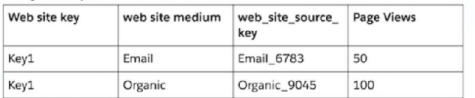
For 'web site medium' values containing the word ''email'' (in all of its forms), the section after the ''_'' delimiter in 'web_site_source_key' is a 4 digit

number, which matches the 'Message Send Key' values from the Salesforce Marketing Cloud file. Possible examples of this can be seen in the

following table:

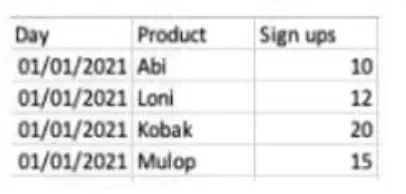
Google Analytics:

Salesforce Marketing Cloud:

The client's objective is to visualize the mutual key values alongside measurements from both files in a table.

In order to achieve this, what steps should be taken?

Correct Answer: A. Within both files, map the desired value to Custom Classification Key as follows Salesforce Marketing Cloud: map entire Message Key to Custom Classification Key. Google Analytics: map the extraction logic to Custom Classification Key.
Explanation:

To create a linkage between Google Analytics and Salesforce Marketing Cloud data based on the 'Message Send Key' and a portion of the 'web_site_source_key,' both values need to be harmonized into a common key. This is done by mapping the full Message Send Key from Salesforce Marketing Cloud and the extracted part of the web_site_source_key from Google Analytics to the same Custom Classification Key. This mapping will create a common identifier that can be used to combine the data from both sources for analysis and visualization.


Question 4

Which option will yield the desired result:?

Correct Answer: B. Option 4
Explanation:

Option 4 presents two calculated measurements for 'Group Min Cost' with 'MIN' and 'AVG' aggregations. This approach aligns with the client's need for the minimum and average media cost values. 'Group Min Cost 4 MIN' will calculate the minimum media cost across the 'Media Buy Key', while 'Group Min Cost 4 FINAL' will average these minimum costs at the 'Campaign Key' level. This will yield the desired result where minimum costs are calculated at the Media Buy Key level and then averaged at the Campaign Key level.


Question 5

What are unstable measurements?

Correct Answer: C. Measurements for which Aggregation Settings are set as 'Not Auto' and Granularity is set as 'None'.
Explanation:

Unstable measurements refer to metrics that are not aggregated in a standard manner across different grains of data, which can result in inconsistent or unpredictable results when reporting across different dimensions or time frames.

Option C describes a scenario where measurements have manual (Not Auto) aggregation settings, meaning they do not automatically adjust to the aggregation level of the report. Combined with a Granularity setting of 'None', this can lead to instability because the metric isn't bound to a specific granularity, which can cause data inconsistencies or misinterpretations when analyzed at varying levels of detail.


Question 6

An implementation engineer is requested to apply the following logic:

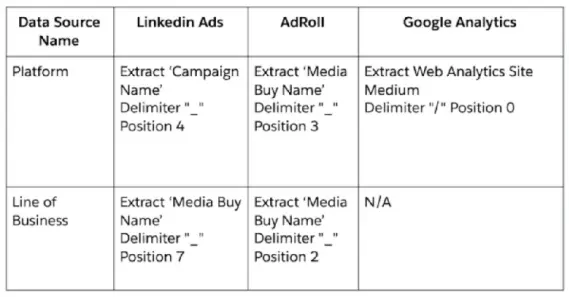
To apply the above logic, the engineer used only the Harmonization Center, without any mapping manipulations. What is the minimum amount of Patterns creating both 'Platform' and 'Line of Business'?"

Correct Answer: B. 3
Explanation:

To create both 'Platform' and 'Line of Business' fields using Patterns in the Harmonization Center without mapping manipulations, the engineer would need to create separate patterns for each data source mentioned. According to the provided images:

One pattern for LinkedIn Ads, to extract the 'Campaign Name' at position 4 for the Platform and 'Media Buy Name' at position 7 for Line of Business.

One pattern for AdRoll, to extract 'Media Buy Name' at position 3 for Platform and at position 2 for Line of Business.

One pattern for Google Analytics, which seems not required for the Platform but could apply if the Line of Business extraction is necessary, although it states N/A.

Hence, a minimum of 3 patterns would be necessary to create the fields required.


Question 7

An implementation engineer has been asked to perform QA for a standard file ingestion, done by the client.

The source file that was ingested can be seen below:

The number of rows added to this data stream is 3. What could have led to this discrepancy?

Correct Answer: D. All fields are mapped except for the Campaign Key
Explanation:

The source file shows data related to media buys, including a 'Media Buy Key', 'Media Buy Name', 'Campaign Key', and 'Site Key', among other fields. If only three rows were added, and the discrepancy is due to a missing field, it's likely that 'Campaign Key' is the field not mapped, because it is crucial for linking related records in the data stream. Without the 'Campaign Key', the system cannot associate the media buy data with specific campaigns, leading to a potential loss of data rows during ingestion.


Question 8

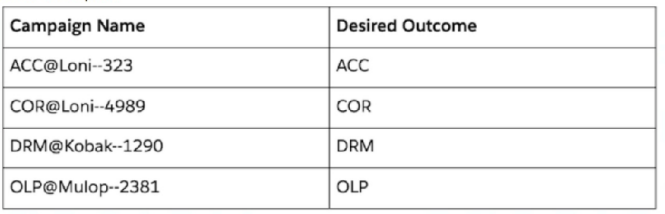
An implementation engineer is requested to extract the first three-letter segment of the Campaign Name values.

For example:

Campaign Name: AFD@Mulop-1290

Desired outcome: AFD

Other examples:

Which formula will return the desired values?

Correct Answer: B. EXTRACT(csv[campaign_name!;@',1)
Explanation:

The EXTRACT function is used to split a string based on a delimiter and return the segment at the specified position. The campaign names are structured with the segment of interest followed by an '@' sign. Therefore, the formula needs to extract the segment before the '@'.

The correct formula is: EXTRACT(csv['campaign_name']; '@', 1). This will take the 'campaign_name' field, split it at the '@' sign, and return the first segment (position 1), which is the three-letter code that is required. The other options are incorrect because they do not properly specify the delimiter and the segment position in the way needed to achieve the desired outcome.


Question 9

Source 3:

Via the harmonization Center, the Client has created Patterns and applied a classification rule using source 2.

While performing QA, you have spotted that the final value of clicks for Product Group Ais 10, where it should've been i5.

How can an implementation engineer fix this discrepancy?

Correct Answer: A. Uncheck the 'Case Sensitive'' checkbox in the data classification
Explanation:

Case Sensitivity Issue:

The discrepancy in the 'Clicks' value for Product Group A (10 instead of 15) likely arises from a mismatch caused by case sensitivity in the classification rules. If some data entries use different capitalization (e.g., 'Product Group A' vs. 'product group a'), the system might treat them as distinct entries, leading to incorrect aggregations.

Solution:

By unchecking the 'Case Sensitive' checkbox, the harmonization process will treat entries with different capitalization as the same value. This ensures consistent classification and resolves discrepancies in aggregated metrics like 'Clicks.'


Question 10

A technical architect is provided with the logic and Opportunity file shown below:

The opportunity status logic is as follows:

For the opportunity stages ''Interest'', ''Confirmed Interest'' and ''Registered'', the status should be ''Open''.

For the opportunity stage ''Closed'', the opportunity status should be closed Otherwise, return null for the opportunity status.

Given the above file and logic and assume that the file is mapped in the OPPORTUNITIES Data Stream type with the following mapping:

''Day'' --- ''Created Date''

''Opportunity Key'' + Opportunity Key

''Opportunity Stage'' --- Opportunity Stage

A pivot table was created to present the count of opportunities in each stage. The pivot table is filtered on Jan 11th. What is the number of 'opportunities in the Confirmed Interest stage?

Correct Answer: D. 0
Explanation:

pivot table is filtered on January 11th, we refer to the Opportunity file and see that there are no records for January 11th. Thus, there would be zero opportunities in the Confirmed Interest stage on that date. The Salesforce Marketing Cloud Intelligence's pivot table feature allows for the display of counts of entities based on the filtered criteria, which in this scenario would show zero since no records exist for the filtered date. Reference: Salesforce Marketing Cloud Intelligence documentation on pivot table functionalities.