
Limited-Time Offer: Enjoy 50% Savings! Ends in 00h 00m 00s Coupon code: 50OFF
Skip to content

Free Salesforce Certified Platform Developer Plat-Dev-201 Exam Questions

Page: 1 / 14 Total 204 questions

Want more questions? Get Premium Access.

Question 1

Given the following Anonymous block:
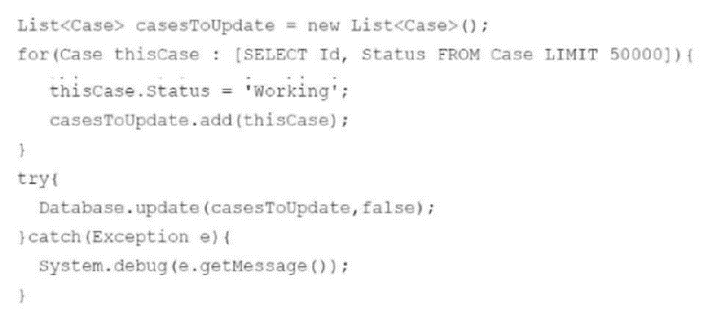
What should a developer consider for an environment that has over 10,000 Case records?
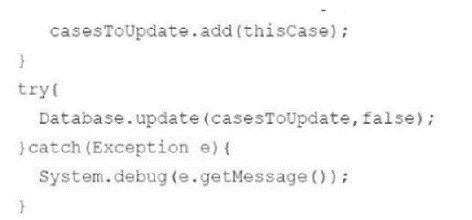
What should a developer consider for an environment that has over 10,000 Case records?

Correct Answer: C. The transaction will fail due to exceeding the governor limit.
Explanation:

The code provided processes allCaserecords in a single transaction. Since it attempts to process over 10,000 records, it exceeds the Salesforce governor limit of 50,000 DML rows per transaction, causing the transaction to fail.

Governor Limits on DML Rows (C):Salesforce enforces a governor limit of 50,000 rows for DML operations per transaction. In this case, if theSELECTquery retrieves over 50,000 records, theDatabase.updatecall will hit this limit and throw aSystem.LimitException.


Why the Try-Catch Block Fails to Handle Limits (B & D):Governor limit exceptions (System.LimitException) cannot be caught by try-catch blocks. Therefore, the exception cannot be handled, and the transaction will fail.
Question 2

Universal Containers wants to automatically assign new cases to the appropriate support representative based on the case origin. They have created a custom field on the Case object to store the support representative name.

What is the best solution to assign the case to the appropriate support representative?

Correct Answer: D. Use an Assignment Flow element.
Explanation:

A Flow with an Assignment element is the best declarative solution to assign cases based on criteria such as Case Origin. It can automatically evaluate the value of the Case Origin and assign the support representative.

Why not other options?

A: Using a trigger is a programmatic approach and less ideal when declarative tools can solve the problem.

B: A formula field cannot assign values; it only calculates and displays results.

C: Validation rules are used to enforce constraints, not for assigning values.

:

Salesforce Flows Overview


Question 3

What are three considerations when using the @lnvocableMethod annotation in Apex?

Choose 3 answers

Correct Answer: A. Only one method using the @invecableMethod annotation can be defined per Apex class_; C. A method using the @invocablemethod annotation must be declaredas static,; E. A method using the @invocableMethod annotation can be declared as Public or Global.
Explanation:

Option A: Only one method annotated with@InvocableMethodcan exist per class.

Option C: The method must bestatic.

Option E: The method can be declared asPublicorGlobalfor broader accessibility.

:Invocable Methods Documentation


Question 4

A developer is creating a Lightning web component to show a list of sales records.

The Sales Representative user should be able to see the commission field on each record. The Sales Assistant user should be able to see all fields on the record except the commission field.

How should this be enforced so that the component works for both users without showing any errors?

Correct Answer: B. Use Security.stripInaccessible Le to remove fields inaccessible to the current user.
Explanation:

UsingSecurity.stripInaccessibleensures compliance with field-level security (FLS) and prevents users from accessing fields they do not have permission to view. In this scenario:

The commission field is inaccessible to Sales Assistants, andSecurity.stripInaccessiblewill automatically remove this field from the result set.

It prevents runtime errors when a user without proper access attempts to retrieve restricted fields.


Question 5

Which two are phases in the Aura application event propagation framework?

Choose 2 answers

Correct Answer: B. default; C. Buddle
Explanation:

Event Propagation Phases in Aura Framework:

Default Phase: The framework executes handlers withevent.setDefault().

Bubble Phase: The event propagates upward from the target component to the root component.

Why Not Other Options?

A . Control: Not a valid Aura event propagation phase.

D . Emit: This is part of event creation, not propagation.


Question 6

A developer has an integer variable called maxAttempts. The developer needs to ensure that once maxAttempts is initialized, it preserves its value for the length of the Apex transaction; while being able to share the variable's state between trigger executions.

How should the developer declare maxAttempts to meet these requirements?

Correct Answer: D. Declare maxAttempts as a private static variable on a helper class.
Explanation:

To preserve the value ofmaxAttemptsfor the length of the Apex transaction and share its state between trigger executions:

Static Variable:

Static variables are initialized once per transaction and retain their value throughout the transaction.

They can be accessed without instantiating the class.

Private Scope:

Declaring it as private ensures encapsulation and prevents unintended external modification.

Helper Class:

Using a helper class ensures the separation of concerns, keeping trigger logic clean and adhering to best practices.

Example Code:public class HelperClass {

private static Integer maxAttempts = 5; // Default value

public static Integer getMaxAttempts() {

return maxAttempts;

}

public static void setMaxAttempts(Integer attempts) {

maxAttempts = attempts;

}

}

A:Constants (static + final) cannot be modified after initialization.

B:Trigger member variables cannot retain values across executions within the same transaction.

C:Declaring it as a non-static variable in a helper class would reset its value during each trigger execution.

Why Not the Other Options?


Question 7

Which Lightning Web Component custom event property settings enable the event to bubble up the containment hierarchy and cross

the Shadow DOM boundary?

Correct Answer: C. bubbles: true, composed: true
Explanation:

Why These Settings?

bubbles: true: Enables the event to propagate up the containment hierarchy.

composed: true: Allows the event to cross the Shadow DOM boundary.

Why Not Other Options?

Other combinations (e.g.,bubbles: false) prevent the event from propagating or crossing the Shadow DOM boundary.


Question 8

Universal Hiring uses Salesforce to capture job applications. A salesforce administrator created two custom objects; Job__c acting as the master object, to Application_c acting as the detail.

Within the Job__c object, a custom multi-select picklist, preferred _Locations__c, contains a list of approved states for the position. Each Job_Application__c record relates to a Contact within the system through a master-detail relationship.

Recruiters have requested the ability to view whether the Contact's Mailing State value matches a value selected on the Preferred Locations__c field, within the Job_Application__c record. Recruiters would like this value to be kept in sync if changes occur to the Contact's Mailing State.

What is the recommended tool a developer should use to meet the business requirement?

Correct Answer: C. Record-triggered flow
Explanation:

A record-triggered flow is the recommended tool for this scenario because it:

Can compare theContact.MailingStatefield with thePreferred_Locations__cfield on theJob__crecord.

Automatically updates or calculates values whenever changes are made, keeping data in sync without requiring Apex code or custom development.


Question 9

Which code statement includes an Apex method named updateAccounts in the class AccountController for use in a Lightning web component?

Correct Answer: D. import updateAccounts from '@salesforce/apex/AccountController.updateAccounts';
Explanation:

When working with a Lightning Web Component (LWC), the correct syntax for importing an Apex method is:import methodName from '@salesforce/apex/ControllerName.methodName';.

Why not other options?

A,B, andC: These use incorrect syntax for importing Apex methods in LWCs.

:

Lightning Web Components Documentation


Question 10

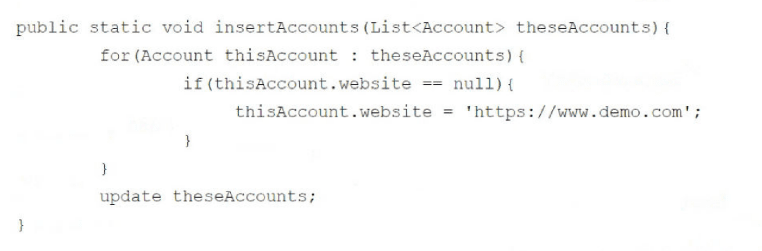
Refer to the exhibit.

When the code executes, a DML exception is thrown.

How should a developer modify the code to ensure exceptions are handled gracefully?

Correct Answer: C. Implement a try/catch block for the DML.
Explanation:

Why a try/catch block is required:

In Salesforce, DML operations such as insert, update, delete, and upsert can throw exceptions due to issues like validation rule violations, field constraints, or sharing rule restrictions.

Using a try/catch block ensures that these exceptions are caught and handled gracefully, preventing the entire transaction from failing.

How to modify the code:

The update statement in the code can be wrapped in a try/catch block to catch and handle any exceptions that occur. For example:

apex

Copy code

public static void insertAccounts(List<Account> theseAccounts) {

try {

for (Account thisAccount : theseAccounts) {

if (thisAccount.website == null) {

thisAccount.website = 'https://www.demo.com';

}

}

update theseAccounts;

} catch (DmlException e) {

System.debug('DML Exception: ' + e.getMessage());

}

}

Why not the other options?

A . Implement the upsert DML statement:

upsert is used to either insert or update records based on an external ID or primary key. It does not inherently handle exceptions.

B . Implement Change Data Capture:

Change Data Capture (CDC) is used for tracking changes to data in real time and is unrelated to handling DML exceptions.

D . Remove null items from the list of Accounts:

While cleaning the input data is a good practice, it does not address the need for exception handling during DML operations.


Apex Error Handling

DML Operations in Apex

Question 11

A developer is designing a new application on the Salesforce platform and wants to ensure it can support multiple tenants effectively.

Which design framework should the developer consider to ensure scalability and maintainability?

Correct Answer: C. Model-View-Controller (MVC)
Explanation:

MVC: The Model-View-Controller design pattern is ideal for Salesforce development as it separates the business logic (model), user interface (view), and controller logic, ensuring scalability and maintainability.

Salesforce's architecture inherently supports MVC, with sObjects as the model, Visualforce or Lightning components as the view, and Apex controllers as the controller.

Why not other options?

A: The Waterfall model is a development methodology, not a design framework.

B: Flux is a front-end application architecture and not relevant to Salesforce.

D: Agile is a development methodology, not a design framework.

:

Salesforce MVC Architecture


Question 12

What is the result of the following code snippet?

public word doWork(Account acct) {

for (Integer i = 0; i <= 2007 i++) {

insert acct;

}

Correct Answer: D. 201 Accounts are inserted.
Explanation:

ThedoWorkmethod inserts an account for every iteration of theforloop, which runs fromi = 0toi <= 200, inclusive.

This results in 201 iterations, and hence 201 accounts are inserted into the org.

Explanation of Code Behavior:

The loop conditioni <= 200runs 201 times (0 to 200).

Theinsert acct;statement is executed 201 times.

:

Apex Developer Guide - Loop Constructs


Question 13

A lead developer creates a virtual class called "OrderRequest". Consider the following code snippet:

Public class CustomerOrder { //code implementation }

How can a developer use the OrderRequest class within the CustomerOrder class?

Correct Answer: C. public class CustomerOrder extends OrderRequest
Explanation:

Below is the formatted response for the provided question, adhering to the specified format and requirements. The question falls under the Developer Fundamentals topic, as it involves understanding Apex class inheritance and virtual classes, which are core concepts in the Salesforce Platform Developer I certification. The answer is based on official Salesforce Platform Developer I documentation, with a comprehensive explanation and references to relevant Salesforce documentation.


Question 14

(Full question statement)

Universal Containers wants Opportunities to no longer be editable when they reach the Closed/Wonstage.

Which two strategies can a developer use to accomplish this?

Choose 2 answers.

Correct Answer: A. Use an automatically launched Approval Process.; B. Use a Validation Rule.
Explanation:

Comprehensive and Detailed Explanation From Exact Extract:

A (Correct):AnApproval Processcan lock a record (making it read-only) once the record meets certain criteria like stage = Closed/Won.

B (Correct):AValidation Rulecan prevent users from saving changes when the stage is Closed/Won, by throwing an error.

Example validation formula:

text

CopyEdit

AND(ISCHANGED(StageName), ISPICKVAL(StageName, 'Closed Won'))

Incorrect options:

C:Before triggers run before the record is saved but don't prevent UI-level edits unless combined with DML rollbacks or errors.

D:Auto-response rules are for sending emails, not restricting edits.


This topic relates to bothProcess Automation and Logic (30%)andSecurity and Data Integritypractices.

Question 15

The sales management team at Universal Containers requires that the Lead Source field of the Lead record be populated when a Lead is converted What should be done to ensure that a user populates the Lead Source field prior to converting a Lead?

Correct Answer: B. Use Lead Conversion field mapping.
Explanation:

A validation rule can ensure that theLead Sourcefield is populated before the Lead is converted. This prevents users from proceeding unless the required data is entered.

Why not other options?

A: Triggers are programmatic, whereas a declarative solution like validation rules is simpler and more efficient.

B: Lead Conversion field mapping maps fields between Lead and Account/Contact but cannot enforce field requirements.

C: A formula field is read-only and cannot enforce user input.

:

Validation Rules Documentation