Limited-Time Offer: Enjoy 50% Savings! Ends in 00h 00m 00s Coupon code: 50OFF
Skip to content

Free Salesforce Certified MuleSoft Developer II Salesforce-MuleSoft-Developer-II Exam Questions

Page: 1 / 6 Total 60 questions

Want more questions? Get Premium Access.

Question 1

Which pattern should be used to invoke multiple HTTP APIs in parallel and roll back failed requests in sequence?

Correct Answer: C. Scatter-Gather as central Saga orchestrator for all API request with compensating actions for failing routes
Explanation:

To invoke multiple HTTP APIs in parallel and roll back failed requests in sequence, the developer should use a Scatter-Gather router as a central Saga orchestrator for all API requests with compensating actions for failing routes. A Scatter-Gather router executes multiple routes concurrently and aggregates the results. A Saga orchestrator coordinates a series of actions across different services and handles failures by executing compensating actions. Therefore, using a Scatter-Gather router as a Saga orchestrator allows invoking multiple HTTP APIs in parallel and rolling back any failed requests in sequence. Reference: https://docs.mulesoft.com/mule-runtime/4.3/scatter-gather-concept https://docs.mulesoft.com/mule-runtime/4.3/saga
Question 2

A healthcare portal needs to validate the token that it sends to a Mule API. The developer plans to implement a custom policy using the HTTP Policy Transform Extension to match the token received in the header from the heathcare portal.

Which files does the developer need to create in order to package the custom policy?

Correct Answer: D. XML template file, YAML configuration file
Explanation:

To package a custom policy using the HTTP Policy Transform Extension, the developer needs to create an XML template file and a YAML configuration file. The XML template file defines the policy logic using Mule components and placeholders for user-defined properties. The YAML configuration file defines the metadata of the policy, such as its name, description, category, parameters, and dependencies. Reference: https://docs.mulesoft.com/api-manager/2.x/http-policy-transform#packaging-the-policy


Question 3

A Mule implementation uses a HTTP Request within an Unit Successful scope to connect to an API.

How should a permanent error response like HTTP:UNAUTHORIZED be handle inside Until Successful to reduce latency?

Correct Answer: C. Put the HTTP Request inside a try scope in Unit Successful. In the error handler, use On Error Continue to catch permanent errors like HTTP UNAUTHORIZED.
Explanation:

To handle a permanent error response like HTTP:UNAUTHORIZED inside Until Successful, the developer should put the HTTP Request inside a try scope in Unit Successful, and use On Error Continue to catch permanent errors like HTTP UNAUTHORIZED in the error handler. This way, the developer can avoid retrying requests that will always fail due to a permanent error, and reduce latency. On Error Continue allows the flow to continue processing after handling the error. Reference: https://docs.mulesoft.com/mule-runtime/4.3/until-successful-scope https://docs.mulesoft.com/mule-runtime/4.3/on-error-continue-concept


Question 4

A developer deploys an API to CloudHub and applies an OAuth policy on API Manager. During testing, the API response is slow, so the developer reconfigures the API so that the out-of-the-box HTTP Caching policy is applied first, and the OAuth API policy is applied second.

What will happen when an HTTP request is received?

Correct Answer: B. In case of a cache it, only the HTTP Caching policy is evaluating; then the cached response is returned to the caller
Explanation:

When an HTTP request is received and the HTTP Caching policy is applied first, it checks if there is a cached response for that request in Object Store. If there is a cache hit, meaning that a valid cached response exists, then only the HTTP Caching policy is evaluated and the cached response is returned to the caller without invoking the OAuth policy or the API implementation. If there is a cache miss, meaning that no valid cached response exists, then both the HTTP Caching policy and the OAuth policy are evaluated before invoking the API implementation. Reference: https://docs.mulesoft.com/api-manager/2.x/http-caching-policy#policy-ordering


Question 5

Refer to the exhibit.

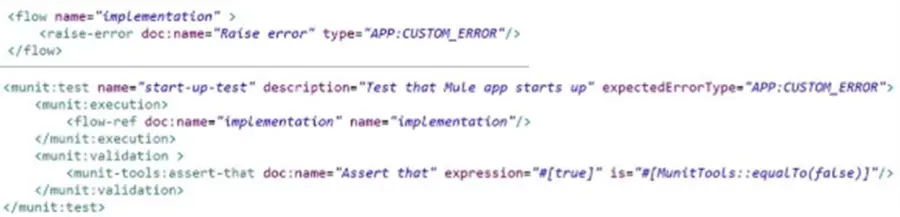
The flow name is ''implementation'' with code for the MUnit test case.

When the MUnit test case is executed, what is the expected result?

Correct Answer: A. The test case fails with an assertion error
Explanation:

Based on the code snippet and MUnit test case below, when the MUnit test case is executed, the expected result is that the test case fails with an assertion error. This is because the assert-equals processor compares two values for equality, and fails if they are not equal. In this case, the expected value is 'Hello World', but the actual value returned by the implementation flow is 'Hello Mule'. Therefore, the assertion fails and an error is thrown. Reference: https://docs.mulesoft.com/munit/2.3/assert-equals-processor


Question 6

Two APIs are deployed to a two-node on-prem cluster. Due to a requirements change, the two APIs must communicate to exchange data asynchronously.

Correct Answer: A. If the two APIs use the same domain, the VM Connector can be leveraged
Explanation:

To communicate asynchronously between two APIs deployed to a two-node on-prem cluster, the developer can use the VM Connector if the two APIs use the same domain. The VM Connector allows passing messages between different Mule applications within a single Mule runtime instance or across different instances using shared memory or persistent storage. If two APIs are deployed under the same domain, they can share resources such as VM queues and communicate asynchronously using VM Connector operations. Reference: https://docs.mulesoft.com/mule-runtime/4.3/vm-connector https://docs.mulesoft.com/mule-runtime/4.3/shared-resources


Question 7

Refer to the exhibit.

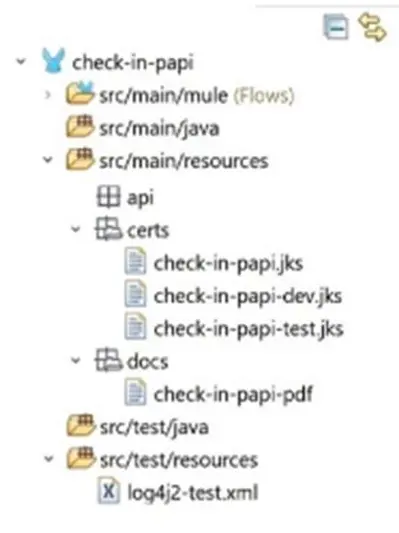
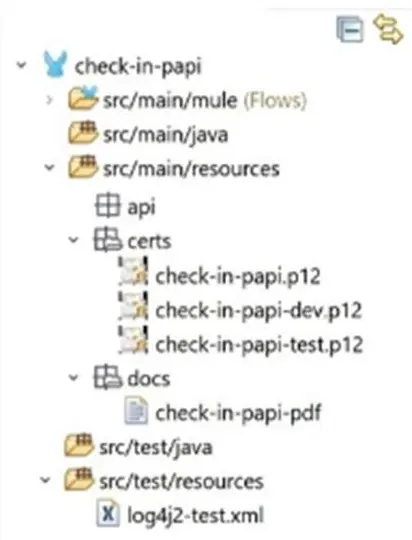
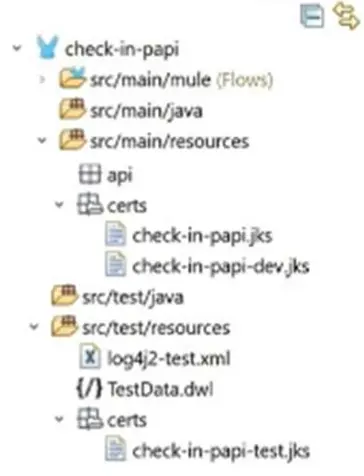
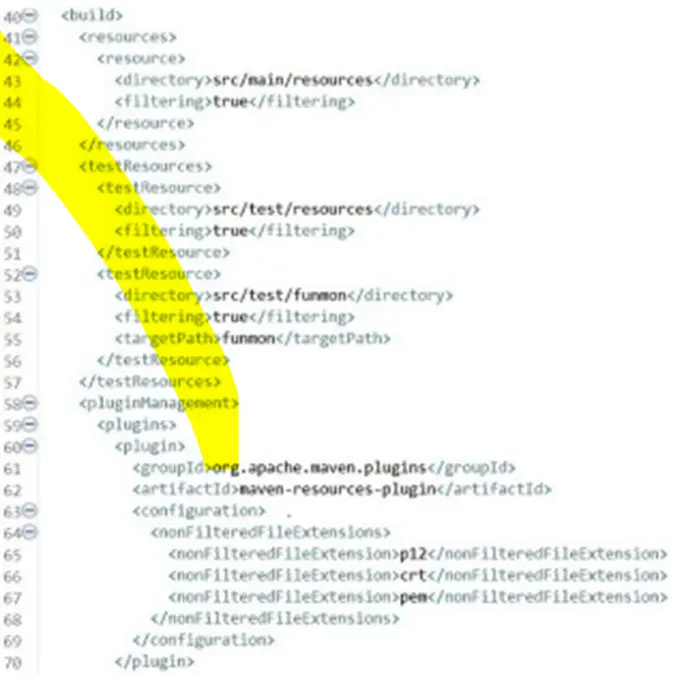
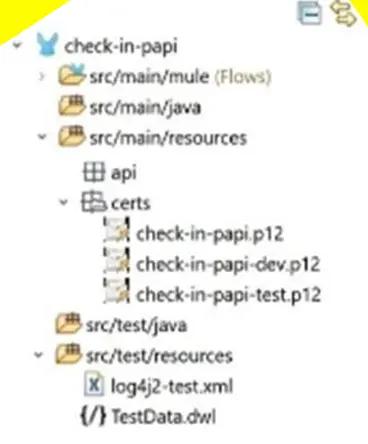
A Mule application pom.xml configures the Maven Resources plugin to exclude parsing binary files in the project's src/main/resources/certs directory.

Which configuration of this plugin achieves a successful build?

A)

B)

C)

D)

Correct Answer: C. Option C
Explanation:

To configure the Maven Resources plugin to exclude parsing binary files in the project's src/main/resources/certs directory, option C should be used. This option specifies that any files with .cer or .jks extensions under the certs directory should be excluded from filtering. Filtering is a process of replacing placeholders with actual values in resource files during the build process. Binary files should not be filtered because they may become corrupted or unusable. Reference: https://maven.apache.org/plugins/maven-resources-plugin/examples/filter.html https://maven.apache.org/plugins/maven-resources-plugin/examples/include-exclude.html


Question 8

A Mule application need to invoice an API hosted by an external system to initiate a process. The external API takes anywhere between one minute and 24 hours to compute its process.

Which implementation should be used to get response data from the external API after it completes processing?

Correct Answer: D. Expose an HTTP callback API in Mule and register it with the external system
Explanation:

To get response data from the external API after it completes processing, the developer should expose an HTTP callback API in Mule and register it with the external system. This way, the external API can invoke the callback API with the response data when it is ready, instead of making the Mule application wait for a long time or poll for a response repeatedly. Reference: https://docs.mulesoft.com/mule-runtime/4.3/http-listener-ref#callback


Question 9

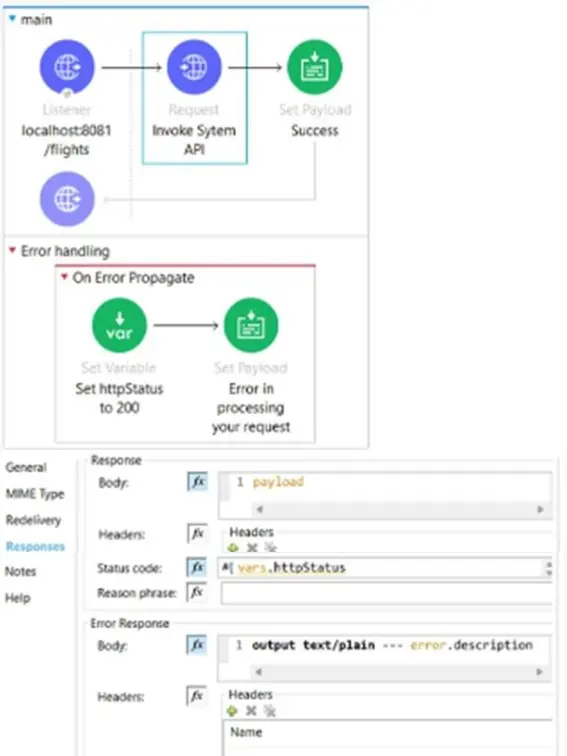
The HTTP Request operation raises an HTTP CONNECTIVITY error.

Which HTTP status code and body are returned to the web client?

Correct Answer: C. HTTP Status Code:500. Body 'Error in processing your request
Explanation:

When the HTTP Request operation raises an HTTP CONNECTIVITY error, it triggers an on-error-continue handler that sets a payload with 'Error in processing your request'. Since no status code is explicitly set in this handler, it defaults to 500 (INTERNAL SERVER ERROR). Therefore, the web client receives an HTTP response with status code 500 and body 'Error in processing your request'. Reference: https://docs.mulesoft.com/mule-runtime/4.3/error-handling#on-error-continue


Question 10

Refer to the exhibit.

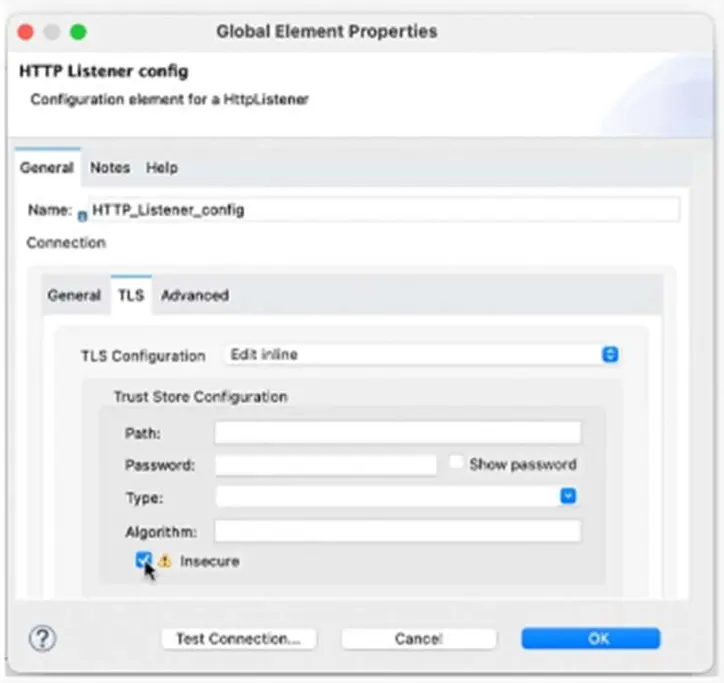
What is the result if ''Insecure'' selected as part of the HTTP Listener configuration?

Correct Answer: C. The HTTP listener will only accept HTTP requests
Explanation:

Based on the exhibit below, if 'Insecure' is selected as part of the HTTP Listener configuration, the HTTP listener will only accept HTTP requests. This means that no TLS context will be configured for this listener and no encryption or authentication will be applied to incoming requests. The protocol attribute of this listener will be set to HTTP instead of HTTPS. Reference: https://docs.mulesoft.com/http-connector/1.6/http-listener-ref#insecure