
Limited-Time Offer: Enjoy 50% Savings! Ends in 00h 00m 00s Coupon code: 50OFF
Skip to content

Free SAP Certified Professional - SAP Enterprise Architect P_SAPEA_2023 Exam Questions

Page: 1 / 8 Total 47 questions

Want more questions? Get Premium Access.

Question 1

You design a Solution Architecture, based on SAP S/4HANA, for an internationally active customer that has a national subsidiary in China and other countries that have special requirements for data storage. As the responsible Enterprise Architect, your task is to propose a solution that takes these special requirements into account. How do you proceed when your customer's Architecture Guideline calls for following a "cloud-first" approach?

Correct Answer: C. This depends on the required solution components. Public cloud solutions may not meet the necessary data protection requirements. Therefore, private cloud or on-premise options must be considered when developing the solution landscape.
Explanation:

The customer's architecture guideline calls for following a 'cloud-first' approach, but this does not mean that all solutions must be deployed in the cloud. In some cases, private cloud or on-premise options may be necessary to meet the customer's data protection requirements.

For example, if the customer's subsidiary in China requires that data be stored within China, then a private cloud solution in China may be the best option. Similarly, if the customer's other subsidiaries have different data protection requirements, then a hybrid solution that combines cloud and on-premise deployments may be necessary.

The Enterprise Architect must carefully consider the customer's specific requirements and constraints before making a decision about the deployment environment.

Here are some of the factors that the Enterprise Architect should consider:

The customer's data protection requirements:The Enterprise Architect must understand the customer's specific data protection requirements and ensure that any solution meets those requirements.

The availability of cloud-based solutions that meet the customer's requirements:Not all cloud-based solutions meet the same data protection requirements. The Enterprise Architect must ensure that the cloud-based solutions that are being considered meet the customer's requirements.

The cost of different deployment options:The Enterprise Architect must consider the cost of different deployment options, including cloud, private cloud, and on-premise.

The scalability and performance requirements of the solution:The Enterprise Architect must ensure that the solution meets the customer's scalability and performance requirements, regardless of the deployment environment.

By carefully considering all of these factors, the Enterprise Architect can make a decision about the deployment environment that meets the customer's specific requirements and constraints.

Topic 2, Case Study -- Wanderlust

Introduction

Wanderlust GmbH, headquartered in Germany but with manufacturing facilities and sales globally, is a leading global manufacturer of conventional fuel driven cars. They are renowned for their best-in-class engineering, but not so much for aftermarket customer service. In recent years, Wanderlust has had limited success expanding into the market of electric vehicles. Following is Wanderlust's geographical manufacturing and supply spread:

Wanderlust offers one compact electric Sedan (model ELAN) and one compact electric SUV (model ELUV), each with three variants -- basic (LX), mid-range (VX) and high-end (ZX). Customers can also choose from a range of five metallic colors, two drive trains and two battery ranges.Overall, 50 different combinations are offered for all segments and variants put together.

Extracts from CEO Interviews -- Business Environment

Constraints/Issues

o Stiff water consumption regulations and enormous penalties for violation -- Lithium extraction is a

heavy water intensive process and mine locations are in very arid areas like the Australian outback

and Atacama Desert

o Significant dependence on external suppliers of Lithium batteries due to limited number of

manufacturing units, long lead times and high carbon footprint in all car manufacturing facilities except

Brazil.

o Long delays in spare battery availability, leading to an avalanche of unresolved battery related

customer complaints for vehicles under warranty

o Limited charging infrastructure, long charging cycles (as compared to refilling fuel) and slow resolution

of battery related complaints.

o Dwindling in store footfall due to pandemic (for feature-based vehicle selection prior to test drive)

Wanderlust offers one compact electric Sedan (model ELAN) and one compact electric SUV (model ELUV), each with three variants -- basic (LX), mid-range (VX) and high-end (ZX). Customers can also choose from a range of five metallic colors, two drive trains and two battery ranges.Overall, 50 different combinations are offered for all segments and variants put together.

Extracts from CEO Interviews -- Business Environment

Constraints/Issues

o Stiff water consumption regulations and enormous penalties for violation -- Lithium extraction is a

heavy water intensive process and mine locations are in very arid areas like the Australian outback

and Atacama Desert

o Significant dependence on external suppliers of Lithium batteries due to limited number of

manufacturing units, long lead times and high carbon footprint in all car manufacturing facilities except

Brazil.

o Long delays in spare battery availability, leading to an avalanche of unresolved battery related

customer complaints for vehicles under warranty

o Limited charging infrastructure, long charging cycles (as compared to refilling fuel) and slow resolution

of battery related complaints.

o Dwindling in store footfall due to pandemic (for feature-based vehicle selection prior to test drive)

Extracts from CIO Interviews -- IT Environment

Extracts from CIO Interviews -- IT Environment

Strategic Priorities - IT

o Ease of usage

o Ease of Maintenance

o Total Cost of Ownership Optimization

o Time to Value Acceleration

Transformation Status

o Only at a conceptual stage -- no planning done yet

o Nascent architecture practice

o Unclear on supported processes, required capabilities, applications, and transition path

o Yet to identify, prioritize and sequence initiatives

As-Is Architecture

Wanderlust has a separate organization and setup for their Automobile and Aftermarket businesses

o Wanderlust is reluctant to consider cloud for Core applications due to data privacy concerns, but are

open for Collaboration applications

o Automobile business started off in Europe and grew through acquisitions in Asia and Americas

o Automobile business runs on three continental SAP ECC instances with inherited, disparate

processes, which need to move to S/4HANA

o Automobile business is also looking to harmonize their processes across the continents, adopt a

seamless, transparent global supply chain for batteries and consolidate the continental instances into

a global single instance, data regulations permitting

o Automotive business uses a highly complex custom developed dealer management solution on ECC,

which needs to be replaced

o Automotive business uses SAP APO, which is nearing end of lifecycle and needs to be replaced by

IBP (DP & SNP) & S/4HANA (PP-DS)

o Automotive business uses several bespoke non-SAP applications, which are considered

irreplaceable, except for the Marketing and Sourcing applications, whichare expensive to maintain,

seldom used and henceneed to be replaced

o Aftermarket business processes are largely uniform and handled through a single ECC instance which

also should move to S/4HANA

o Aftermarket business uses SAP SCM which is nearing end of lifecycle and needs to be replaced by

S/4HANA AATP (gATP) and eSPP (SPP)

Extracts from Interview with Enterprise Architect

Enterprise Architecture Dimensions & Maturity

o Wanderlust's Key EA Dimensions, their overall purpose and current maturity level

Top three priorities given the current maturity level, are as follows

o Stakeholder Involvement is the topmost priority, to create a Stakeholder Map that'll identify all key EA stakeholders within Wanderlust

o Business-IT Alignment is also a top priority, to anchor every IT initiative to a Business Strategy Map,

consisting of clearly defined strategic business objectives, tangible goals and measurable value drivers

o Architecture Development is the next priority, beginning with development of business architectures, followed by application architectures and finally opportunities & solutions planning

Enterprise Architecture Practice Structure (Current)

Enterprise Architecture Principles

o Wanderlust's Enterprise Architecture Principles are a collection of crisp and precise one liners

pertaining to business, application, information, integration, technology and security aspects of

transformation

o Some of the EA Principles in the repository are

These EA Principles serve as high level directional statements and long term guard rails to the above

six aspects of transformation programs & projects

o They should ideally correlate (many to many) with the Strategic Objectives, defined in the Business-IT

alignment EA Dimension -- this is yet to be done though

Question 2

Green Elk & Company is the world's leading manufacturer of agricultural and forestry machinery. The former company slogan "Eik always runs has recently been changed to "Eik feeds the world" One of Green Elk's strategic goals is to increase its revenue in the emerging markets of China, India, and other parts of Asia by 80 % within three years. This requires a new business model that caters to significantly smaller farms with limited budgets You are the Chief Enterprise Architect and the decision was taken to implement regional S/4HANA productive systems while ensuring a high degree of standardization. Which of the following implementation approach would you consider best in this case?

Correct Answer: A. Phased by Application
Explanation:

As the Chief Enterprise Architect for Green Elk & Company, the strategic goal of expanding into emerging markets with a new business model tailored for smaller farms requires a careful and considered approach to implementing S/4HANA productive systems. The best implementation approach in this scenario would bePhased by Application.

This approach allows for a gradual rollout of the S/4HANA system across different applications, which can be prioritized based on the most critical business needs and the unique requirements of each regional market. By implementing in phases, the company can ensure that each application is tailored to support the new business model effectively while maintaining a high degree of standardization across the regions.

The benefits of a Phased by Application approach include:

Risk Mitigation: By deploying one application at a time, the company can minimize the risks associated with a large-scale implementation.

Focused Attention: Each phase allows the project team to focus on specific applications, ensuring better quality and alignment with business needs.

Feedback Incorporation: After each phase, feedback can be gathered and incorporated into subsequent phases, aligning with agile principles.

Resource Optimization: Resources can be allocated more efficiently, with expertise focused on specific applications during each phase.

The other options, such as Big Bang, would involve a high-risk, all-at-once implementation, which is not suitable given the strategic and operational changes required. Small buck is not a recognized implementation strategy in the context of enterprise architecture. Phased by Company could be considered if the organizational structure was the primary concern, but given the focus on application alignment with the new business model, Phased by Application is the most appropriate.


SAP SE. (n.d.). Implementing SAP S/4HANA: A Framework for Planning and Executing SAP S/4HANA Projects. SAP SE.

The Open Group. (2018). TOGAF Version 9.2: Enterprise Architecture Framework.

SAP SE. (n.d.). SAP Activate Methodology. SAP SE.

Question 3

As part of the mapping of a Business Architecture to the Solution Architecture, an Environment & Location Diagram must be developed in the Technology Architecture phase. In this context, numerous architecture decisions have to be made. Among other things, you must check which SAP BTP services and which SAP SaaS solutions are available as part of the Solution Architecture in which data center of the desired hyperscaler. How do you go about this validation?

Correct Answer: B. I use the SAP Discovery Center to check which of the selected SAP BTP services are offered by which hyperscaler. With help from the SAP Trust Center, I check in which data center the involved SAP SaaS solutions are available.
Explanation:

According to the SAP Discovery Center1and the SAP Trust Center2, the steps involved in this validation are:

Use the SAP Discovery Center to check which of the selected SAP BTP services are offered by which hyperscaler. The SAP Discovery Center is a platform that provides access to SAP BTP services, events, and related resources, and helps you to implement your use cases on SAP BTP with step-by-step guidance and support from topic experts and SAP Community. In the Service Catalog section of the SAP Discovery Center, you can browse and filter the available SAP BTP services by category, region, or hyperscaler. You can also compare the features and pricing of different services, and learn how to use them in your projects.

Use the SAP Trust Center to check in which data center the involved SAP SaaS solutions are available. The SAP Trust Center is a platform that provides information on cloud performance, security, privacy, and compliance. In the Certification and Compliance section of the SAP Trust Center, you can find certificates, reports, and attestations that show how SAP meets various industry standards and regulatory requirements. You can also filter the documents by solution, region, or hyperscaler, and download them for your reference.

The other options (A and C) are not correct for how to validate the availability of SAP BTP services and SAP SaaS solutions in the desired hyperscaler's data center, because they either do not exist or do not provide the required information. For example:

Option A is not correct because there is no such platform as SAP Business Accelerator Hub (api.sap.com) that provides all the required information regarding SAP BTP service and SAP SaaS solution availability for each hyperscaler. The correct name of the platform is SAP API Business Hub (api.sap.com), which is a platform that provides access to SAP APIs, events, and related resources, but it does not provide any information on the availability of SAP BTP services or SAP SaaS solutions for each hyperscaler or data center.

Option C is not correct because the SAP Discovery Center does not provide any information on the availability of SAP SaaS solutions for each hyperscaler or data center. The SAP Discovery Center only provides information on the availability of SAP BTP services for each hyperscaler or region, but not for specific data centers. To check the availability of SAP SaaS solutions for each data center, you need to use the SAP Trust Center instead.


Question 4

As an Enterprise Architect, you must ensure that future extensions to the Digital Core of the enterprise guarantee stable and reliable operations. The architecture guideline demands to follow the clean-core strategy. What does this demand ensure and entail?

Correct Answer: A. Extensions do not break an upgrade, and upgrades do not break an extension. Such extensions can access SAP business objects only through well defined, upgrade-stable interfaces.

Question 5

What kind of applications can you develop with SAP Business Application Studio?

Correct Answer: C. SAPUI5 (SAP Fiori) applications
Explanation:

SAP Business Application Studio is a modern development environment designed to support the development of various SAP-centric applications. Among the supported application types are:

SAPUI5 (SAP Fiori) applications (C): SAP Business Application Studio provides extensive tools and templates specifically tailored for developing SAPUI5 applications, which are the backbone of the SAP Fiori user experience. This includes support for frontend development with rich user interfaces, integration with SAP services, and adherence to SAP Fiori design principles.

Options A and B are incorrect because SAP Business Application Studio does not support ABAP development directly within its environment. ABAP development traditionally requires a different set of tools and environments provided by SAP, such as the ABAP Development Tools (ADT) in Eclipse or the ABAP environment on SAP Cloud Platform.


SAP Business Application Studio documentation.

SAP Fiori development guidelines provided by SAP.

Question 6

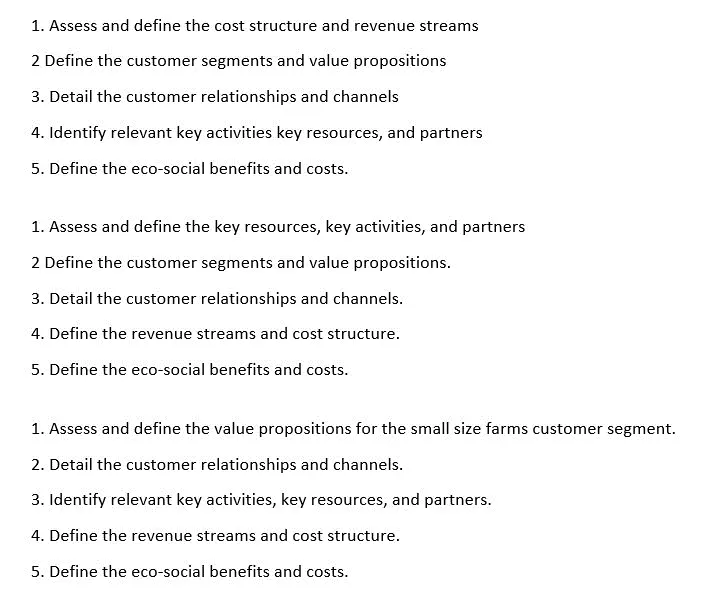
Green Elk & Company is the world's leading manufacturer of agricultural and forestry machinery. The former company slogan "Elk always runs" has recently been changed to "Elk feeds the world". One of Green Elk's strategic goals is to increase its revenue in the emerging markets of China, India, and other parts of Asia by 80 % within three years. This requires a new business model that caters to significantly smaller farms with limited budgets. You are the Chief Enterprise Architect and the CIO asks you to assess the now business model for smaller farms with smaller budgets. By applying the Sustainable Business Model Canvas, which sequence of steps is best practice?

Correct Answer: C. 1. Assess and define the value propositions for the small size farms customer segment. /2. Detail the customer relationships and channels. /3. Identify relevant key activities, key resources, and partners. /4. Define the revenue streams and cost structure. /5. Define the eco-social benefits and costs.
Explanation:

The Sustainable Business Model Canvas approach for assessing new business models, especially for smaller farms with smaller budgets, starts with understanding the unique value propositions tailored to the needs of small-size farm owners. This is crucial in creating offerings that resonate well with the target market's requirements and constraints. Following this, detailing customer relationships and channels becomes essential in establishing and maintaining a strong connection with the market segment, ensuring the delivery mechanism aligns with their preferences and capabilities. The next step involves identifying the key activities, resources, and partnerships necessary to deliver on the value proposition effectively, which is critical for operational execution and sustainability. Subsequently, defining the revenue streams and cost structure is paramount to ensure financial viability and strategic pricing that aligns with the target market's budgetary limitations. Lastly, delineating the eco-social benefits and costs integrates the broader impact of the business model, aligning with sustainable and ethical business practices, which is increasingly important for modern enterprises. Reference = This sequence is aligned with the methodologies proposed by Alexander Osterwalder in the context of business model development and specifically tailored by SAP for digital business modeling and value engineering within the SAP ecosystem. This approach encompasses strategies for optimizing business processes through value discovery workshops and the application of value management processes across various lifecycle phases (Source: SAP Enterprise Support Services documentation, Digital Business Modelling guidelines, and SAP Value Engineering methodologies).