
Limited-Time Offer: Enjoy 50% Savings! Ends in 00h 00m 00s Coupon code: 50OFF
Skip to content

Free ServiceNow Certified Implementation Specialist - Data Foundations (CMDB and CSDM) CIS-DF Exam Questions

Page: 1 / 14 Total 203 questions

Want more questions? Get Premium Access.

Question 1

What ensures data volume in the CMDB is manageable?

Correct Answer: C. Archive Policies
Explanation:

Managing CMDB data volume is a key Data Foundations governance objective. Over time, CMDBs naturally accumulate retired, obsolete, or decommissioned CIs. If these records are not properly managed, they degrade CMDB performance, reduce reporting accuracy, and negatively impact discovery reconciliation and health scores.

Archive Policies are the mechanism designed to address this challenge. They define when CI records should be archived or deleted based on lifecycle state, age, or retention requirements. By automating archival and cleanup, archive policies ensure that only relevant, active CIs remain in the operational CMDB, keeping data volume manageable and performant.

Business Rules (Option A) are used to enforce logic during record creation or updates, not for long-term data volume control. Scheduled Jobs (Option B) may execute tasks, but without archive policies they have no governance logic to determine what should be removed or retained.

Archive policies work in conjunction with CMDB Data Manager to enforce lifecycle-based retention and cleanup, making them the correct and verified answer.

Therefore, Option C -- Archive Policies is correct.

Question 2

A CMDB Administrator needs to identify which attributes have been created specifically for the Windows Server class.

Which tab in the Attributes section is used?

Correct Answer: B. Added
Explanation:

Within the CMDB class dictionary in ServiceNow, attributes can be inherited from parent classes or defined directly on a specific class. To identify attributes created specifically for the Windows Server class, administrators must use the Added tab.

The Added tab displays attributes that are unique to the selected class and not inherited from parent classes (such as Server or Computer). This is essential for understanding class-specific extensions---like Windows-only configuration details---that were introduced to support platform requirements, discovery enhancements, or organizational needs.

The All tab shows every attribute available to the class, including inherited and added attributes, which makes it difficult to isolate class-specific additions. The Child tab focuses on attributes inherited by subclasses, not attributes introduced at the current class level. The Derived tab shows attributes calculated or derived from other data, not necessarily those created specifically for the class.

Using the Added tab supports best practices for configuration transparency, impact analysis during upgrades, and governance---especially important in Data Foundations to minimize unnecessary customization and maintain upgrade-safe designs.

Therefore, the correct answer is B -- Added.


Question 3

Which shows the most complete list of policy types that are provided by CMDB Data Manager?

Correct Answer: A. Retire, Archive, Attestation, Certification, and Delete
Explanation:

CMDB Data Manager supports multiple governance policy types because CMDB lifecycle management is broader than simply deleting or certifying records. The complete set represented here is Retire, Archive, Attestation, Certification, and Delete. Retire policies support lifecycle transition of CIs that should no longer be active. Archive policies remove records from active operational use while preserving them according to retention requirements. Delete policies permanently remove records when they no longer need to be retained. Attestation policies validate that a CI still exists or is still relevant. Certification policies require users to validate and potentially correct specific CI attribute values. Options B, C, and D are incomplete because each omits at least one major CMDB Data Manager policy type. Option A is therefore the best answer because it includes both lifecycle/removal policy types and validation-focused policy types.


Question 4

The CMDB Administrator has set up two Dynamic Reconciliation Rules within the ServiceNow Production Instance. The 'Server' class has a Dynamic

Reconciliation Rule of largest value for the RAM field. The 'Windows Server' class has a Dynamic Reconciliation Rule of most reported for the RAM field.

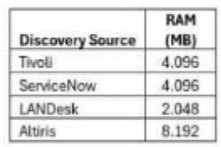
Given the above data in Multisource CMDB, which value is added to the CMDB for RAM for a Server CI?

Correct Answer: B. 8,192 MB
Explanation:

This question hinges on understanding class-specific Dynamic Reconciliation Rules in CMDB 360 / Multisource CMDB within ServiceNow.

Although two different dynamic rules are configured, the rule applied depends on the CI class being evaluated:

For the Server class, the configured rule is Largest value for the RAM attribute.

For the Windows Server class, the rule Most reported would apply---but only if the CI were evaluated as a Windows Server.

The question explicitly asks for the resulting RAM value for a Server CI, not a Windows Server CI. Therefore, the Largest value rule governs the outcome.

Looking at the multisource values:

2,048 MB (LANDesk)

4,096 MB (Tivoli)

4,096 MB (ServiceNow)

8,192 MB (Altiris)

Under the Largest value dynamic reconciliation rule, the IRE selects the maximum numeric value, regardless of how frequently it is reported or which source provided it.

The Most reported logic (which would result in 4,096 MB) does not apply here because that rule is configured for a different class (Windows Server).

This scenario illustrates an important CMDB 360 principle: Dynamic reconciliation is evaluated per class, and child-class rules do not override parent-class rules unless the CI is actually classified under that child class.


Question 5

A Windows administration team needs to organize Windows Server CIs for targeted Incident Management and Change Management workflows.

Which approaches can the team use to create logical groupings within CMDB groups?

(Choose two options.)

Correct Answer: A. Manually select specific Windows Server instances and assign them to a named CMDB group.; C. Use encoded queries to dynamically filter and group Windows Server CIs based on specific attribute conditions.
Explanation:

CMDB groups can represent either a deliberately selected set of CIs or a dynamically maintained population. For a static grouping, administrators can manually select the required Windows Server CIs and associate them with the named group.

For a dynamic grouping, an encoded query or equivalent CMDB query condition can identify records based on class and attribute criteria. For example, the query can select active Windows Server CIs in a particular location, environment, or support group. As CI records begin or cease to meet the conditions, group membership can be updated accordingly.

Tag-based mapping is principally associated with cloud-native Application Service mapping rather than the standard mechanism described for CMDB group membership. Reconciliation rules determine which source can update CI attributes; they do not assign CIs to operational groups based on source priority. Dynamic CI groups are designed to maintain membership through defined filtering criteria.


Question 6

What is the difference between Data Certification and Attestation policies when managing a CI?

Correct Answer: D. Attestation tracks acknowledgement the CI still exists, while Data Certification requires validating specific attributes of a CI
Explanation:

Within ServiceNow CMDB governance, Attestation and Data Certification serve distinct but complementary purposes. The key difference lies in what is being validated.

Attestation is focused on existence and ownership confirmation. When a CI is attested, the assigned user or group is asked to confirm that the CI still exists, is still relevant, and is still owned or managed by the appropriate team. No detailed attribute-level validation is required. This lightweight process is commonly used to prevent ''ghost CIs'' from lingering in the CMDB.

Data Certification, on the other hand, is more rigorous. It requires the certifier to validate specific attributes of the CI, such as lifecycle status, support group, environment, or service relationships. Certification ensures data correctness and completeness, which directly impacts CMDB Health scores and downstream processes like Change and Incident Management.

Options A, B, and C incorrectly describe these mechanisms or their assignment and scheduling capabilities. Both attestation and certification can be scheduled and assigned flexibly, but their validation depth is what truly differentiates them.

Therefore, Option D correctly describes the distinction: attestation confirms existence, while data certification validates CI attributes.


Question 7

A ServiceNow organization is establishing a governance structure for its CMDB implementation. The organization needs to assign accountability for ensuring that CI data meets organizational standards, resolving data inconsistencies, and maintaining ongoing data accuracy across discovery sources.

Which role should be assigned these data-quality and governance responsibilities?

Correct Answer: B. CMDB Process Owner
Explanation:

The CMDB Process Owner is accountable for the overall Configuration Management process and its governance framework. This includes establishing data standards, defining ownership and stewardship expectations, coordinating remediation processes, monitoring CMDB health, and ensuring that identification and reconciliation practices support trustworthy data.

A CI Analyst performs operational work on assigned CI classes, including updating records and resolving specific CMDB-related tasks. However, the analyst does not own organization-wide governance standards. A CMDB Architect designs the CMDB data model and technical architecture, while a Service Owner is accountable for a particular service. The IT Asset Manager focuses primarily on financial, contractual, and asset-lifecycle information.

Because the requirement covers organizational standards, cross-source data quality, and ongoing governance accountability---not merely individual record maintenance---the CMDB Process Owner is the correct role.


Question 8

A development team is working on a project where an application will be deployed to many servers. There are several security requirements that must be checked to adhere to lawful regulatory compliance because the application will be holding customer personal data (PII and PCI).

Where in the CSDM should the development team store the information that will be used to satisfy audits?

Correct Answer: B. Business Applications and Information Objects
Explanation:

Within the Common Service Data Model (CSDM), regulatory, security, and compliance-related information---especially for PII and PCI---must be modeled at the business and information level, not at the infrastructure or service offering level. The correct location for this data is Business Applications combined with Information Objects.

Business Applications represent the logical applications that support business capabilities and processes. Since compliance obligations (such as GDPR, PCI-DSS, or HIPAA) are assessed based on how the business uses data---not how many servers host the application---this is the correct anchor point for audit-relevant context.

Information Objects are explicitly designed to capture what data is processed, stored, or transmitted by an application, including data classifications such as PII, PCI, PHI, or confidential business data. They allow organizations to document regulatory scope, retention rules, encryption requirements, and audit controls without overloading CI records or polluting infrastructure classes.

Option A is incorrect because Technical Service Offerings and Groups focus on operational support and service delivery, not regulatory data context. Option C is also incorrect because Customer Service Offerings describe how services are consumed, while databases are technical components; neither is the authoritative place for compliance definitions.

Therefore, Business Applications and Information Objects are the correct CSDM constructs to support audits and regulatory compliance, making Option B the correct answer.


Question 9

A Service Portfolio Manager wants to know which Application Services their Business Service Offerings depend on.

At what stage of CSDM would this relationship be mapped?

Correct Answer: B. Walk
Explanation:

The Walk stage introduces the service-model relationships required to connect business-facing services and offerings to the Application Services that technically enable them. At this stage, the organization has progressed beyond foundational CMDB population and begins establishing service context for operational processes.

Relating Business Service Offerings to Application Services allows service owners to determine which technical services support each consumable business offering. This enables impact assessment, outage communication, change-risk evaluation, and identification of affected consumers. The guide explains that the Walk stage establishes Business Services and their relationships with Application Services and infrastructure so the CMDB can support Incident, Problem, and Change impact analysis.

Crawl primarily establishes foundational CI data and ingestion controls. Run and Fly represent more advanced operationalization and optimization. Foundation is a CSDM domain rather than the appropriate maturity stage for this relationship.


Question 10

A CMDB Administrator has been tasked with improving CMDB health and aligning the organization's CMDB with ServiceNow best practices.

How does the CMDB Data Foundations Dashboard Playbook help in this situation?

Correct Answer: A. Uses a step-by-step approach to improving CMDB data quality
Explanation:

The CMDB Data Foundations Dashboard identifies implementation risks and data-quality deficiencies, while its associated playbooks provide structured remediation guidance. The playbooks lead the administrator through a repeatable sequence for understanding the problem, identifying affected records and data sources, correcting existing data, and introducing governance controls to prevent recurrence.

The dashboard does not automatically install or configure third-party integrations. Those integrations are handled through capabilities such as Service Graph Connectors, IntegrationHub ETL, and Discovery. It also does not replace the CMDB Health Dashboard. CMDB Health calculates and reports metrics such as completeness, correctness, compliance, duplicates, orphaned CIs, and stale CIs. The Data Foundations Dashboard complements those health capabilities by focusing on foundational readiness and guided improvement.

Therefore, the defining benefit of the playbook is its step-by-step approach to improving CMDB data quality and alignment with recommended practices.


Question 11

During a bulk import of user endpoint devices into the CMDB, Computer CI records are successfully populated with owner information in the Owned by [owned_by] field. The Asset Management team requires the same owner information to be synchronized automatically to the corresponding Asset records.

Which automated approach should a Configuration Analyst implement?

Correct Answer: A. Use the Asset-CI Field Mapping module to create a rule that replicates the Owned by value between the Computer CI and its associated Asset record.
Explanation:

The Asset-CI Field Mapping capability is specifically designed to control synchronization between related Asset and CI records. The Configuration Analyst can create or configure a field-mapping rule so that the Computer CI's Owned by value is propagated to the corresponding Asset field through the platform's supported synchronization framework.

CI Class Manager controls CMDB class definitions and does not create parent-child inheritance between Asset and CI tables for field synchronization. A scheduled integration could copy the information, but it introduces unnecessary processing and delay when an out-of-box synchronization mechanism exists. A scripted business rule could also work technically, but it introduces custom code, maintenance effort, and upgrade risk.

Using Asset-CI Field Mapping provides a governed, supportable, and reusable configuration that keeps the operational CI and financial Asset perspectives aligned.


Question 12

As part of a CMDB improvement initiative, a team is evaluating the effectiveness of the CMDB Data Foundations Dashboard.

Which option describes a key benefit of the dashboard?

Correct Answer: A. Improves visibility into CMDB health and data quality
Explanation:

The CMDB Data Foundations Dashboard gives Configuration Management teams visibility into the condition, readiness, and quality of CMDB data. It presents curated metrics that expose gaps involving important attributes, configuration practices, relationships, ownership, and data-governance readiness. These results help administrators determine where corrective action is necessary and prioritize remediation according to operational risk.

The dashboard does not eliminate audits. Auditing, certification, attestation, and health calculations remain separate controls required to validate data. It also does not automatically correct every issue. Instead, the dashboard provides actionable findings and links to structured remediation playbooks that guide administrators through analysing, correcting, and governing the affected data.

The study guide specifically describes dashboard benefits as providing actionable insights for improving data quality and completeness and enabling CMDB health to be monitored over time. Therefore, improved visibility into CMDB health and data quality is the only accurate answer.


Question 13

Which are business values of CMDB? (Choose two.)

Correct Answer: C. Streamlining incident and change management; D. Strengthening operational resiliency
Explanation:

A CMDB delivers business value when it enables better outcomes across IT and enterprise service delivery---especially when aligned with CSDM so services, offerings, and supporting technology are connected in a consumable model. Two major business values are improved operational execution and improved business continuity.

Option C is a direct business value: a trusted CMDB improves incident and change management by providing accurate CI details, relationships, and service context. This supports faster triage and assignment, better prioritization, and higher-quality impact analysis for changes. When incidents and changes are informed by dependable configuration data, organizations reduce downtime, avoid unnecessary escalations, and make safer change decisions---benefits that the business experiences as higher service quality and fewer disruptions.

Option D is also a core business value: CMDB strengthens operational resiliency by enabling clearer dependency understanding and faster response to failures. Resiliency improves when teams can quickly identify what's impacted, understand upstream/downstream relationships, and plan mitigation steps using known service-to-technology mappings. In regulated or mission-critical environments, this translates into better continuity, reduced risk exposure, and improved compliance reporting.

Option A can be beneficial, but it is more of a technical/operational mechanism than a primary ''business value'' statement in Data Foundations framing. Option B is primarily the domain of IT Asset Management and financial systems; while CMDB can relate to assets, it is not the system of record for financial management. Hence, the best two business values are streamlining incident and change management and strengthening operational resiliency.


Question 14

A CMDB Administrator is working in the CI Class Manager on the Basic Info tab.

How can the class be set as a Principal Class?

Correct Answer: B. Check the Principal Class check box
Explanation:

A CI class is set as a Principal Class from the Basic Info tab in CI Class Manager by selecting the Principal Class check box. Principal Classes are important because they control which CI classes are treated as primary, operationally meaningful classes in CMDB processes and reference fields. For example, Principal Classes influence which CIs appear in key task fields such as Configuration Item fields on Incident, Change, and other ITSM records. This keeps users from selecting low-level or irrelevant child records when the business process expects a meaningful CI. There is no separate requirement to click a dedicated Principal Class UI Action, and it is not configured through a Yes/No choice list in this scenario. The Basic Info tab exposes the class-level property directly, so checking the Principal Class checkbox is the correct configuration action.


Question 15

A CMDB Data Manager needs to access the ServiceNow platform to create, publish, and manage policies that automate and govern CI lifecycle operations, ensuring the CMDB remains healthy and efficient.

Where can the Data Manager do this?

Correct Answer: B. CMDB Workspace -- Management tab
Explanation:

In Data Foundations, ''govern'' is not only about defining standards---it also includes implementing repeatable controls that keep CMDB data clean over time. CMDB Data Manager is the ServiceNow capability built specifically for policy-driven CI lifecycle operations such as deletion, archival, and attestation. Rather than relying on one-off scripts or manual cleanup, Data Manager applies consistent lifecycle rules at scale, which is a core expectation of CMDB Data Foundations governance.

The place to administer these lifecycle policies is within CMDB Workspace, under the Management area, where the Data Manager tools expose a dedicated Policies experience. From there, a Data Manager can create new policies, publish them, and manage existing policies used to automate lifecycle processing. This aligns with the intent of ''keeping the CMDB healthy and efficient'' because it operationalizes governance through automated, standardized actions and controlled approvals where needed.

By contrast, CI Class Manager is primarily for managing CI class definitions and class-level settings (for example, class configuration related to identification, reconciliation, and health rules), not for publishing CI lifecycle automation policies. ''CMDB 360'' is oriented toward exploring CI/service context, and ''Service Operations Workspace'' is designed for operational workflows rather than CMDB lifecycle policy administration.