
Limited-Time Offer: Enjoy 50% Savings! Ends in 00h 00m 00s Coupon code: 50OFF
Skip to content

Free Snowflake SnowPro Advanced: Architect Certification Exam ARA-C01 Exam Questions

Page: 1 / 11 Total 162 questions

Want more questions? Get Premium Access.

Question 1

An Architect needs to design a data unloading strategy for Snowflake, that will be used with the COPY INTO command.

Which configuration is valid?

Correct Answer: C. Location of files: Google Cloud Storage . File formats: Parquet . File encoding: UTF-8 * Compression: gzip
Explanation:

For the configuration of data unloading in Snowflake, the valid option among the provided choices is 'C.' This is because Snowflake supports unloading data into Google Cloud Storage using the COPY INTO <location> command with specific configurations. The configurations listed in option C, such as Parquet file format with UTF-8 encoding and gzip compression, are all supported by Snowflake. Notably, Parquet is a columnar storage file format, which is optimal for high-performance data processing tasks in Snowflake. The UTF-8 file encoding and gzip compression are both standard and widely used settings that are compatible with Snowflake's capabilities for data unloading to cloud storage platforms. Reference:

Snowflake Documentation on COPY INTO command

Snowflake Documentation on Supported File Formats

Snowflake Documentation on Compression and Encoding Options

Question 2

An Architect has chosen to separate their Snowflake Production and QA environments using two separate Snowflake accounts.

The QA account is intended to run and test changes on data and database objects before pushing those changes to the Production account. It is a requirement that all database objects and data in the QA account need to be an exact copy of the database objects, including privileges and data in the Production account on at least a nightly basis.

Which is the LEAST complex approach to use to populate the QA account with the Production account's data and database objects on a nightly basis?

Correct Answer: C. 1) Enable replication for each database in the Production account 2) Create replica databases in the QA account 3) Create clones of the replica databases on a nightly basis 4) Run tests directly on those cloned databases
Explanation:

This approach is the least complex because it uses Snowflake's built-in replication feature to copy the data and database objects from the Production account to the QA account. Replication is a fast and efficient way to synchronize data across accounts, regions, and cloud platforms. It also preserves the privileges and metadata of the replicated objects. By creating clones of the replica databases, the QA account can run tests on the cloned data without affecting the original data. Clones are also zero-copy, meaning they do not consume any additional storage space unless the data is modified. This approach does not require any external stages, tasks, Snowpipe, or external functions, which can add complexity and overhead to the data transfer process.


Introduction to Replication and Failover

Replicating Databases Across Multiple Accounts

Cloning Considerations

Question 3

An Architect is designing a pipeline to stream event data into Snowflake using the Snowflake Kafka connector. The Architect's highest priority is to configure the connector to stream data in the MOST cost-effective manner.

Which of the following is recommended for optimizing the cost associated with the Snowflake Kafka connector?

Question 4

A company is designing its serving layer for data that is in cloud storage. Multiple terabytes of the data will be used for reporting. Some data does not have a clear use case but could be useful for experimental analysis. This experimentation data changes frequently and is sometimes wiped out and replaced completely in a few days.

The company wants to centralize access control, provide a single point of connection for the end-users, and maintain data governance.

What solution meets these requirements while MINIMIZING costs, administrative effort, and development overhead?

Correct Answer: A. Import the data used for reporting into a Snowflake schema with native tables. Then create external tables pointing to the cloud storage folders used for the experimentation data. Then create two different roles with grants to the different datasets to match the different user personas, and grant these roles to the corresponding users.
Explanation:

The most cost-effective and administratively efficient solution is to use a combination of native and external tables. Native tables for reporting data ensure performance and governance, while external tables allow for flexibility with frequently changing experimental data. Creating roles with specific grants to datasets aligns with the principle of least privilege, centralizing access control and simplifying user management12.

Reference

* Snowflake Documentation on Optimizing Cost1.

* Snowflake Documentation on Controlling Cost2.


Question 5

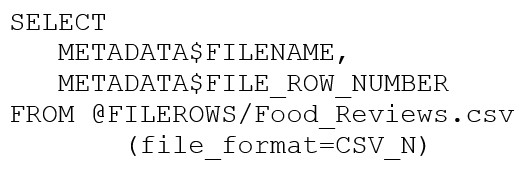
An Architect runs the following SQL query:

How can this query be interpreted?

Correct Answer: A. FILEROWS is a stage. FILE_ROW_NUMBER is line number in file.
Explanation:

A stage is a named location in Snowflake that can store files for data loading and unloading. A stage can be internal or external, depending on where the files are stored.

The query in the question uses theLISTfunction to list the files in a stage named FILEROWS. The function returns a table with various columns, including FILE_ROW_NUMBER, which is the line number of the file in the stage.

Therefore, the query can be interpreted as listing the files in a stage named FILEROWS and showing the line number of each file in the stage.


: Stages

: LIST Function

Question 6

A user can change object parameters using which of the following roles?

Correct Answer: C. ACCOUNTADMIN, USER with PRIVILEGE
Explanation:

According to the Snowflake documentation, object parameters are parameters that can be set on individual objects such as databases, schemas, tables, and stages. Object parameters can be set by users with the appropriate privileges on the objects. For example, to set the object parameter AUTO_REFRESH on a table, the user must have the MODIFY privilege on the table. The ACCOUNTADMIN role has the highest level of privileges on all objects in the account, so it can set any object parameter on any object. However, other roles, such as SECURITYADMIN or SYSADMIN, do not have the same level of privileges on all objects, so they cannot set object parameters on objects they do not own or have the required privileges on. Therefore, the correct answer is C. ACCOUNTADMIN, USER with PRIVILEGE.


Parameters | Snowflake Documentation

Object Parameters | Snowflake Documentation

Object Privileges | Snowflake Documentation

Question 7

A media company needs a data pipeline that will ingest customer review data into a Snowflake table, and apply some transformations. The company also needs to use Amazon Comprehend to do sentiment analysis and make the de-identified final data set available publicly for advertising companies who use different cloud providers in different regions.

The data pipeline needs to run continuously ang efficiently as new records arrive in the object storage leveraging event notifications. Also, the operational complexity, maintenance of the infrastructure, including platform upgrades and security, and the development effort should be minimal.

Which design will meet these requirements?

Correct Answer: B. Ingest the data using Snowpipe and use streams and tasks to orchestrate transformations. Create an external function to do model inference with Amazon Comprehend and write the final records to a Snowflake table. Then create a listing in the Snowflake Marketplace to make the data available to other companies.
Explanation:

This design meets all the requirements for the data pipeline. Snowpipe is a feature that enables continuous data loading into Snowflake from object storage using event notifications. It is efficient, scalable, and serverless, meaning it does not require any infrastructure or maintenance from the user. Streams and tasks are features that enable automated data pipelines within Snowflake, using change data capture and scheduled execution. They are also efficient, scalable, and serverless, and they simplify the data transformation process. External functions are functions that can invoke external services or APIs from within Snowflake. They can be used to integrate with Amazon Comprehend and perform sentiment analysis on the data. The results can be written back to a Snowflake table using standard SQL commands. Snowflake Marketplace is a platform that allows data providers to share data with data consumers across different accounts, regions, and cloud platforms. It is a secure and easy way to make data publicly available to other companies.


Snowpipe Overview | Snowflake Documentation

Introduction to Data Pipelines | Snowflake Documentation

External Functions Overview | Snowflake Documentation

Snowflake Data Marketplace Overview | Snowflake Documentation

Question 8

Data is being imported and stored as JSON in a VARIANT column. Query performance was fine, but most recently, poor query performance has been reported.

What could be causing this?

Correct Answer: B. The order of the keys in the JSON was changed.
Explanation:

Data is being imported and stored as JSON in a VARIANT column. Query performance was fine, but most recently, poor query performance has been reported. This could be caused by the following factors:

The order of the keys in the JSON was changed. Snowflake stores semi-structured data internally in a column-like structure for the most common elements, and the remainder in a leftovers-like column. The order of the keys in the JSON affects how Snowflake determines the common elements and how it optimizes the query performance. If the order of the keys in the JSON was changed, Snowflake might have to re-parse the data and re-organize the internal storage, which could result in slower query performance.

There were variations in string lengths for the JSON values in the recent data imports. Non-native values, such as dates and timestamps, are stored as strings when loaded into a VARIANT column. Operations on these values could be slower and also consume more space than when stored in a relational column with the corresponding data type. If there were variations in string lengths for the JSON values in the recent data imports, Snowflake might have to allocate more space and perform more conversions, which could also result in slower query performance.

The other options are not valid causes for poor query performance:

There were JSON nulls in the recent data imports. Snowflake supports two types of null values in semi-structured data: SQL NULL and JSON null. SQL NULL means the value is missing or unknown, while JSON null means the value is explicitly set to null. Snowflake can distinguish between these two types of null values and handle them accordingly. Having JSON nulls in the recent data imports should not affect the query performance significantly.

The recent data imports contained fewer fields than usual. Snowflake can handle semi-structured data with varying schemas and fields. Having fewer fields than usual in the recent data imports should not affect the query performance significantly, as Snowflake can still optimize the data ingestion and query execution based on the existing fields.


Considerations for Semi-structured Data Stored in VARIANT

Snowflake Architect Training

Snowflake query performance on unique element in variant column

Snowflake variant performance

Question 9

Which SQL alter command will MAXIMIZE memory and compute resources for a Snowpark stored procedure when executed on the snowpark_opt_wh warehouse?

Correct Answer: A. Option A
Explanation:

To maximize memory and compute resources for a Snowpark stored procedure, you need to set the MAX_CONCURRENCY_LEVEL parameter for the warehouse that executes the stored procedure. This parameter determines the maximum number of concurrent queries that can run on a single warehouse. By setting it to 16, you ensure that the warehouse can use all the available CPU cores and memory on a single node, which is the optimal configuration for Snowpark-optimized warehouses. This will improve the performance and efficiency of the stored procedure, as it will not have to share resources with other queries or nodes. The other options are incorrect because they either do not change the MAX_CONCURRENCY_LEVEL parameter, or they set it to a lower value than 16, which will reduce the memory and compute resources for the stored procedure.Reference:

[Snowpark-optimized Warehouses]1

[Training Machine Learning Models with Snowpark Python]2

[Snowflake Shorts: Snowpark Optimized Warehouses]3


Question 10

A Snowflake Architect is designing an application and tenancy strategy for an organization where strong legal isolation rules as well as multi-tenancy are requirements.

Which approach will meet these requirements if Role-Based Access Policies (RBAC) is a viable option for isolating tenants?

Correct Answer: A. Create accounts for each tenant in the Snowflake organization.
Explanation:

In a scenario where strong legal isolation is required alongside the need for multi-tenancy, the most effective approach is to create separate accounts for each tenant within the Snowflake organization. This approach ensures complete isolation of data, resources, and management, adhering to strict legal and compliance requirements. Role-Based Access Control (RBAC) further enhances security by allowing granular control over who can access what resources within each account. This solution leverages Snowflake's capabilities for managing multiple accounts under a single organization umbrella, ensuring that each tenant's data and operations are isolated from others. Reference: Snowflake documentation on multi-tenancy and account management, part of the SnowPro Advanced: Architect learning path.


Question 11

Which organization-related tasks can be performed by the ORGADMIN role? (Choose three.)

Correct Answer: B. Creating an account; C. Viewing a list of organization accounts; F. Enabling the replication of a database
Explanation:

According to the SnowPro Advanced: Architect documents and learning resources, the organization-related tasks that can be performed by the ORGADMIN role are:

Creating an account in the organization.A user with the ORGADMIN role can use the CREATE ACCOUNT command to create a new account that belongs to the same organization as the current account1.

Viewing a list of organization accounts.A user with the ORGADMIN role can use the SHOW ORGANIZATION ACCOUNTS command to view the names and properties of all accounts in the organization2.Alternatively, the user can use the Admin Accounts page in the web interface to view the organization name and account names3.

Enabling the replication of a database. A user with the ORGADMIN role can use the SYSTEM$GLOBAL_ACCOUNT_SET_PARAMETER function to enable database replication for an account in the organization.This allows the user to replicate databases across accounts in different regions and cloud platforms for data availability and durability4.

The other options are incorrect because they are not organization-related tasks that can be performed by the ORGADMIN role. Option A is incorrect because changing the name of the organization is not a task that can be performed by the ORGADMIN role.To change the name of an organization, the user must contact Snowflake Support3. Option D is incorrect because changing the name of an account is not a task that can be performed by the ORGADMIN role.To change the name of an account, the user must contact Snowflake Support5. Option E is incorrect because deleting an account is not a task that can be performed by the ORGADMIN role. To delete an account, the user must contact Snowflake Support.Reference:CREATE ACCOUNT | Snowflake Documentation,SHOW ORGANIZATION ACCOUNTS | Snowflake Documentation,Getting Started with Organizations | Snowflake Documentation,SYSTEM$GLOBAL_ACCOUNT_SET_PARAMETER | Snowflake Documentation,ALTER ACCOUNT | Snowflake Documentation, [DROP ACCOUNT | Snowflake Documentation]


Question 12

A user, analyst_user has been granted the analyst_role, and is deploying a SnowSQL script to run as a background service to extract data from Snowflake.

What steps should be taken to allow the IP addresses to be accessed? (Select TWO).

Correct Answer: B. ALTER USER ANALYSTJJSER SET NETWORK_POLICY='ANALYST_POLICY';; D. USE ROLE SECURITYADMIN; CREATE OR REPLACE NETWORK POLICY ANALYST_POLICY ALLOWED_IP_LIST = ('10.1.1.20');
Explanation:

To ensure that an analyst_user can only access Snowflake from specific IP addresses, the following steps are required:

Option B: This alters the network policy directly linked to analyst_user. Setting a network policy on the user level is effective and ensures that the specified network restrictions apply directly and exclusively to this user.

Option D: Before a network policy can be set or altered, the appropriate role with permission to manage network policies must be used. SECURITYADMIN is typically the role that has privileges to create and manage network policies in Snowflake. Creating a network policy that specifies allowed IP addresses ensures that only requests coming from those IPs can access Snowflake under this policy. After creation, this policy can be linked to specific users or roles as needed.

Options A and E mention altering roles or using the wrong role (USERADMIN typically does not manage network security settings), and option C incorrectly attempts to set a network policy directly as an IP address, which is not syntactically or functionally valid. Reference: Snowflake's security management documentation covering network policies and role-based access controls.


Question 13

A company is using Snowflake in Azure in the Netherlands. The company analyst team also has data in JSON format that is stored in an Amazon S3 bucket in the AWS Singapore region that the team wants to analyze.

The Architect has been given the following requirements:

1. Provide access to frequently changing data

2. Keep egress costs to a minimum

3. Maintain low latency

How can these requirements be met with the LEAST amount of operational overhead?

Correct Answer: B. Use an external table against the S3 bucket in AWS Singapore and copy the data into transient tables.
Explanation:

:Option A is the best design to meet the requirements because it uses a materialized view on top of an external table against the S3 bucket in AWS Singapore.A materialized view is a database object that contains the results of a query and can be refreshed periodically to reflect changes in the underlying data1.An external table is a table that references data files stored in a cloud storage service, such as Amazon S32. By using a materialized view on top of an external table, the company can provide access to frequently changing data, keep egress costs to a minimum, and maintain low latency. This is because the materialized view will cache the query results in Snowflake, reducing the need to access the external data files and incur network charges. The materialized view will also improve the query performance by avoiding scanning the external data files every time.The materialized view can be refreshed on a schedule or on demand to capture the changes in the external data files1.

Option B is not the best design because it uses an external table against the S3 bucket in AWS Singapore and copies the data into transient tables.A transient table is a table that is not subject to the Time Travel and Fail-safe features of Snowflake, and is automatically purged after a period of time3. By using an external table and copying the data into transient tables, the company will incur more egress costs and operational overhead than using a materialized view. This is because the external table will access the external data files every time a query is executed, and the copy operation will also transfer data from S3 to Snowflake. The transient tables will also consume more storage space in Snowflake and require manual maintenance to ensure they are up to date.

Option C is not the best design because it copies the data between providers from S3 to Azure Blob storage to collocate, then uses Snowpipe for data ingestion.Snowpipe is a service that automates the loading of data from external sources into Snowflake tables4. By copying the data between providers, the company will incur high egress costs and latency, as well as operational complexity and maintenance of the infrastructure. Snowpipe will also add another layer of processing and storage in Snowflake, which may not be necessary if the external data files are already in a queryable format.

Option D is not the best design because it uses AWS Transfer Family to replicate data between the S3 bucket in AWS Singapore and an Azure Netherlands Blob storage, then uses an external table against the Blob storage.AWS Transfer Family is a service that enables secure and seamless transfer of files over SFTP, FTPS, and FTP to and from Amazon S3 or Amazon EFS5. By using AWS Transfer Family, the company will incur high egress costs and latency, as well as operational complexity and maintenance of the infrastructure. The external table will also access the external data files every time a query is executed, which may affect the query performance.


Question 14

A Developer is having a performance issue with a Snowflake query. The query receives up to 10 different values for one parameter and then performs an aggregation over the majority of a fact table. It then

joins against a smaller dimension table. This parameter value is selected by the different query users when they execute it during business hours. Both the fact and dimension tables are loaded with new data in an overnight import process.

On a Small or Medium-sized virtual warehouse, the query performs slowly. Performance is acceptable on a size Large or bigger warehouse. However, there is no budget to increase costs. The Developer

needs a recommendation that does not increase compute costs to run this query.

What should the Architect recommend?

Correct Answer: C. Enable the search optimization service on the table. When the users execute the query, the search optimization service will automatically adjust the query execution plan based on the frequently-used parameters.
Explanation:

Enabling the search optimization service on the table can improve the performance of queries that have selective filtering criteria, which seems to be the case here. This service optimizes the execution of queries by creating a persistent data structure called a search access path, which allows some micro-partitions to be skipped during the scanning process. This can significantly speed up query performance without increasing compute costs1.

Reference

* Snowflake Documentation on Search Optimization Service1.


Question 15



