Limited-Time Offer: Enjoy 50% Savings! Ends in 00h 00m 00s Coupon code: 50OFF
Skip to content

Free Snowflake SnowPro Core Certification Exam COF-C02 Exam Questions

Page: 1 / 52 Total 778 questions

Want more questions? Get Premium Access.

Question 1

When unloading data with the COPY into command, what is the purpose of the PARTITION BY parameter option?

Correct Answer: D. To split the output into multiple files, one for each distinct value of the specified expression.
Explanation:

The PARTITION BY <expression> parameter option in the COPY INTO <location> command is used to split the output into multiple files based on the distinct values of the specified expression. This feature is particularly useful for organizing large datasets into smaller, more manageable files and can help with optimizing downstream processing or consumption of the data. For example, if you are unloading a large dataset of transactions and use PARTITION BY DATE(transactions.transaction_date), Snowflake generates a separate output file for each unique transaction date, facilitating easier data management and access.

This approach to data unloading can significantly improve efficiency when dealing with large volumes of data by enabling parallel processing and simplifying data retrieval based on specific criteria or dimensions.

References:

Snowflake Documentation on Unloading Data: COPY INTO <location>

Question 2

Which resource monitor setting will cancel all active queries in a virtual warehouse when the threshold is met?

Correct Answer: D. SUSPEND_IMMEDIATE

Question 3

Which virtual warehouse consideration can help lower compute resource credit consumption?

Correct Answer: C. Automating the virtual warehouse suspension and resumption settings
Explanation:

One key strategy to lower compute resource credit consumption in Snowflake is by automating the suspension and resumption of virtual warehouses. Virtual warehouses consume credits when they are running, and managing their operational times effectively can lead to significant cost savings.

A . Setting up a multi-cluster virtual warehouse increases parallelism and throughput but does not directly lower credit consumption. It is more about performance scaling than cost efficiency.

B . Resizing the virtual warehouse to a larger size increases the compute resources available for processing queries, which increases the credit consumption rate. This option does not help in lowering costs.

C . Automating the virtual warehouse suspension and resumption settings: This is a direct method to manage credit consumption efficiently. By automatically suspending a warehouse when it is not in use and resuming it when needed, you can avoid consuming credits during periods of inactivity. Snowflake allows warehouses to be configured to automatically suspend after a specified period of inactivity and to automatically resume when a query is submitted that requires the warehouse.

D . Increasing the maximum cluster count parameter for a multi-cluster virtual warehouse would potentially increase credit consumption by allowing more clusters to run simultaneously. It is used to scale up resources for performance, not to reduce costs.

Automating the operational times of virtual warehouses ensures that you only consume compute credits when the warehouse is actively being used for queries, thereby optimizing your Snowflake credit usage.


Question 5

Question 6

Which Snowflake table type persists until it is explicitly dropped. is available for all users with relevant privileges (across sessions). and has no Fail-safe period?

Correct Answer: D. Transient
Explanation:

The type of Snowflake table that persists until it is explicitly dropped, is available for all users with relevant privileges across sessions, and does not have a Fail-safe period, is a Transient table. Transient tables are designed to provide temporary storage similar to permanent tables but with some reduced storage costs and without the Fail-safe feature, which provides additional data protection for a period beyond the retention time. Transient tables are useful in scenarios where data needs to be temporarily stored for longer than a session but does not require the robust durability guarantees of permanent tables.


Question 7

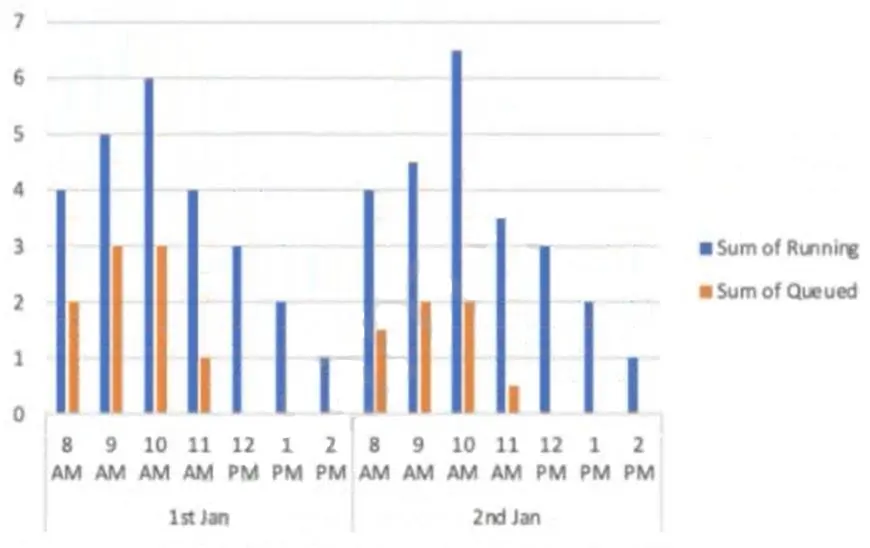
A virtual warehouse is created using the following command:

Create warehouse my_WH with

warehouse_size = MEDIUM

min_cluster_count = 1

max_cluster_count = 1

auto_suspend = 60

auto_resume = true;

The image below is a graphical representation of the warehouse utilization across two days.

What action should be taken to address this situation?

Question 8

What does a table with a clustering depth of 1 mean in Snowflake?

Correct Answer: C. The table has no overlapping micro-partitions.
Explanation:

In Snowflake, a table's clustering depth indicates the degree of micro-partition overlap based on the clustering keys defined for the table. A clustering depth of 1 implies that the table has no overlapping micro-partitions. This is an optimal scenario, indicating that the table's data is well-clustered according to the specified clustering keys. Well-clustered data can lead to more efficient query performance, as it reduces the amount of data scanned during query execution and improves the effectiveness of data pruning.

References:

Snowflake Documentation on Clustering: Understanding Clustering Depth


Question 9

Which of the following statements describes a schema in Snowflake?

Question 10

Which service or feature in Snowflake is used to improve the performance of certain types of lookup and analytical queries that use an extensive set of WHERE conditions?

Correct Answer: C. Search optimization service
Explanation:

The Search Optimization Service in Snowflake is designed to improve the performance of specific types of queries, particularly those involving extensive sets of WHERE conditions. By maintaining a search index on tables, this service can accelerate lookup and analytical queries, making it a valuable feature for optimizing query performance and reducing execution times for complex searches.

References:

Snowflake Documentation: Search Optimization Service


Question 11

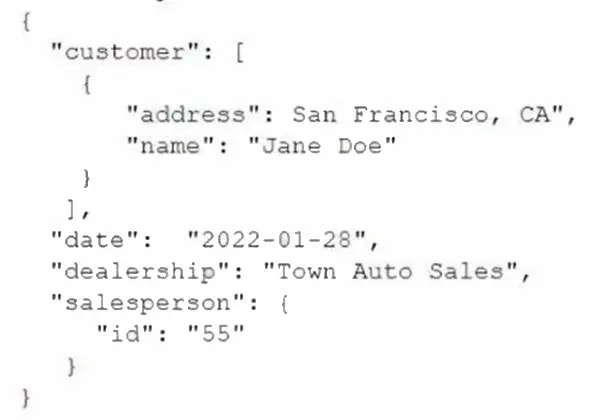
The following JSON is stored in a VARIANT column called src of the CAR_SALES table:

A user needs to extract the dealership information from the JSON.

How can this be accomplished?

Correct Answer: B. select src.dealership from car_sales;
Explanation:

In Snowflake, to extract a specific element from a JSON stored in a VARIANT column, the correct syntax is to use the dot notation. Therefore, the queryselect src.dealership from car_sales;will return the dealership information contained within each JSON object in thesrccolumn.

References: For a detailed explanation, please refer to the Snowflake documentation on querying semi-structured data.


Question 13

At what levels can a resource monitor be configured? (Select TWO).

Correct Answer: A. Account; E. Virtual warehouse
Explanation:

Resource monitors in Snowflake can be configured at the account and virtual warehouse levels. They are used to track credit usage and control costs associated with running virtual warehouses. When certain thresholds are reached, resource monitors can trigger actions such as sending alerts or suspending warehouses to prevent excessive credit consumption.References:[COF-C02] SnowPro Core Certification Exam Study Guide


Question 14

What persistent data structures are used by the search optimization service to improve the performance of point lookups?

Correct Answer: D. Search access paths
Explanation:

The search optimization service in Snowflake uses persistent data structures known as search access paths to improve the performance of point lookups. These structures enable efficient retrieval of data by reducing the amount of data scanned during queries.

Search Access Paths:

Search access paths are special indexing structures maintained by the search optimization service.

They store metadata about the distribution of data within tables, enabling faster lookups for specific values.

Point Lookups:

Point lookups involve searching for a specific value within a column.

By leveraging search access paths, Snowflake can quickly locate the exact micro-partition containing the value, minimizing the amount of data scanned.

Performance Improvement:

The use of search access paths significantly reduces query execution time for point lookups.

This is especially beneficial for large tables where scanning all micro-partitions would be computationally expensive.

References:

Snowflake Documentation: Search Optimization Service

Snowflake Documentation: Understanding Search Access Paths


Question 15

Which features make up Snowflake's column level security? (Select TWO).