Limited-Time Offer: Enjoy 50% Savings! Ends in 00h 00m 00s Coupon code: 50OFF
Skip to content

Free The Open Group ArchiMate 3 Part 2 Exam OGA-032 Exam Questions

Page: 1 / 2 Total 12 questions

Want more questions? Get Premium Access.

Question 1

Please read this scenario prior to answering the question

ArchiCar is a specialized company that focuses on manufacturing luxury electric cars and powertrain components, along with producing battery-charging equipment. With its own distribution network and showrooms, ArchiCar adopts a direct-to-

customer sales model through online channels.

The manufacturing of ArchiCar's electric cars is carried out on fully automated assembly lines. Leveraging a cutting-edge manufacturing process, the company boasts an impressive ability to sell and deliver a vehicle within just one month from the

time of order placement. Anticipating significant growth, the CEO has set ambitious plans to increase annual production from 100,000 to 500,000 vehicles within a three-year timeframe.

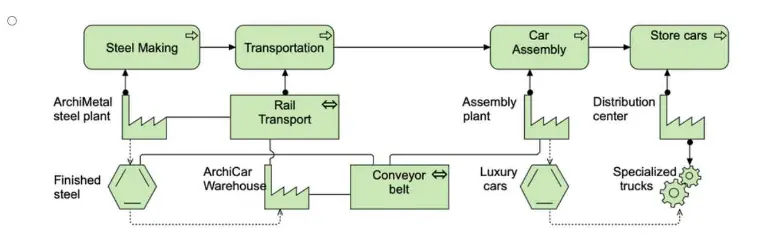
To ensure the highest quality standards, ArchiCar relies on locally manufactured finished steel from the renowned ArchiMetal plant. ArchiMetal specializes in lightweight steels that allow ArchiCar to achieve a reduced vehicle weight without

compromising strength and crash performance. The finished steel is efficiently transported by rail to ArchiCar's production plant, where it is stored in a dedicated warehouse until required for the automated car assembly process. Conveyor belts

facilitate the seamless transfer of the finished steel from the warehouse to the assembly plant.

At the ArchiCar assembly plant, an optimized and streamlined assembly process is implemented, resulting in the production of 12 vehicles per hour. Once assembled, the cars are transported to a nearby distribution center using specialized trucks.

These vehicles are then stored at the distribution center until they are ready for delivery to their eagerly awaiting new owners.

Refer to the Scenario

You are a consultant to the CIO. She has asked you to illustrate the end-to-end technology processes at ArchiCar from raw materials to assembled cars ready for delivery.

Which of the following answers provides the best description?

A.
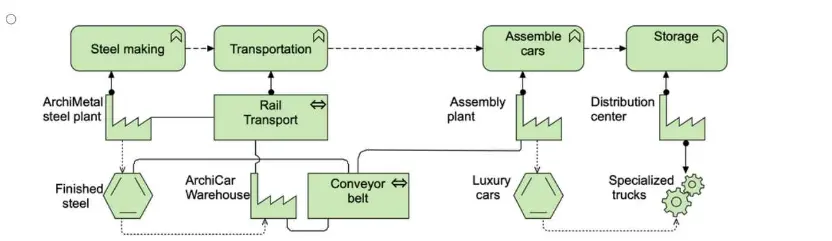
B.
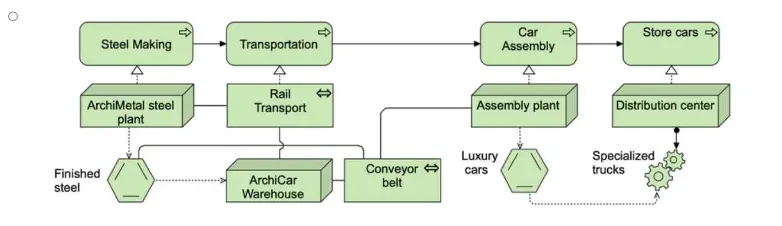
C.
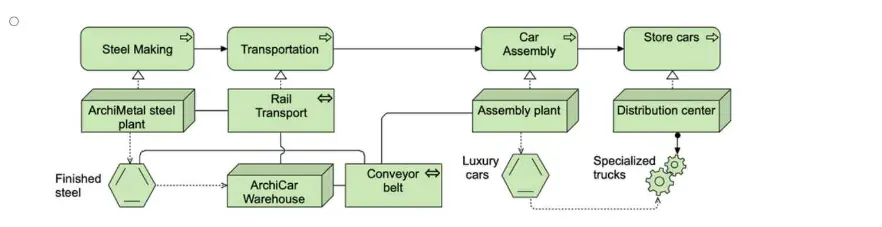
D.
Correct Answer: D. Option D
Explanation:

In this scenario, the task is to model the end-to-end technology processes at ArchiCar, showing how raw materials (finished steel) are processed through the company's manufacturing, transportation, and distribution system, ultimately resulting in fully assembled cars ready for delivery.

Key ArchiMate 3.2 Concepts Applied:

Business Processes:

Steel Making: ArchiMetal manufactures finished steel, a key raw material for ArchiCar's production.

Transportation: The finished steel is transported by rail from the ArchiMetal steel plant to ArchiCar's warehouse.

Storage: The finished steel is stored in the ArchiCar Warehouse until it is required for the assembly process.

Car Assembly: The conveyor belt moves the steel from the warehouse to the assembly plant, where cars are assembled on automated lines.

Transportation (Specialized Trucks): Once assembled, the cars are transported to a distribution center using specialized trucks.

Storage (Distribution Center): The finished cars are stored in the distribution center, awaiting delivery to customers.

Application and Technology Components:

Conveyor Belt: The transfer of finished steel between the warehouse and assembly plant is automated via the conveyor belt.

Rail Transport and Specialized Trucks: Rail transport handles the movement of steel, and specialized trucks are used for car transportation to the distribution center.

End-to-End Flow:

The model needs to clearly depict the full process flow from the production of steel, through its transportation and storage, to the automated assembly of luxury cars and their eventual transportation to the distribution center.

The relationships between processes (e.g., steel making, transportation, car assembly, and storage) must be clear and follow the logical flow of operations.

Why Option D is Correct:

Option D provides a clear and accurate representation of the end-to-end process as described in the scenario.

It begins with the steel-making process at the ArchiMetal steel plant and follows through with the transportation of the finished steel to the warehouse by rail transport.

The process of moving steel via the conveyor belt from the warehouse to the assembly plant for car manufacturing is clearly depicted.

Once cars are assembled, they are transported to the distribution center using specialized trucks and are then stored until delivery, completing the end-to-end flow.

The relationships between processes and supporting components (e.g., conveyor belt, transportation methods) are clearly illustrated, following ArchiMate standards.

Why Other Options Are Incorrect:

Option A is incorrect because it misses some key elements of the process. It does not fully clarify the role of the warehouse or how the finished steel is transported between locations.

Option B misrepresents the process flow, particularly the storage and assembly process. The connection between steel production and car assembly is not as clearly illustrated.

Option C also lacks clarity in how the finished steel is moved from the warehouse to the assembly plant, and it does not accurately capture the flow of transportation and storage after car assembly.

Conclusion:

Option D is the best answer because it provides the most complete and clear description of the end-to-end technology processes at ArchiCar, from raw materials (finished steel) to assembled luxury cars ready for delivery. It aligns well with the scenario and adheres to ArchiMate 3.2 modeling standards, showing all necessary relationships between business processes and supporting components.
Question 2

Please read this scenario prior to answering the question

The ArchiSurance senior management, board members, customers, and major stockholders have expressed long-standing concerns regarding the business continuity risks associated with relying on a single data center. Located in an area prone

to flooding, earthquakes, and occasional water leaks from the cafeteria above, the current data center has significant vulnerabilities.

To address these concerns and mitigate the risks, ArchiSurance has developed a comprehensive plan to relocate its existing data center to two separate ready-to-use data centers in different cities. As a major undertaking, the approval of the

Board of Directors is required to proceed with the project.

The primary objectives of the data center move are to reduce the risk of business interruptions, reduce both planned and unplanned downtime for critical applications, and provide reassurance to ArchiSurance stakeholders. Ensuring minimal

disruption during the transition is crucial. However, several constraints make the planned migration to the new data centers particularly challenging. Certain critical ArchiSurance applications cannot be offline for more than one hour, and any

planned downtime must be restricted to specific four-hour windows on weekends. Additionally, the migration cannot take place during quarterly or year-end closing periods to avoid disrupting critical processing operations.

ArchiSurance management has devised a multi-phase data center transformation program to facilitate a smooth transition. Each phase is critical for establishing stable and fully functional data center configurations throughout the transformation

process. The initial phase entails detailed scheduling and planning to develop a comprehensive transformation plan aligned with ArchiSurance's timing and scheduling requirements. During the second phase, ArchiSurance will procure the

necessary hardware and software for the new data centers, while also seeking refunds for the hardware and software in the current data center once it is decommissioned. The third phase involves setting up the new data centers and conducting

parallel testing of the new hardware and software alongside the existing production environment. The transition between the old and new data centers occurs in the fourth phase, followed by the fifth phase, which is the decommissioning of the old

data center. This involves returning the hardware and software to obtain the contracted refunds. Each phase, from the second to the fifth, is initiated once specific conditions outlined in the previous phase have been met.

Refer to the Scenario

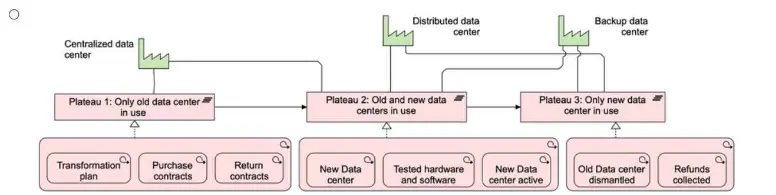
The program manager overseeing the data center transformation has asked you to model an outline of the implementation plan which has three stable states defined. You should show the deliverables associated with each plateau in connection

with the physical elements. Additionally, you need to show how each phase contributes to achieving a stable state for the data center transformation.

Which of the following answers provides the best description?

A.

B.

C.

D.

Correct Answer: A. Option A
Explanation:

This question focuses on modeling the implementation plan for the data center transformation at ArchiSurance. The goal is to represent how the different phases of the project contribute to achieving the three stable states, or plateaus, while illustrating the deliverables connected to these plateaus and the physical elements involved.

Key ArchiMate 3.2 Concepts Applied:

Plateaus: Plateaus represent intermediate stable states within an architecture transformation, showing the condition of the architecture at specific moments in time. In this scenario, the plateaus correspond to the stable data center configurations at different phases:

Plateau 1: Only the old data center is in use.

Plateau 2: Both the old and new data centers are in use simultaneously.

Plateau 3: Only the new data center is in use, and the old data center is fully decommissioned.

Physical Elements: These refer to the data centers, hardware, software, and networks that make up the infrastructure being migrated. These should be clearly depicted in connection with each phase of the transformation program.

Deliverables and Phases: Each phase of the transformation process includes specific deliverables, such as:

Procurement of new hardware and software.

Setting up and testing the new data centers.

Transitioning between the old and new data centers.

Dismantling the old data center and returning its hardware for refunds.

Work Packages and Dependencies: Work packages represent activities or tasks in ArchiMate and are connected to the plateaus. These must be modeled with proper sequencing, showing how each phase contributes to reaching the next stable state.

Why Option A is Correct:

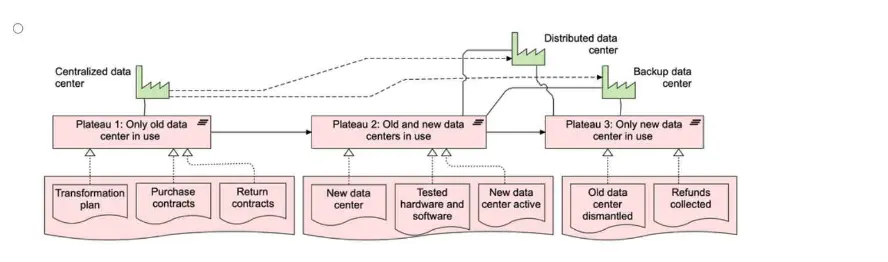
Option A accurately represents the three plateaus (stable states) and clearly illustrates the deliverables (e.g., the new data center, tested hardware and software, and dismantled old data center) in relation to each phase of the transformation.

The connections between the physical elements (such as the centralized data center, distributed data center, and backup data center) are properly displayed and aligned with the described multi-phase process.

The phases are laid out logically, showing how each phase (e.g., procurement, testing, transition) leads to the next stable state (plateau), following the principles of a plateau and work package transformation in ArchiMate.

The flow of deliverables from one plateau to the next is consistent with the need for dependencies (e.g., the new data center cannot be fully active until the hardware and software have been tested in parallel).

Why Other Options Are Incorrect:

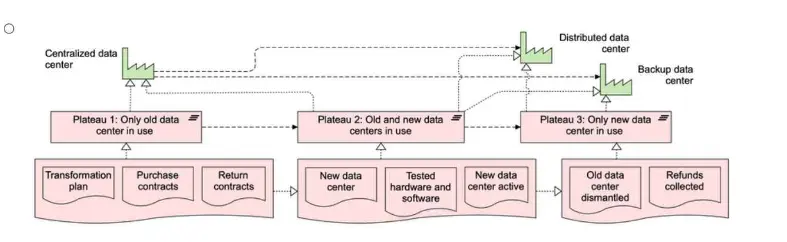
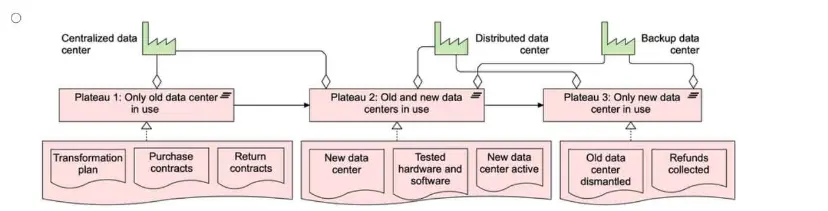
Option B and Option D do not show the relationships between the phases and the stable states as clearly as Option A. They lack some critical connections or do not accurately represent the progression between plateaus and the physical infrastructure.

Option C is closer but misses important sequencing in how the work packages (activities) and plateaus interact, leading to an incomplete representation of the transformation.

Conclusion:

Option A provides the most complete and accurate description based on ArchiMate 3.2 modeling principles. It correctly demonstrates how each phase of the data center transformation contributes to achieving the stable states (plateaus) and ensures that the physical elements, work packages, and deliverables are properly aligned.


Question 3

Please read this scenario prior to answering the question

ArchiSurance has decided to leverage its financial expertise by offering defined contribution retirement plans. Each trading day, ArchiSurance submits consolidated mutual fund trading transactions to a stock exchange on behalf of its retirement

plan participants.

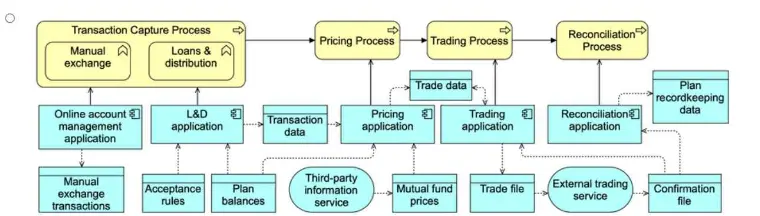
The daily mutual fund trading cycle consists of four key processes: Transaction capture, pricing, trading and reconciliation. Transaction capture consists of two sub-processes: manual exchange and loans and distributions (L&D). For transaction

capture, retirement plan participants use an online account management application to enter manual fund exchange transactions. For L&D, plan participants use a separate application to enter requests. The L&D application determines whether

the request can be fulfilled based on the mutual fund balances held in each plan balances and a set of business rules. Each day's captured manual exchange transactions accumulate in a transaction database.

ArchiSurance contracts with a third-party information service to receive a file of mutual fund prices at the close of each trading day. The pricing application uses this file to convert captured transaction into trades, and then validates each trade

against the mutual fund balances held in each plan. The pricing application generates a trade file with the minimum number of trades necessary. The trading application sends this file to an external trading service. When the trading application

receives a confirmation file back from the trading service, it causes the reconciliation application to update the plan recordkeeping database.

The account management and L&D applications are hosted on separate application server clusters. Each cluster is a physically separate host that runs application server software on a set of virtualized hosts. All of these applications use a

database server infrastructure that is hosted on another separate cluster of virtualized servers also on a dedicated physical host. The pricing, consolidation, trading and reconciliation applications, however, are batch applications that run on the

ArchiSurance mainframe computer. All application hosts are connected via a converged data center network (DCN), which also connects them to a storage area network (SAN) as well as a wide area network (WAN) that is used to communicate

with the external trading service. The SAN includes two physically separate storage arrays, one of which holds data for all databases, and another that holds data for all files.

Refer to the Scenario

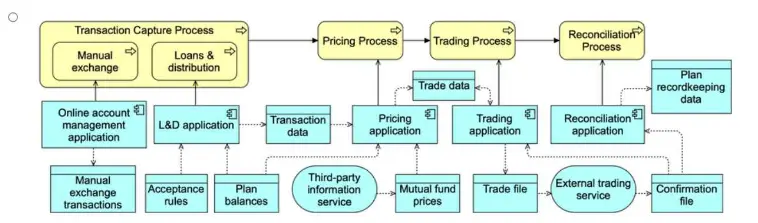
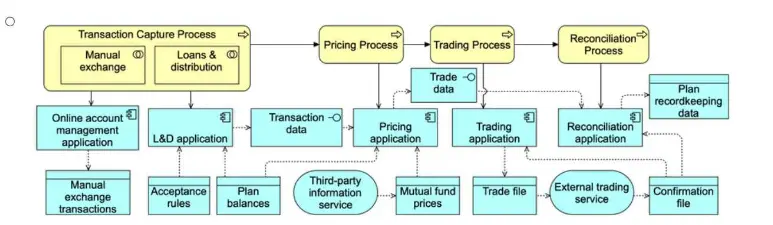
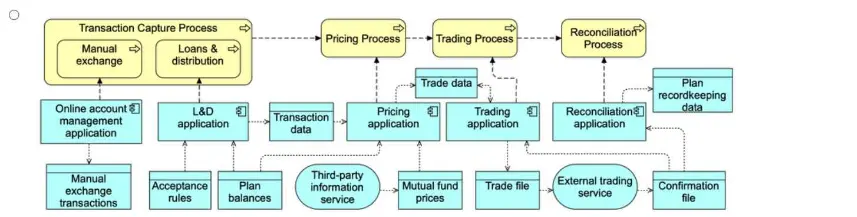
The systems analysts would like to better understand the business processes and applications for daily fund trading. You have been asked to describe the business processes and sub-processes, the applications that they use, the data objects

accessed by those applications, and the external application services that access some of those data objects.

Which of the following is the best answer? Note that you are not required to model the business actors/roles.

A.

B.

C.

D.

Correct Answer: B. Option B
Explanation:

In this scenario, the goal is to model the business processes, their sub-processes, the applications supporting these processes, and the data objects these applications access. Additionally, external services that access some of these data objects need to be shown. This includes capturing the key processes and their dependencies, as well as understanding how the applications interact with data and external services.

Key ArchiMate 3.2 Concepts Applied:

Business Processes and Sub-Processes:

Transaction Capture Process: Consists of two sub-processes:

Manual Exchange

Loans & Distribution (L&D) This process is responsible for capturing transactions from users through different applications (Online Account Management, L&D Application).

Pricing Process: This process uses the Mutual Fund Prices from a third-party service and the Plan Balances to validate and price trades.

Trading Process: This process generates a Trade File and interacts with an external Trading Service.

Reconciliation Process: This final process updates the Plan Recordkeeping Data after confirming trades from the External Trading Service.

Applications and Data:

Online Account Management Application and L&D Application: These capture user inputs for transactions and maintain Transaction Data and Plan Balances.

Pricing Application: Uses Mutual Fund Prices and Transaction Data to generate Trade Data.

Trading Application: Submits Trade Data and receives a Confirmation File from the external Trading Service.

Reconciliation Application: Uses the Confirmation File to update Plan Recordkeeping Data.

External Application Services:

Third-Party Information Service: Provides Mutual Fund Prices.

External Trading Service: Processes trades and returns a Confirmation File.

Data Objects:

Transaction Data: Captured by the transaction capture processes.

Mutual Fund Prices: Received from the third-party service.

Trade Data: Generated by the pricing and trading applications.

Plan Recordkeeping Data: Updated by the reconciliation process after trade confirmation.

Why Option B is Correct:

Option B provides the most complete and accurate representation of the scenario. It captures the business processes (Transaction Capture, Pricing, Trading, Reconciliation) and their sub-processes, while showing the appropriate connections to the applications that support these processes.

It clearly depicts the data objects (Transaction Data, Plan Balances, Trade File, Mutual Fund Prices, Plan Recordkeeping Data) and their flows between the processes and applications.

The model also includes the external services (Third-Party Information Service and External Trading Service), showing how these interact with the internal applications and data objects.

It accurately represents the flow of Trade Data from the Pricing Application to the Trading Application, and the use of Mutual Fund Prices by the Pricing Process.

Why Other Options Are Incorrect:

Option A and Option D miss some critical connections between the applications and the external services. They also lack clarity in how the data flows between the processes and applications.

Option C does not adequately represent the interaction between the applications and the external services (e.g., Third-Party Information Service), which is a key requirement in this scenario.

Conclusion:

Option B provides the best and most accurate description of the business processes, applications, data objects, and external services involved in ArchiSurance's daily fund trading operations, following ArchiMate 3.2 standards for modeling business processes and applications.


Question 4

Please read this scenario prior to answering the question

ArchiSurance has decided to leverage its financial expertise by offering defined contribution retirement plans. Each trading day, ArchiSurance submits consolidated mutual fund trading transactions to a stock exchange on behalf of its retirement plan

participants.

The daily mutual fund trading cycle consists of four key processes: Transaction capture, pricing, trading and reconciliation. Transaction capture consists of two sub-processes: manual exchange and loans and distributions (L&D). For transaction

capture, retirement plan participants use an online account management application to enter manual fund exchange transactions. For L&D, plan participants use a separate application to enter requests. The L&D application determines whether the

request can be fulfilled based on the mutual fund balances held in each plan balances and a set of business rules. Each day's captured manual exchange transactions accumulate in a transaction database.

ArchiSurance contracts with a third-party information service to receive a file of mutual fund prices at the close of each trading day. The pricing application uses this file to convert captured transaction into trades, and then validates each trade against the

mutual fund balances held in each plan. The pricing application generates a trade file with the minimum number of trades necessary. The trading application sends this file to an external trading service. When the trading application receives a

confirmation file back from the trading service, it passes it to the reconciliation application, which updates the plan recordkeeping database.

The lead application Architect has decided to merge the pricing application, the trading application and the reconciliation application into one application, which will be serving the pricing, trading and reconciliation processes respectively. The reason for

this is that maintenance costs for these three components are too high and the performance is too slow. This implementation will increase the performance and lower the maintenance cost significantly.

The CIO has agreed on this plan, but wants this to be done in two phases, each in a separate project. Phase 1 should include the merger of the Trading and Pricing applications. Phase 2 should then merge the merged applications with the Reconciliation

application respectively. Each project phase has a number of defined deliverables. Phase 1 has two deliverables, TraPri application implemented and tested' and 'Active TraPri application', which together form a first transition architecture. Phase 2 has

two deliverables, 'Recon 2.0 application implemented and tested' and 'Back-up applications phased out', which together form the second transition architecture. These two projects are part of the ArchiSurance application integration program scheduled

for the next 6 months.

Refer to the Scenario

You have been asked by the lead application architect to show how the applications used for daily trading can be migrated. This should include a description of the work packages, deliverables and transition architectures.

Which of the following answers best describes the applications and migration plan?

A.

B.

C.

D.

Correct Answer: D. Option D
Explanation:

We need to determine the best model that:

Shows the current applications and their functions -- Pricing, Trading, and Reconciliation applications.

Represents the migration phases --

Phase 1: Merges the Trading and Pricing applications into TraPri.

Phase 2: Merges TraPri with the Reconciliation application to create Recon 2.0.

Includes transition architectures -- Each phase has distinct deliverables marking the transition from old applications to new merged applications.

Shows the work packages and dependencies -- The sequence of activities leading to the final implementation.

Why D is the Best Choice:

Clearly distinguishes baseline (existing) applications and the new applications after the migration. Illustrates the two transition states correctly --

First transition: Implementation and activation of the TraPri application.

Second transition: Implementation of Recon 2.0 and phase-out of backup applications. Depicts the migration process sequentially -- Ensuring a clear understanding of how the applications evolve over time. Work packages and deliverables are well structured -- Aligning with the phases described in the scenario.

Why Not A, B, or C?

A: Does not correctly represent the transition phases and their deliverables.

B: Lacks clarity in differentiating baseline applications from transition architectures.

C: Misrepresents dependencies and transition states, making the migration process unclear.


Question 5

Please read this scenario prior to answering the question

The ArchiSurance Mobile consumer solution is used for selling and renewing insurance products, providing customer service, enabling accurate and convenient home recordkeeping, and capturing and processing claims. The solution consists of

three applications. The Consultant application lets customers review their existing coverage, and update it based on common life events, such as getting a new car, moving into a new home, or having a family member move in or out. If necessary,

they can speak or chat with a customer service representative. The Home Manager application helps customers photograph and catalogue their valuable possessions in order to support the filing of accurate claims in case of loss or damage. The

Claim Manager application enables customers to quickly file a claim for loss or damage to an insured auto, home or possession. It enables customers to describe the incident by referencing information captured with the Consultant and the Home

Manager applications. In addition, it allows the customer to add photographs, audio, video and text to support a claim, submit the claim, and monitor its progress.

The ArchiSurance Mobile applications rely on a number of application services hosted by ArchiSurance. The first is an Auto Identification and Description (AID) service that the Consultant application uses to validate and complete auto information

entered by customers. The second service, Home Identification and Description (HID) performs the same function for home information, and is used by the Home Manager application. The Consultant application also uses the Virtual Agent

service to guide customers as they select coverage options, the Payment Processor service to arrange premium payments, and the Coverage Activator service to generate policies and put them in force.

ArchiSurance Mobile also relies on a number of technology services. The Home Manager application uses a Multimedia Repository service to store and retrieve information about insured homes. The Claim Manager application also uses this

service for claim information entered by customers. All three ArchiSurance Mobile applications use a Personal Security service to register and authenticate customers, and to manage their profiles.

Each application service is realized by an application component with the same name. Each technology service is realized by a system software environment, having the same name. ArchiSurance hosts both the application components and

system software environments in a virtualized server pool within its data center. Each service has its own virtual server. Each virtual server is connected to a data center network (DCN) which in turn connects to a commercial wide area network

(WAN).

Refer to the Scenario

You have been asked to show the applications that make up the ArchiSurance Mobile solution and the technology that supports these applications.

Which of the following answers provides the best description? Note that it is not necessary to model the networks.

A.

B.

C.

D.

Correct Answer: C. Option C
Explanation:

In this scenario, the focus is on modeling the ArchiSurance Mobile solution, showing the applications that make up this solution and the technology infrastructure that supports them. This includes applications, application services, and the system software environments (technology services) upon which the applications rely.

Key ArchiMate 3.2 Concepts Applied:

Application Components and Services:

Consultant Application: This allows customers to review, update coverage, and speak with customer service representatives. It uses the following application services:

Auto Identification and Description (AID) for validating auto information.

Virtual Agent for helping customers select options.

Payment Processor to arrange payments.

Coverage Activator to generate and activate policies.

Home Manager Application: This allows customers to catalogue possessions and use the Home Identification and Description (HID) service to validate home information.

Claim Manager Application: Enables filing of claims, referencing data from the Consultant and Home Manager applications and storing information (such as photos, videos) via the Multimedia Repository.

Technology Services:

Personal Security Service: Used for customer registration, authentication, and profile management across all three applications.

Multimedia Repository Service: Used to store and retrieve information related to home possessions and claim details, supporting both the Home Manager and Claim Manager applications.

Technology Infrastructure:

Each application component (Consultant, Home Manager, Claim Manager) is hosted on its own virtual server within a virtualized server pool.

Each technology service is realized by a corresponding system software environment (e.g., Multimedia Repository, Personal Security), each with its own virtual server.

The infrastructure is hosted in a data center, but the focus here is on the services rather than the network connections.

Why Option C is Correct:

Option C accurately represents the key applications (Consultant, Home Manager, Claim Manager) in connection with the appropriate technology services and their respective virtual servers.

The model shows the relationships between the applications and their dependencies on Personal Security and Multimedia Repository, aligning with the description provided.

The virtual server pool is depicted clearly, showing how the applications and services are realized within this infrastructure.

The relationships between applications and application services (AID, HID, Virtual Agent, Payment Processor, Coverage Activator) are not modeled in full detail here, but they are implicitly understood through the applications.

Why Other Options Are Incorrect:

Option A and Option D both incorrectly depict some relationships between the applications and their supporting technology services or servers, or miss certain dependencies.

Option B does not provide as clear a depiction of the virtualized infrastructure and how the applications relate to the Multimedia Repository and Personal Security services.

Conclusion:

Option C provides the most accurate and complete description of the ArchiSurance Mobile solution and the supporting technology, as required by the scenario. It correctly illustrates the relationships between the applications, the virtual servers, and the supporting technology services according to ArchiMate 3.2 principles.