Limited-Time Offer: Enjoy 50% Savings! Ends in 00h 00m 00s Coupon code: 50OFF
Skip to content

Free The Open Group TOGAF Business Architecture Part 1 OGB-001 Exam Questions

Page: 1 / 5 Total 30 questions

Want more questions? Get Premium Access.

Question 1

Which of the following best describes what a business model is?

Correct Answer: A. The rationale for how an organization, creates, deliveries and captures value.
Explanation:

A business model is a plan that describes how a business intends to make money by providing value to its customers or clients. It defines the value proposition, the target market, the revenue streams, and the cost structure of the business.According to Investopedia1, a business model is ''a company's plan for making a profit.It identifies the products or services the business plans to sell, its identified target market, and any anticipated expenses


Question 2

Which of the following best describes the relationship between business models and business architecture?

Correct Answer: D. Business Architecture articulates the different perspectives and impacts o' the business model
Explanation:

Business Architecture is a discipline that helps to design, analyze, and optimize the business model of an organization. It provides a holistic and shared understanding of the business strategy, capabilities, processes, information, and stakeholders.According to The Open Group2, Business Architecture ''describes how the enterprise needs to operate to achieve the business goals, and respond to the strategic drivers set out in the Architecture Vision''.Business Architecture also helps to assess the alignment and impact of the business model on different aspects of the organization, such as its infrastructure, customers, and finances


Question 3

Consider the following business capability model. there cells of a model are given different colors to represent desired maturity levels (Green (G) - level achieved, yellow (Y) = one level away, red (R) -two more more levels away, purple (P) = missing capability):
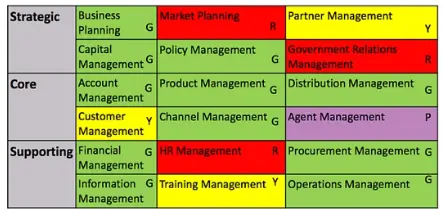
Which of the following best describes what this model shows?

Correct Answer: C. Customer Management, Training Management and Partner Management need immediate attention. Market Planning. HR Management and Government Relations Management need attention. Agent Management exists as a new Core capability but has not yet been assessed.
Explanation:

This answer is based on the color-coding of the business capability model, which indicates the desired maturity levels of each capability. Red cells mean that the capability is two or more levels away from the desired maturity level, yellow cells mean that the capability is one level away, green cells mean that the capability has achieved the desired maturity level, and purple cells mean that the capability is missing or not defined. According to this logic, the capabilities that need immediate attention are those that are red, which are Customer Management, Training Management and Partner Management. The capabilities that need attention are those that are yellow, which are Market Planning, HR Management and Government Relations Management. The capability that is missing as a Core capability is Agent Management, which is purple. The rest of the capabilities are green, which means they have reached the desired maturity level.


Question 4

Which input to Phase A provides context for the architecture work by describing the needs and ways of working of the enterprise?

Correct Answer: A. Business principles, goals, and drivers
Explanation:

This answer is based on the TOGAF Standard, Version 9.2 - Phase A: Architecture Vision1, which states that ''Business principles, business goals, and strategic drivers of the organization are already defined elsewhere in the enterprise. If so, the activity in Phase A is involved with ensuring that existing definitions are current, and clarifying any areas of ambiguity. Otherwise, it involves defining these essential items from scratch.'' Business principles, goals, and drivers provide context for the architecture work by describing the needs and ways of working of the enterprise. They define the desired outcomes, the guiding values, and the strategic direction of the enterprise. They also help to align the architecture work with the business strategy and objectives. The other options are not correct, as they do not provide context for the architecture work in Phase A.


Question 5

Which Input to Phase B is a document that may form the basis of a contractual agreement between the supplier and consume! of the architecture services?

Correct Answer: C. Statement of Architecture Work
Explanation:

This answer is based on the definition of Statement of Architecture Work in the TOGAF Standard, Version 9.2 - Phase A: Architecture Vision3, which states that ''The Statement of Architecture Work is a document that may form the basis of a contractual agreement between the supplier and consumer of architecture services. It defines what will be delivered by an architecture project, how it will be delivered, when it will be delivered, and how much it will cost.'' The Statement of Architecture Work is an input to Phase B, as it provides the scope, approach, constraints, assumptions, risks, and deliverables of the architecture project. The other options are not correct, as they are not documents that may form the basis of a contractual agreement between the supplier and consumer of architecture services.


Question 6

Which of the following best describes a benefit of business models?

Correct Answer: B. They can improve communication among business executives.
Explanation:

This answer is based on the benefit of business models as communication tools, as stated in the article ''Business Models - Example, Types, Importance & Advantages''2. According to this article, ''Advantages of Business Models. A good business model gives the company a competitive edge in the industry. A strong business model provides the company good reputation in the market place encouraging investors to remain invested in the company.'' One of the ways that a good business model can achieve these advantages is by improving communication among business executives, as well as with other stakeholders such as customers, suppliers, and investors. A clear and concise business model can help convey the value proposition, target market, revenue streams, and cost structure of the business in an effective way. The other options are not as accurate or relevant as benefits of business models.