
Limited-Time Offer: Enjoy 50% Savings! Ends in 00h 00m 00s Coupon code: 50OFF
Skip to content

Free The Open Group TOGAF Business Architecture Foundation Exam OGBA-101 Exam Questions

Page: 1 / 13 Total 128 questions

Want more questions? Get Premium Access.

Question 1

Consider the following example using the Business Model Canvas:
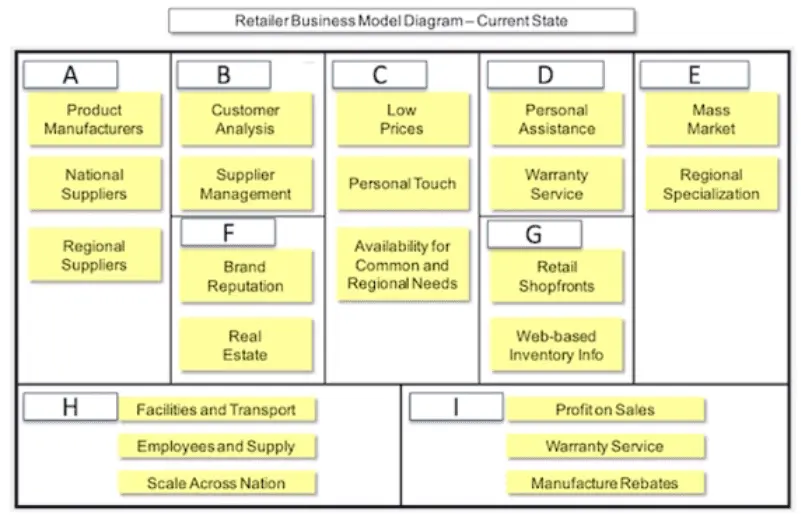
What are the segments labeled A, D and I?

Correct Answer: C. Key Partners, Customer Relationships, Revenue Streams.
Explanation:

The segments labeled A, D and I in the Business Model Canvas are Key Partners, Customer Relationships, and Revenue Streams respectively1.The Business Model Canvas is a tool that can be used to describe how an organization creates, delivers, and captures value for its stakeholders1.The Business Model Canvas consists of nine segments that cover four main areas: customers (segments B,C,D), offer (segment E), infrastructure (segments A,F,G), and financial viability (segments H,I)1. The segments are defined as follows:

Key Partners (segment A): The network of suppliers and partners that make the business model work1.Key partners can provide resources, activities, or support that enable the organization to offer its value proposition1.

Customer Relationships (segment D): The type of relationship that the organization establishes with its customer segments1.Customer relationships can be driven by customer acquisition, retention, or loyalty objectives1.Customer relationships can also influence the customer experience and satisfaction1.

Revenue Streams (segment I): The sources of income that the organization generates from each customer segment1.Revenue streams can be derived from different pricing mechanisms, such as asset sale, subscription, fee, commission, or advertising1.Revenue streams can also reflect the value that customers are willing to pay for the organization's offer1.

https://pubs.opengroup.org/togaf-standard/business-architecture/business-models.html Figure 8: The Business Model Canvas[6]


Question 2

Which of the following is a difference between an organization map and an organization chart?

Correct Answer: C. An organization map describes the complex interactions and relationship within an organization.
Explanation:

An organization map provides a detailed representation of the complex interactions and relationships within an organization, going beyond the hierarchical structure shown in an organization chart. It includes the connections and dependencies between different business units, teams, and roles, offering a more comprehensive view of how the organization operates and collaborates to achieve its objectives.


Question 3

Which of the following best describes this diagram?

Correct Answer: A. Business Capability Map
Explanation:

The diagram presented is best described as a Business Capability Map. Here's a detailed explanation:

Business Capability Map:

Definition: A Business Capability Map represents the various capabilities an organization requires to deliver its products and services and achieve its strategic objectives. It typically categorizes capabilities into different levels or tiers, such as strategic, core, and supporting capabilities.

Diagram Analysis:

Layers and Groupings: The diagram shows capabilities grouped into three categories: Strategic, Core, and Supporting. Each group lists specific business capabilities necessary for the organization's functioning.

Color Coding: The use of different colors (green, red, yellow, purple) may indicate various aspects such as priority, status, or different business units. However, the primary purpose is to visually represent and categorize capabilities.

TOGAF Reference:

Phase B: Business Architecture: In this phase, creating a Business Capability Map is a crucial activity. It helps in understanding the business functions and aligning them with strategic goals.

Capability-Based Planning: TOGAF promotes capability-based planning, which involves identifying, mapping, and analyzing business capabilities to ensure they support the overall strategy and objectives.

Purpose and Benefits:

Strategic Alignment: The Business Capability Map helps in aligning business capabilities with the strategic objectives of the organization. It provides a clear view of what the organization needs to do to achieve its goals.

Gap Analysis: It is useful for conducting gap analysis by comparing current capabilities with the desired state, helping to identify areas for improvement.

Resource Allocation: By understanding the different capabilities, organizations can allocate resources more effectively to areas that need development or enhancement.

In summary, the diagram is best described as a Business Capability Map because it visually represents and categorizes the various capabilities needed by the organization into strategic, core, and supporting layers, aligning them with the business strategy and objectives.


Question 4

Which of the following best describes the relationship between business models and business architecture?

Correct Answer: B. Business Architecture articulates the different perspectives and impacts of the business model.
Explanation:

The relationship between business models and business architecture in TOGAF can be described as follows:

Business Models:

Definition: Business models describe how an organization creates, delivers, and captures value. They provide a high-level overview of the business, including elements such as value propositions, customer segments, channels, and revenue streams.

Purpose: Business models are used to understand and analyze the core elements of the business and how they interact to create value.

Business Architecture:

Definition: Business architecture provides a detailed view of the business, including its structure, capabilities, processes, and information. It articulates how the business operates and supports the business model.

Purpose: Business architecture translates the high-level view of the business model into detailed architectural views and artifacts. It ensures that the architecture aligns with the business strategy and supports the execution of the business model.

Relationship:

Articulation of Perspectives: Business architecture articulates the different perspectives and impacts of the business model by providing detailed views of the business components that support the model. This includes defining the necessary capabilities, processes, and organizational structures.

Alignment and Execution: Business architecture ensures that the architecture aligns with the business model and supports its execution. It translates the strategic intent of the business model into actionable and implementable architectural components.

TOGAF Reference:

Phase B: Business Architecture: This phase involves developing a detailed business architecture that aligns with and supports the business model. It includes identifying and defining business capabilities, processes, and organizational structures.

Strategic Planning: TOGAF emphasizes the importance of aligning business architecture with business strategy and models to ensure that the architecture supports the overall business goals.

Benefits:

Comprehensive Understanding: By articulating the different perspectives and impacts of the business model, business architecture provides a comprehensive understanding of how the business operates and delivers value.

Strategic Alignment: Ensures that the architecture is aligned with the business strategy and supports the execution of the business model, leading to better business outcomes.

In summary, business architecture articulates the different perspectives and impacts of the business model by providing detailed views of the business components that support the model, ensuring alignment and effective execution of the business strategy.


Question 5

Complete the sentence. The "Name" part of the recommended TOGAF template for Architecture Principles should________________________

Correct Answer: B. be easy to remember

Question 6

What process is used to decompose a set of business capabilities to communicate more detail?

Correct Answer: D. Leveling
Explanation:

The process used to decompose a set of business capabilities to communicate more detail is leveling6.Leveling is a technique that can be used to break down a business capability into sub-capabilities at lower levels of granularity6.Leveling can help to provide more clarity and specificity about what a business capability entails and how it supports the business goals and objectives6.Leveling can also help to identify dependencies, gaps, overlaps, or redundancies among business capabilities6.


Question 7

In the ADM, what is the name for a document deliverable that has completed a review and is approved?

Correct Answer: C. ratified

Question 8

Which approach to modeling business value is designed to create and end-to-end perspective of value from the customer's perspective?

Correct Answer: B. Value streams
Explanation:

A value stream is an approach to modeling business value that focuses on the end-to-end sequence of activities that an organization performs to deliver a product or service to the customer. This perspective is designed to help organizations understand the full lifecycle of value creation, from the initial customer demand to the final delivery of value. It provides a holistic view of the flow of value through the organization and is instrumental in identifying areas of waste and opportunities for improvement to enhance the overall customer experience. Value streams help in visualizing and optimizing the steps necessary to effect change in the business processes and systems that create value for the customers.


Question 9

Which of the following best describes the relationship between business models and business architecture?

Correct Answer: B. Business Architecture breaks a business model down into the core functional elements that describe how the business works.
Explanation:

A business model describes how an organization creates, delivers, and captures value for its stakeholders3.A business architecture breaks a business model down into the core functional elements that describe how the business works, such as the value proposition, the customer segments, the channels, the revenue streams, the cost structure, the key resources, the key activities, and the key partnerships3.

The relationship between business models and business architecture is that while business models provide a high-level description of business elements such as customers, markets, and the economic rationale of the business, the business architecture takes this model and breaks it down into more detailed descriptions. It identifies the core functional components and their relationships, which describe how the business operates, the roles involved, the information flowing through the business, and the technology supporting business activities.


Question 10

Consider the following statements;

1. A whole corporation or a division of a corporation

2. A government agency or a single government department

3. Partnerships and alliances of businesses working together, such as a consortium or supply chain

What are those examples of according to the TOGAF Standard?

Correct Answer: D. Enterprises
Explanation:

According to the TOGAF Standard, an enterprise is defined as any collection of organizations that has a common set of goals and/or a single bottom line1.The examples given in the question are all types of enterprises that can be the subject of enterprise architecture1.

In the context of TOGAF, the term 'enterprise' encompasses more than just a single organization. It refers to any collection of organizations that has a common set of goals. This can include, as described in the statements provided, entire corporations or their divisions, government agencies or departments, as well as business partnerships such as consortia or supply chains. TOGAF uses the term 'enterprise' to define the full scope of the entity that is the subject of planning, design, implementation, and operation of an Enterprise Architecture.