
Limited-Time Offer: Enjoy 50% Savings! Ends in 00h 00m 00s Coupon code: 50OFF
Skip to content

Free The Open Group TOGAF Enterprise Architecture Part 1 Exam OGEA-101 Exam Questions

Page: 1 / 12 Total 172 questions

Want more questions? Get Premium Access.

Question 1

Which of the following supports the need to govern Enterprise Architecture?

Correct Answer: C. Best practice governance enables the organization to control value realization
Explanation:

This statement best supports the need to govern Enterprise Architecture. Best practice governance enables the organization to control value realization by ensuring that architectures are aligned with the enterprise's strategy and objectives, meet the quality and performance requirements, and deliver the expected benefits and outcomes. The Architecture Project does not mandate the governance of the target architecture, but rather follows the governance framework established by the enterprise. The TOGAF standard can be used without executive governance, but it is recommended that executive sponsorship and support are obtained for successful architecture development and transition. The Stakeholders preferences may go beyond the architecture project scope and need control, but this is not the primary reason for governing Enterprise Architecture. Reference: The TOGAF Standard | The Open Group Website, Section 3.3.6 Architecture Governance.

Question 2

Consider the following statements:

A whole corporation or a division of a corporation

A government agency or a single government department

A chain of geographically distant organizations linked together by common ownership

Complete the sentence. The TOGAF Standard considers these to be examples of:

Correct Answer: C. Enterprises
Explanation:

''TOGAF defines **'enterprise' as any collection of organizations that has a common set of goals. For example, an enterprise could be a government agency, a whole corporation, a division of a corporation, a single department, or a chain of geographically distant organizations linked together by common ownership.'' www.opengroup.org


Question 3

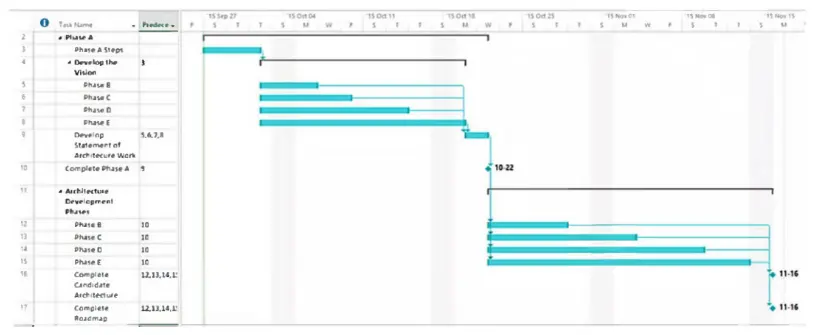
Consider the following chart:

Which important concept for Enterprise Architecture Practitioners does it illustrate?

Correct Answer: C. ADM phases must be run in a sequenced approach to produce the Architecture.
Explanation:

The chart shown is a Gantt chart, which is commonly used for project management to illustrate a project schedule. In the context of TOGAF (The Open Group Architecture Framework), which is a framework for enterprise architecture, this Gantt chart is demonstrating the sequenced approach to the Architecture Development Method (ADM). The ADM is the core process of TOGAF which provides a tested and repeatable process for developing architectures. The ADM is described as being iterative, over the whole process, between phases, and within phases. For each iteration of the ADM, a fresh decision must be taken about each of the parameters (scope, granularity, time period, and architecture assets).

The ADM consists of a number of phases that have to be followed in sequence:

Preliminary Phase: Framework and principles

Phase A: Architecture Vision

Phase B: Business Architecture

Phase C: Information Systems Architectures, including Data and Application Architectures

Phase D: Technology Architecture

Phase E: Opportunities and Solutions

Phase F: Migration Planning

Phase G: Implementation Governance

Phase H: Architecture Change Management

Requirements Management

Each phase is dependent on the outputs of the previous phase and the Requirements Management phase runs throughout. The Gantt chart clearly shows the dependency and sequence in which these phases occur, implying that a structured approach is followed to produce the enterprise architecture.

The TOGAF Standard, Version 9.2, a standard of The Open Group

The TOGAF documentation available at https://publications.opengroup.org/standards/architecture and https://publications.opengroup.org/guides/architecture


Question 4

Complete the sentence. The "Rationale" part of the recommended TOGAF template for Architecture Principles should:

Correct Answer: C. state the impact to the business of adopting the principle
Explanation:

In TOGAF, an Architecture Principle is defined using a structured template that includes several key elements such as Name, Statement, Rationale, and Implications. Each element serves a distinct purpose to ensure clarity, usability, and governance effectiveness.

The Rationale specifically explains why the principle exists and why it is important to the organization. It provides the business justification for the principle and describes the benefits of applying it. This includes outlining how adopting the principle supports business objectives, improves operations, reduces risk, or enables strategic outcomes. Therefore, the Rationale is closely tied to business impact and value, making option C the correct answer.

Option B is incorrect because communicating the fundamental rule is the role of the Statement, not the Rationale. Option A refers more to implementation guidance, which belongs to the Implications section, where the consequences and actions required to follow the principle are described. Option D is not part of the standard TOGAF template for principles.

By clearly stating the business impact, the Rationale helps stakeholders understand the importance of adhering to the principle and ensures alignment between architecture governance and business strategy. Therefore, the correct answer is C.


Question 5

Which statement best describes iteration and the ADM?

Correct Answer: D. The ADM is iterative, over the whole process between phases and within phases
Explanation:

This statement best describes iteration and the ADM. The ADM is iterative over the whole process between phases and within phases because it allows for feedback loops and refinements at any point in the architecture development and transition process. Iteration enables architects to address changing requirements, assumptions, constraints, and environments; to validate and improve architectures; to manage risks and issues; and to ensure stakeholder satisfaction and value realization. Reference: The TOGAF Standard | The Open Group Website, Section 3.1 Introduction to the ADM.


Question 6

Complete the sentence When considering agile development Architecture to Support Project will identify what products the Enterprise needs the boundary of the products and what constraints a product owner has. this defines the Enterprise's___________.

Correct Answer: B. backlog
Explanation:

When considering agile development, Architecture to Support Project will identify what products the enterprise needs, the boundary of the products, and what constraints a product owner has. This defines the enterprise's backlog. A backlog is a list of features or tasks that need to be done to deliver a product or service. It is prioritized by the product owner based on the value and urgency of each item. Reference: The TOGAF Standard | The Open Group Website, Section 3.3.5 Architecture to Support Project.


Question 7

Which of the following is the representation of a system from the perspective of a related set of concerns?

Correct Answer: D. Architecture View
Explanation:

In TOGAF, an Architecture View is defined as the representation of a system from the perspective of a related set of concerns. This means a view is created to address the interests of specific stakeholders by focusing on those aspects of the architecture that matter to them. For example, business stakeholders may need a view centered on processes and capabilities, while technical stakeholders may need a view showing applications, interfaces, or technology infrastructure.

The other options are not correct because they refer to specific forms of architectural content rather than the broader concept of stakeholder-oriented representation. A Catalog is a list of architectural elements. A Matrix shows relationships between items. A Diagram presents information graphically. All of these may be used to help construct or express an architecture view, but they are not themselves the formal TOGAF concept being asked about in the question.

The key phrase in the question is ''from the perspective of a related set of concerns.'' That wording matches the TOGAF definition of an Architecture View. It is specifically intended to communicate architecture in a way that is meaningful to stakeholders and their concerns. Therefore, the correct answer is Architecture View.


Question 8

Consider the following statements describing the TOGAF ADM:

All ADM activities are carried out within an iterative cycle of continuous architecture definition and realization

The Requirements Management phase is a continuous phase

Output from an early phase may be modified in a later phase

When a phase starts, the previous phase closes

Which statements are correct?

Correct Answer: B. 1, 2 & 3
Explanation:

Comprehensive and Detailed Explanation

Let's examine each statement against the TOGAF ADM principles:

All ADM activities are carried out within an iterative cycle of continuous architecture definition and realization

Correct. The ADM is iterative in three dimensions: across the cycle, between levels (enterprise, segment, capability), and within phases. This means architecture development is never linear but part of a continuous cycle of definition and realization.

The Requirements Management phase is a continuous phase

Correct. Requirements Management is central to the ADM cycle. It operates continuously, ensuring requirements are identified, stored, and addressed throughout all phases, not only in a single step.

Output from an early phase may be modified in a later phase

Correct. The ADM is iterative and allows feedback between phases. For example, new requirements identified in later phases may lead to modifications of deliverables from earlier phases.

When a phase starts, the previous phase closes

Incorrect. The ADM is not strictly sequential. Phases can overlap, iterate, and provide feedback loops. One phase starting does not imply that the previous phase is closed; instead, phases interact dynamically.

Correct Mapping

Statements 1, 2, and 3 are correct.

Statement 4 is incorrect.

Correct answer is B (1, 2 & 3).

Why the other options are incorrect

A (2, 3 & 4): Includes statement 4, which is incorrect.

C (1, 2 & 4): Includes statement 4, which is incorrect.

D (1, 3 & 4): Includes statement 4, which is incorrect.

Reference

The Open Group, TOGAF Standard, Version 9.2, Part II: ADM --- overview of ADM iterations, Requirements Management, and feedback between phases.

The Open Group, TOGAF 9 Certified Study Guide --- emphasizes ADM as iterative and requirements-driven.


Question 9

Which of the following matches the Architecture Capability component of the Architecture Repository?

A record of governance activity across the enterprise

The architectural representation of assets in use or planned

The parameters, structures, and processes to support governance of the Repository

The standards with which new architectures must comply

The authorized change requests from the Architecture Board

Correct Answer: D. The parameters, structures, and processes to support governance of the Repository.
Explanation:

Within the TOGAF Architecture Repository, the Architecture Capability component contains the organizational and governance support needed to operate the repository and the architecture function effectively. This includes the parameters, structures, roles, processes, and control mechanisms that allow the repository and architecture practice to be governed in a disciplined way. Because of that, option D is the correct match.

The other descriptions relate to different repository components. ''The architectural representation of assets in use or planned'' belongs more closely to the Landscape Repository, which captures current and planned architecture assets. ''The standards with which new architectures must comply'' corresponds to the Standards Information Base, where relevant standards and rules are maintained. ''A record of governance activity across the enterprise'' aligns with the Governance Log, which tracks governance-related actions and decisions. ''Authorized change requests from the Architecture Board'' would be treated as governance-controlled change information rather than the Architecture Capability itself.

TOGAF distinguishes the Architecture Capability from the content held in the repository because capability is about how architecture is governed and supported, not only what architecture content is stored. Therefore, the correct answer is the parameters, structures, and processes to support governance of the Repository, which is option D.


Question 10

In the ADM, what is the name for a document deliverable that has completed a review and is approved?

Correct Answer: A. final
Explanation:

Comprehensive and Detailed Explanation

In the TOGAF ADM, deliverables go through a lifecycle of development, review, approval, and usage. TOGAF distinguishes between draft deliverables (work-in-progress) and final deliverables (those that have been formally reviewed and signed off).

Draft deliverables are produced as working versions of the required outputs in each ADM phase. These may carry version labels such as 0.1, 0.5, 0.9, etc., and are subject to stakeholder review and refinement.

Once the document has been reviewed and approved by the relevant stakeholders (e.g., Architecture Board, governance bodies), it becomes a final deliverable.

Final deliverables are baseline-controlled items and are formally stored in the Architecture Repository as an approved architecture artifact.

Thus, the correct term for a deliverable that has completed review and is approved is ''final''.

Why the other options are incorrect

B . Approved: While true in general language, TOGAF uses the formal term ''final deliverable'', not ''approved deliverable.''

C . Ratified: This term is not used in TOGAF to describe the state of a deliverable.

D . Version 0.9: This is a draft numbering convention, not the status of an approved deliverable.

Reference

The Open Group, TOGAF Standard, Version 9.2, Part II: ADM --- description of deliverables, artifacts, and building blocks.

The Open Group, TOGAF 9 Certified Study Guide --- explanation of draft vs. final deliverables in the ADM lifecycle.


Question 11

Which of the following best describes purpose of the Business Scenarios?

Correct Answer: B. To identify and understand requirements
Explanation:

Business scenarios are a technique for capturing, clarifying, and communicating the functional and non-functional requirements of a system. Business scenarios describe the business environment, the actors involved, the desired outcomes, and the processes or rules that govern the behavior of the system. Business scenarios are useful for ensuring that the architecture addresses the real needs and concerns of the stakeholders, and for validating and testing the architecture against expected situations.Business scenarios are developed in Phase A: Architecture Vision of the ADM cycle, and refined and updated throughout the other phases3Reference:3: The TOGAF Standard, Version 9.2, Part III: ADM Guidelines and Techniques, Chapter 26: Business Scenarios : The TOGAF Standard, Version 9.2, Part II: Architecture Development Method (ADM), Chapter 18: Phase A: Architecture Vision


Question 12

Refer to the table below:

Which ADM Phase(s) does this describe?

Correct Answer: D. Phase F

Question 13

In which phase of the ADM cycle do building blocks become implementation-specific?

Correct Answer: D. Phase E
Explanation:

Building blocks are reusable components of business, IT, or architectural capability that can be combined to deliver architectures and solutions. Building blocks can be defined at various levels of detail, depending on the stage of architecture development. In the earlier phases of the ADM cycle (A to D), building blocks are defined in generic terms, such as logical or physical, to provide a high-level view of the architecture. In Phase E: Opportunities and Solutions, building blocks become implementation-specific, meaning that they are linked to specific products, standards, technologies, and vendors that are available in the market.This phase also identifies the delivery vehicles, such as projects, programs, or portfolios, that will realize the building blocks12Reference:1: The TOGAF Standard, Version 9.2, Part II: Architecture Development Method (ADM), Chapter 23: Phase E: Opportunities and Solutions2: The TOGAF Standard, Version 9.2, Part IV: Architecture Content Framework, Chapter 36: Building Blocks


Question 14

Complete the sentence A business scenario describes______________

Correct Answer: C. business and technology environment in which those problems occur
Explanation:

A business scenario describes business and technology environment in which those problems occur. It provides a realistic context for identifying and addressing business problems and opportunities, as well as their impact on the enterprise's architecture. Reference: The TOGAF Standard | The Open Group Website, Section 3.3.1 Business Scenarios.

business and technology environment in which those problems occur https://pubs.opengroup.org/togaf-standard/business-architecture/business-scenarios.html#_Toc68617078 '

A Business Scenario is a uniform description of: - Real business problems - The business and technology environment in which those problems occur - Value streams enabled by capabilities - The desired outcome(s) of proper execution - The human and computing components (the ''actors'') who provide the capabilities'


Question 15

Complete the sentence. The ''Statement'' part of the recommended TOGAF template for Architecture Principles

Correct Answer: D. should clearly communicate the fundamental rule
Explanation:

In TOGAF, when defining an architecture principle, one part of the standard template is the ''Statement.'' The purpose of the Statement is to convey clearly and unambiguously the principle itself --- not its rationale, implications, or how to apply it. The Statement should be phrased such that stakeholders can read it and immediately understand the core rule or guiding intent. It is not intended to describe the implementation or benefits or constraints, nor to be a mnemonic. Thus the Statement must clearly communicate the fundamental rule. The rationale, implications, and further explanation belong in other parts of the principle documentation, not in the Statement. This division helps maintain clarity, separation of concerns, and consistency in how principles are documented and governed.