Free The Open Group TOGAF Enterprise Architecture Bridge OGEA-10B Exam Questions
Page: 1 / 11Total 104 questions
Want more questions? Get Premium Access.
Question 1
Which of the following best describes the purpose of the Architecture Requirements Specification?
Correct Answer:B. It provides a set of statements that outline what a project must do to comply with the architecture
Explanation:
The Architecture Requirements Specification is one of the TOGAF deliverables that provides a set of quantitative statements that outline what an implementation project must do in order to comply with the architecture12. It is a companion to the Architecture Definition Document, which provides a qualitative view of the solution and aims to communicate the intent of the architect. The Architecture Requirements Specification provides a quantitative view of the solution, stating measurable criteria that must be met during the implementation of the architecture3. It typically forms a major component of an implementation contract or contract for more detailed Architecture Definition4. Reference:
* Deliverable: Architecture Requirements Specification - The Open Group
* Architecture Requirements Specification - Visual Paradigm Community Circle
* The TOGAF Standard, Version 9.2 - Definitions - The Open Group
* The TOGAF Standard, Version 9.2 - Architecture Requirements Specification - The Open Group
Question 2
Which of the following are interests important to the stakeholders in a system?
Correct Answer:C. Concerns
Explanation:
Concerns are interests important to the stakeholders in a system. They are used to identify and classify the system's stakeholders and to guide the selection of viewpoints for the architecture description. Reference: The TOGAF Standard | The Open Group Website, Section 3.2.1 Architecture Viewpoints
Question 3
What should be put in place through organization structures, roles, responsibilities, skills and processes to carry out architectural activity effectively?
Correct Answer:A. An EA Capability
Explanation:
An EA Capability is the ability of an organization to perform enterprise architecture effectively and efficiently. It involves establishing and maintaining the appropriate organization structures, roles, responsibilities, skills, processes, tools, and governance mechanisms to support the development and use of enterprise architecture.An EA Capability enables the organization to align its business and IT strategies, deliver value from its investments, manage change and complexity, and improve its performance and agility12Reference:1: The TOGAF Standard, Version 9.2, Part VI: Architecture Capability Framework, Chapter 44: Introduction2: The TOGAF Standard, Version 9.2, Part VI: Architecture Capability Framework, Chapter 45: Establishing and Maintaining an Enterprise Architecture Capability
Question 4
What are the following activities part of?
* Initial risk assessment
* Risk mitigation and residual risk assessment
* Risk monitoring
Correct Answer:A. Risk Management
Explanation:
The following activities are part of Risk Management:
Initial risk assessment
Risk mitigation and residual risk assessment
Risk monitoring
Risk Management is the process of identifying, assessing, and responding to risks that may affect the achievement of the enterprise's objectives. Risk Management involves balancing positive and negative outcomes resulting from the realization of either opportunities or threats. Reference: The TOGAF Standard | The Open Group Website, Section 3.3.3 Risk Management.
Question 5
Which of the following does the TOGAF standard describe as a package of functionality defined to meet business needs across an organization?
Correct Answer:D. A building block
Question 6
Which of the following best describes a purpose of the Gap Analysis technique?
Correct Answer:D. To identify missing functions
Explanation:
Gap analysis is a technique that is used to validate an architecture by highlighting the shortfall between the Baseline Architecture and the Target Architecture. One of the purposes of gap analysis is to identify missing functions that are either deliberately omitted, accidentally left out, or not yet defined in the Target Architecture.Missing functions are marked as gaps that need to be filled by developing or procuring the building blocks.
Question 7
What are the following activities part of?
. Risk classification
. Risk identification
. Initial risk assessment
Correct Answer:D. Risk Management
Explanation:
Risk management is a generic technique that can be applied across all phases of the Architecture Development Method (ADM), as well as in the Preliminary Phase and the Requirements Management Phase2. Risk management involves the following steps1:
* Risk identification: This step involves identifying the potential risks that may affect the architecture project, such as technical, business, organizational, environmental, or legal risks. The risks can be identified through various sources, such as stakeholder interviews, workshops, surveys, checklists, historical data, or expert judgment.
* Risk classification: This step involves categorizing the risks based on their nature, source, impact, and priority. The risks can be classified according to different criteria, such as time, cost, scope, quality, security, or compliance. The classification helps in prioritizing the risks and allocating resources and efforts to address them effectively.
* Initial risk assessment: This step involves assessing the likelihood and impact of each risk, and determining the initial level of risk. The likelihood is the probability of the risk occurring, and the impact is the severity of the consequences if the risk occurs. The initial level of risk is the product of the likelihood and impact, and it indicates the urgency and importance of the risk. The initial risk assessment helps in identifying the most critical risks that need immediate attention and mitigation.
Question 8
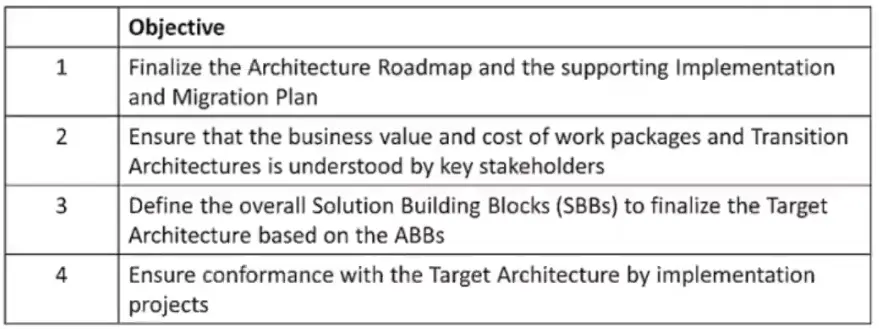
Consider the following ADM phases objectives.
Which phase does each objective match?
Correct Answer:B. 1E-2F-3E-4G
Explanation:
1E: To identify delivery vehicles (projects programs portfolios) that will deliver the Target Architecture 2F: To confirm readiness and ability to undergo change 3E: To determine whether an incremental approach is required and if so identify Transition Architectures that will deliver continuous business value 4G: To perform appropriate governance functions while the solution is being implemented
Question 9
Complete the following sentence:
Presenting different_________and_________to stakeholders helps architects to extract hidden agendas principles and requirements that could impact the final Target Architecture
According to the TOGAF Standard, an architecture view is a representation of a system from the perspective of a related set of concerns1.An architecture viewpoint is a specification of the conventions for a particular kind of architecture view1. Presenting different architecture views and architecture viewpoints to stakeholders helps architects to extract hidden agendas, principles, and requirements that could impact the final target architecture.This is because different stakeholders may have different concerns and interests in the system, and by showing them how the system addresses their concerns from different perspectives, the architects can elicit more feedback and validation from them2.For example, a business stakeholder may be interested in the business architecture view, which focuses on the business processes, functions, and capabilities of the system3.A security stakeholder may be interested in the enterprise security view, which addresses the security aspects of the system, such as confidentiality, integrity, and availability3.By presenting these views to the respective stakeholders, the architects can ensure that the system meets their expectations and needs, and also identify any potential issues or gaps that may affect the target architecture.Reference:1: The TOGAF Standard, Version 9.2 - Architectural Artifacts - The Open Group1;2: Understanding TOGAF Views and Viewpoints in Enterprise Architecture2;3: Developing Architecture Views - The Open Group4
Question 10
Please read this scenario prior to answering the question
Your role is that of a consultant to the Lead Enterprise Architect to an international supplier of
engineering services and automated manufacturing systems. It has three manufacturing plants
where it assembles both standard and customized products for industrial production
automation. Each of these plants has been operating its own planning and production
scheduling systems, as well as applications and control systems that drive the automated
production line.
The Enterprise Architecture department has been operating for several years and has mature,
well-developed architecture governance and development processes that are based on the
TOGAF Standard. The CIO sponsors the Enterprise Architecture.
During a recent management meeting, a senior Vice-President highlighted an interview where
a competitor company's CIO is reported as saying that their production efficiency had been
improved by replacing multiple planning and scheduling systems with a common Enterprise
Resource Planning (ERP) system located in a central data center. Some discussion followed,
with the CIO responding that the situations are not comparable, and the current architecture is
already optimized.
In response, the Architecture Board approved a Request for Architecture Work covering the
investigations to determine if such an architecture transformation would lead to improvements
in efficiency. You have been assigned to support the architecture team working on this project.
A well-known concern of the plant managers is about the security and reliability of driving their
planning and production scheduling from a remote centralized system. Any chosen system
would also need to support the current supply chain network consisting of local partners at
each of the plants.
Refer to the scenario
You have been asked to explain how you will initiate the architecture project.
Based on the TOGAF Standard, which of the following is the best answer?
Correct Answer:C. You would hold a series of interviews at each of the manufacturing plants using the
business scenarios technique. This will allow you to understand the systems and
integrations with local partners. You would use stakeholder analysis to identify key
players in the engagement, and to understand their concerns. You will then identify
and document the key high-level stakeholder requirements for the architecture. You
will then generate high level definitions of the baseline and target architectures.
Explanation:
The best answer is C. You would hold a series of interviews at each of the manufacturing plants using the business scenarios technique. This will allow you to understand the systems and integrations with local partners. You would use stakeholder analysis to identify key players in the engagement, and to understand their concerns. You will then identify and document the key high-level stakeholder requirements for the architecture. You will then generate high level definitions of the baseline and target architectures.
This answer is based on the TOGAF standard, which recommends the following steps to initiate the architecture project1:
Establish the architecture project
Identify stakeholders, concerns, and business requirements
Confirm and elaborate business goals, business drivers, and constraints
Evaluate business capabilities
Assess readiness for business transformation
Define scope
Confirm and elaborate Architecture Principles, including business principles
Develop Architecture Vision
Define the Target Architecture value propositions and KPIs
Identify the business transformation risks and mitigation activities
Secure stakeholder and sponsor approval
The answer C covers most of these steps, by using the business scenarios technique to elicit and validate the business requirements, goals, drivers, and constraints, as well as the current and future states of the architecture2. The answer C also uses stakeholder analysis to identify and engage the key stakeholders, and to address their concerns and expectations3. The answer C also generates high level definitions of the baseline and target architectures, which can be used to develop the Architecture Vision and the value propositions4.
The other answers are not the best approach for architecture development, because:
Answer A focuses on researching vendor literature and conducting briefings with vendors, which is not the best way to understand the business needs and the current situation of the enterprise. Answer A also defines a preliminary Architecture Vision without involving the stakeholders or validating the requirements, which may lead to misalignment and lack of consensus.
Answer B conducts a pilot project that will enable vendors to demonstrate potential solutions, which is premature and costly at this stage of the architecture project. Answer B also does not address the stakeholder concerns or the current systems and integrations, which may result in gaps and risks. Answer B also develops the requirements after the pilot project, which may not reflect the actual business needs and goals.
Answer D develops baseline and target architectures for each of the manufacturing plants, which may not consider the enterprise-wide perspective and the potential benefits of a common ERP system. Answer D also does not involve the stakeholders or address their concerns, which may result in resistance and conflict. Answer D also does not define the business case or the performance metrics, which are essential for demonstrating the value and feasibility of the architecture.