
Limited-Time Offer: Enjoy 50% Savings! Ends in 00h 00m 00s Coupon code: 50OFF
Skip to content

Free Versa Networks Versa Certified SD-WAN Specialist VNX301 Exam Questions

Page: 1 / 6 Total 60 questions

Want more questions? Get Premium Access.

Question 1

A Versa Director operator wants to monitor CPU, memory, disk, recent events, uptime, HA status, package information, and license details from the Director GUI. Which top-level tab should be used?

Correct Answer: A. Monitor
Explanation:

The correct answer is A. Versa documentation states that from a Director node, administrators can monitor the Director node itself, provider organizations, tenants, and VOS devices. The procedure begins by selecting the Monitor tab in the top menu bar. When a Director node is selected, the monitor screen displays panes such as System Detail, Recent Events, Package Information, Uptime, High Availability, and License.

This view is intended for operational monitoring and troubleshooting. It allows administrators to see system resource status, recent alarms and events, software package details, uptime, HA configuration, and licenses installed on managed VOS devices.

Workflows are used for provisioning and template-based configuration, not monitoring these system panes. Analytics Search is useful for querying logs and flow records, but it is not the Director system-monitoring screen described in the question. Administration > Connectors relates to integration and resource connectivity rather than Director node health and license monitoring. Therefore, the correct location is the Monitor tab.
Question 2

You need to quickly check interface administrative status, operational status, tenant ID, VRF, MAC address, and IP address on a VOS device. Which command should you use?

Correct Answer: A. show interfaces brief
Explanation:

The correct answer is A. Versa's handy CLI command reference lists show interfaces brief as the command used to view a list of interfaces along with their MAC addresses, operational and administrative status, tenant ID, VRF, and IP addresses. This is one of the first commands administrators run when validating device bring-up, staging interface assignment, WAN/LAN mapping, or whether a template applied interface addressing as expected.

For deeper interface troubleshooting, show interfaces detail provides additional information such as interface index, host interface, MTU, speed and duplex settings, RX/TX errors, and bridge information. However, for a quick overview of state and addressing across interfaces, show interfaces brief is the correct choice.

show system package-info identifies the running VOS software package. show system storage reports system storage resources. show coredumps shows generated core files. These are valuable operational commands, but they do not provide the requested interface status and addressing summary.


Question 3

You configured Direct Internet Access on your Versa branches using the workflow template. Which statement is true in this scenario?

Correct Answer: C. DIA configured in a workflow automatically creates a CGNAT pool and rule, and associates it with the internet-facing network.
Explanation:

The correct answer is C. In Versa Secure SD-WAN, Direct Internet Access, or DIA, provides local internet breakout from the branch rather than backhauling internet-bound traffic through a hub. Versa design documentation explains that the DIA architecture creates an internal connection between the tenant VRF and the WAN transport VR and uses CGNAT to translate internet-bound LAN traffic to the public IP address associated with the WAN transport interface. It specifically states that the main DIA components include the CGNAT function for translating internet-bound traffic and that DIA is configured using Director Workflows when configuring tunnels.

When the workflow template is used and the DIA option is selected for the internet breakout tunnel, Director automatically builds the required DIA infrastructure, including the NAPT/CGNAT configuration associated with the internet-facing transport network. This is why manual creation of the CGNAT pool and rule is not required in the workflow-based method. Option A describes a manual configuration approach, not the workflow-generated behavior. Option B is incorrect because NAT must be associated with the internet-facing breakout path, not simply the LAN interface. Option D is incorrect because DIA normally requires address translation for LAN users accessing the public internet.


Question 4

Examine the exhibit below. The exhibit shows a device group created for a new group of hubs. The device template called ''BMBF-TEMPLATE'' has an Address object called ''Server''. A network administrator creates the Class of Service Template called ''Ship-CoS-IT'' that has an Address object with the same name. Then it tries to onboard a new device to this device group. Which statement is true about the configuration that this device will have?

Correct Answer: D. The device configuration will have the version of the Address object in the QoS template.
Explanation:

The correct answer is D. In the displayed post-staging template association order, the device template BMBF-TEMPLATE is applied before the QoS service template Ship-CoS-IT. Versa documentation explains that device templates, also called post-staging templates, provide the baseline configuration for devices, while service templates are service-specific configurations that can be applied to device configurations. It also states that service templates are associated with device groups and that, in a device group, the administrator can choose the order in which service templates are applied.

Because the QoS template is later in the shown association order, the final merged device configuration uses the Address object definition from the QoS template when the same object name exists in both templates. It does not automatically create two copies of the same Address object, because the object name is the key for the configuration element. It also should not fail merely because the same object name exists in a later template; the merge behavior resolves the effective configuration according to the template order. Therefore, the onboarded hub device receives the Server Address object version from Ship-CoS-IT, the QoS template.


Question 5

Examine the exhibit below. You are configuring an IPsec tunnel towards a non-SD-WAN site over the INETTransport-VR. The site IP address is 10.1.1.1. This tunnel is for traffic between the 192.168.100.0/24 and the 192.168.200.0/24 LAN networks. The tunnel does not establish. Referring to the exhibit, which statement is correct?

Correct Answer: A. The Tunnel Routing Instance is incorrect.
Explanation:

The correct answer is A. The exhibit shows that the IPsec VPN is being configured with Tunnel Routing Instance: XIAN-Control-VR. However, the question states that the tunnel is toward a non-SD-WAN site over the INET-Transport-VR. For a site-to-site IPsec tunnel, the tunnel routing instance must match the routing instance used to reach the peer public IP address. In this case, the remote non-SD-WAN peer is 10.1.1.1, and the intended underlay transport is INET-Transport-VR, not the Control VR.

Versa troubleshooting documentation explains that routing instances are used to define where traffic is sourced and forwarded. For example, configuration examples select routing instances when enabling services or initiating tests, and traffic must use the correct WAN or transport routing instance to reach the remote endpoint. Versa branch troubleshooting also emphasizes that after transport connectivity is available, the branch establishes IKE-based IPsec connectivity; if that connectivity fails, the IPsec-related interface remains down.

Changing the routing instance to global would not be correct because the intended path is specifically INET-Transport-VR. A higher precedence value is not required to establish the tunnel. The policy selector shown already defines local-to-remote interesting traffic, and the key failure is the incorrect tunnel routing instance.


Question 6

Examine the exhibit below.

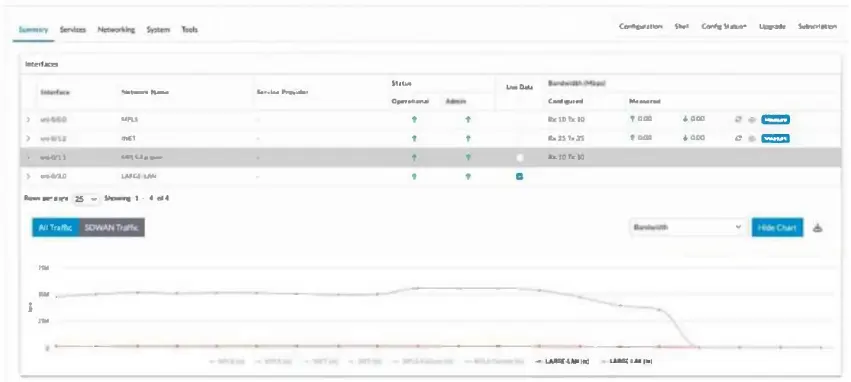
As an administrator of a Versa Secure SD-WAN deployment, you are asked to find the current bandwidth of each WAN circuit used for SD-WAN connectivity in a branch, but Versa Director is not displaying any information for the WAN circuits. In this scenario, what should be done to get the graph populated for all WAN circuits?

Correct Answer: B. Select Live Data for all WAN circuits in the dashboard.
Explanation:

The correct answer is B. In the exhibit, Versa Director shows multiple branch interfaces and a Live Data column. To populate the bandwidth graph with current real-time statistics for all WAN circuits, Live Data must be selected for each WAN circuit that should be monitored. Versa documentation states that from a Director node, administrators can monitor VOS devices, provider organizations, tenants, events, and alarms. It also explains that Versa Director, together with Versa Analytics, can poll VOS devices in real time to provide visibility into what is happening on those devices and to assist with troubleshooting.

Because the requirement is to find the current bandwidth of each WAN circuit, simply refreshing the page is not enough. Refreshing only reloads the dashboard; it does not enable real-time polling for interfaces that are not selected. Selecting Live Data only for MPLS circuits would populate only MPLS-related data and would not satisfy the requirement for all WAN circuits. Unselecting and reselecting only the INET circuit affects only that one circuit. Therefore, the correct operational step is to enable Live Data for all WAN circuits shown in the branch interface dashboard.


Question 7

Examine the CLI output in the exhibit.

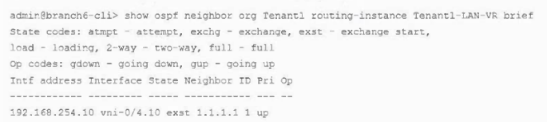
You are reviewing the OSPF adjacency on a VOS CPE, and the output is shown in the exhibit. In this scenario, what is the probable cause of the OSPF adjacency issue?

Correct Answer: B. There is an interface MTU mismatch between the OSPF peers.
Explanation:

The correct answer is B. The exhibit shows the OSPF neighbor in the exst state, which means Exchange Start. Versa documentation lists the OSPF neighbor state codes and identifies exst as ''exchange start,'' followed by exchange, loading, and full. In normal OSPF adjacency formation, neighbors progress through initialization and two-way communication before they negotiate database exchange. If the neighbor becomes stuck in ExStart or Exchange, a common and highly probable cause is an MTU mismatch between the two OSPF peers. During database description packet negotiation, the peers must agree on parameters that allow LSDB exchange; an MTU mismatch can prevent the adjacency from advancing to Full.

Option A is less likely because an area mismatch usually prevents the neighbor relationship from forming correctly rather than leaving it stuck in ExStart. Option C is also incorrect because the neighbor has already progressed beyond early states, which indicates that bidirectional communication has occurred. Option D is not the best answer because dropping OSPF multicast 224.0.0.5 would typically prevent discovery or keep the adjacency in an earlier state, not specifically in ExStart. Therefore, the probable cause is an interface MTU mismatch.


Question 8

During branch onboarding, you need to verify whether the Controller has sent branch-connect and branch-disconnect notifications to Versa Director. Which CLI command should be used?

Correct Answer: A. show alarms
Explanation:

The correct answer is A. Versa troubleshooting documentation states that after a branch device successfully establishes an IPsec connection to the Controller node, the Controller sends a notification to the Director node. To display the details of this notification, the documentation instructs administrators to issue the show alarms CLI command. It also provides examples using show alarms | match branchd | match br101 to view branch-connect and branch-disconnect events.

These alarm entries are valuable during onboarding because they show whether the branch reached the Controller, whether staging progressed, and whether the branch later disconnected. For example, branch lifecycle notifications include factory-default connection, staged connection, Stage 3 connection with WAN IP addresses, and branch disconnect events.

show system storage is useful for disk usage, show interfaces detail helps with link state, speed, duplex, and interface counters, and show cgnat acl info is used for CGNAT matching. None of those commands directly confirms branch lifecycle notifications between Controller and Director.


Question 9

Examine the exhibit below. A DoS Profile shown in the exhibit is applied to an SD-WAN branch. Referring to the exhibit, which statement is correct?

Correct Answer: B. Packets are randomly dropped if TCP throughput is 7000 packets per second.
Explanation:

The correct answer is B. The DoS profile in the exhibit is a Classified Profile using Source IP Only as the classification key. For TCP flood protection, the profile is enabled and shows an Alarm Rate of 5000 packets per second, an Activate Rate of 7000 packets per second, a Maximum Rate of 100000 packets per second, a Drop Period of 300 seconds, and an action of Random. This means the first threshold, 5000 pps, is used to trigger alarm behavior, while the second threshold, 7000 pps, activates the configured mitigation action. Since the selected action is Random, packets are randomly dropped when the TCP rate reaches the activate threshold.

Versa documentation shows that DoS policies can match traffic using source, destination, service, application, schedule, IP version, DSCP, and other conditions, and that a DoS policy can set either an aggregate or classified DoS profile. It also documents that DoS policies support enforcement actions and logging through LEF profiles for DoS events. Therefore, 7000 pps does not merely generate an alarm, and it does not mean complete dropping. Complete dropping is not selected in the exhibit.


Question 10

Examine the exhibit below.

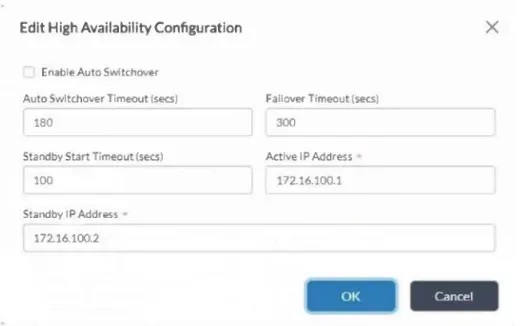
You are deploying Versa Secure SD-WAN and require high availability for the Versa Directors. You configured the Versa Director high availability parameters shown in the exhibit. With the parameters shown, which two statements are true? (Choose two.)

Correct Answer: B. The backup Director will automatically take over mastership if the primary Director fails.; D. The administrator must manually set the primary Director as active once it comes back online.
Explanation:

Comprehensive and Detailed 150 to 250 words of Explanation From Versa Networks SDWAN Topics:

The correct answers are B and D. In the exhibit, Enable Auto Switchover is not selected. However, the Failover Timeout value is configured as 300 seconds. Versa Director HA documentation states that the Failover Timeout is the timeout period before the standby Director node can promote itself to become the active Director node. Therefore, if the active or primary Director fails, the backup Director can automatically assume the active role after the failover condition and timeout are met.

The important distinction is that Auto Switchover controls revertive behavior after recovery, not the initial standby takeover during failure. Versa documentation explains that Director HA is non-revertive by default. This means that when the designated master or primary Director comes back online after recovery, it is not automatically promoted back to active unless automatic switchover is enabled. To make the designated active Director automatically reclaim the active state after recovery, Enable Auto Switchover must be selected and the Auto Switchover Timeout must expire.