Limited-Time Offer: Enjoy 50% Savings! Ends in 00h 00m 00s Coupon code: 50OFF
Skip to content

Free VMware Cloud Professional Exam 2V0-33.22PSE Exam Questions

Page: 1 / 13 Total 126 questions

Want more questions? Get Premium Access.

Question 1

A cloud administrator wants to enable administrator wants to enable Enterprise Federation to the Cloud Services Portal in order to be able to authenticate with the on-premises Active Directory. The Administrator Already deployed the on-premises VMware Workspace One Access Connector. Through which port does the Cloud Service Portal communicate with Workspace ONE Access Connector?

Question 2

Which statements accurately describe gateway firewalls and distributed firewalls? (Select two options)

Correct Answer: B. Only gateway firewalls use stateful rules.; D. A gateway firewall protects north-south traffic.
Explanation:

Gateway firewalls are used to protect east-west traffic, while distributed firewalls control the I/O path to and from a VM's virtual NIC. Furthermore, gateway firewalls and distributed firewalls cannot share the same sets of rules and policies.


Question 3

A cloud administrator with an existing virtual private cloud (VPC) needs to create a dedicated connection to VMware Cloud on AWS. Which connection type would meet this requirement?

Correct Answer: D. Private virtual interface

Question 4

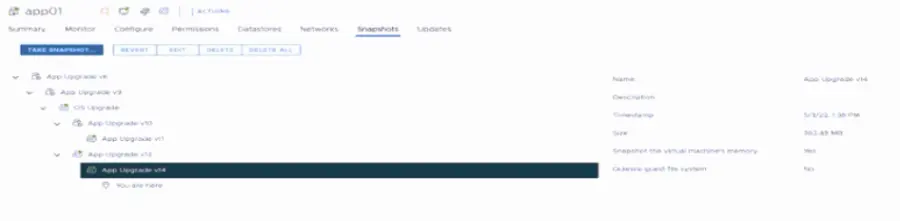
Refer to the exhibit.

A cloud administrator is investigating a reported performance issue on a virtual machine (VM). The administrator observes low latency on the datastore but high latency within the VM. The administrator notes that it is a standard operating procedure to take a snapshot of the VM whenever there is an application or operating system upgrade on this VM.

Based on the exhibit, which snapshot characteristic will result in performance degradation?

Correct Answer: A. Snapshot chain length
Explanation:

https://www.nakivo.com/blog/vmware-snapshots-vsphere-how-to/#title-12

Follow these recommendations to get the best performance when using snapshots:

* Use snapshots as a temporary measure only. The presence of snapshots can have a significant impact on guest application performance, especially in a VMFS environment, for I/O intensive workloads. The guest applications fully recover performance after snapshots are deleted.

* Keep the snapshot chain length short when possible, to minimize the guest application performance impact. Performance degradation is higher as the snapshot chain length increases.

* If you need to increase the size of a virtual disk that has snapshots associated with it, you must delete the snapshots first before you can increase the virtual disk's size.


Question 5

What is a benefit of public cloud computing?

Correct Answer: D. Cost savings on capital hardware expenses
Explanation:

One benefit of public cloud computing is cost savings on capital hardware expenses. Since the cloud provider owns and manages the hardware, the customer does not need to invest in the purchase and maintenance of physical hardware, resulting in significant cost savings. Additionally, public cloud services often provide scalability and can be accessed from anywhere with an internet connection.


Question 6

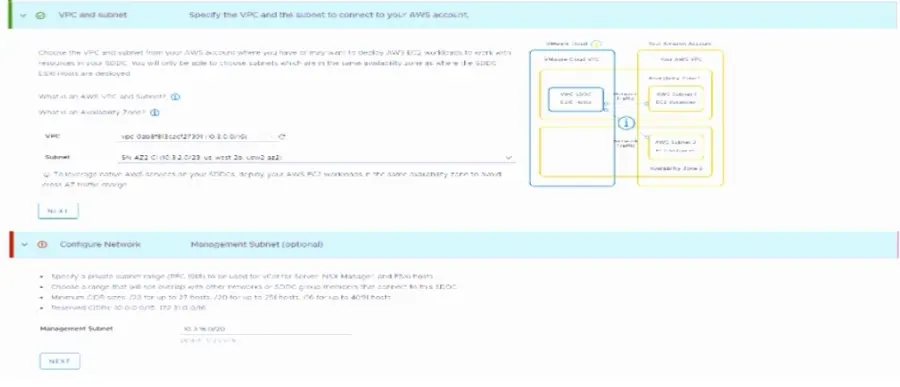
Refer to the exhibit.

A cloud administrator is deploying a new VMware Cloud on AWS virtual private cloud (VPC). After clicking on deploy, the screen refreshes and displays the information that is provided in the exhibit.

What is the issue with the management CIDR that is causing the deployment to fall?

Question 7

A cloud administrator is In the process of troubleshooting a non-compliant object. How can the administrator change a VM storage policy for an ISO image?

Correct Answer: C. Apply a new VM storage policy.
Explanation:

To address a non-compliant object, such as an ISO image, a cloud administrator can apply a new VM storage policy directly to that object. This doesn't require modifying the default VM storage policy or recreating the ISO image. Applying a new policy to the ISO allows for specific storage requirements to be met without affecting other objects or the default settings.


Question 8

A cloud administrator would like the VMware Cloud on AWS cluster to automatically scale-out and scale-In based on resource demand. Which two Elastic DRS policies can be configured to meet this requirement? (Choose two.)

Correct Answer: B. Optimize for Best Performance policy; C. Optimize for Lowest Cost policy

Question 9

A cloud administrator needs to configure a VM storage policy for virtual machines that will host a business critical application. The environment consists of a single cluster with six hosts. The application is storage I/O intensive and redundancy must be provided at the highest level possible.

Which VM storage policy settings should the administrator configure to meet these requirements?

Correct Answer: B. RAID-1 FTT = 2
Explanation:

RAID-1 is a mirror configuration that provides high availability by creating multiple copies of a VMDK. RAID-5 and RAID-6 are erasure coding configurations that provide fault tolerance by distributing data and parity across multiple hosts.

The number of failures to tolerate (FTT) determines how many copies or parity blocks are created for each VMDK. For example, RAID-1 FTT = 2 means that there are three copies of each VMDK.

Therefore, based on your requirements, a possible VM storage policy setting could beRAID-1 FTT = 2, which would provide redundancy at the highest level possible with six hosts.

https://docs.vmware.com/en/VMware-Cloud-on-AWS/services/com.vmware.vsphere.vmc-aws-manage-data-center-vms.doc/GUID-EDBB551B-51B0-421B-9C44-6ECB66ED660B.html


Question 10

Which three organizational aspects need to be considered to successfully transition to a cloud operating model? (Choose three.)