
Limited-Time Offer: Enjoy 50% Savings! Ends in 00h 00m 00s Coupon code: 50OFF
Skip to content

Free VMware Cloud Management and Automation Advanced Design 3V0-32.23 Exam Questions

Page: 1 / 9 Total 86 questions

Want more questions? Get Premium Access.

Question 1

Refer to the exhibit. An architect has created a logical design for VMware Aria Operations.
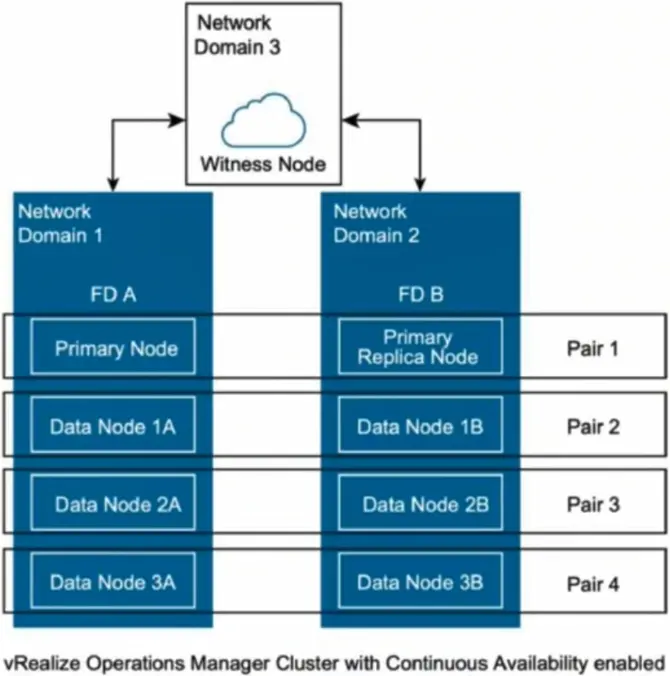
The architect has included Continuous Availability as part of the design.

Which scenarios does this design protect against. (Choose three.)

Correct Answer: A. The loss of Data Node 1A and Data Node 3A; E. The loss of a single network domain; F. The loss of two Data Node 2A and Data Node 2B
Explanation:

Continuous Availability (CA) in VMware Aria Operations (vRealize Operations Manager) protects against failures by distributing nodes across fault domains (FDs) and pairing nodes across domains. This design protects against losing any two nodes from different pairs (e.g., 1A and 3A, or 2A and 2B), and it can tolerate the complete loss of a single network domain (all nodes in either FD A or FD B), ensuring continuous service availability. It does not protect against the simultaneous loss of both the Primary Node and Primary Replica Node or both nodes of a pair (1A and 1B).


Question 2

Which design decision should an architect make to support continuous availability in VMware Aria Operations?

Correct Answer: B. The VMware Aria Operations cluster should be separated into two Fault Domains.
Explanation:

Continuous availability in VMware Aria Operations is achieved by splitting the cluster into two fault domains, allowing the system to withstand a complete failure of one domain without service interruption.


Question 3

An architect is designing a VMware Aria Operations for Logs cluster. Due to budget constraints the organization would like to use existing components as much as possible.

What should the architect choose as the load balancing solution for the VMware Aria Operations for Logs cluster?

Correct Answer: B. Use an existing external load balancer.
Explanation:

Leveraging the customer's already deployed external load balancer meets the load-balancing requirement without introducing new infrastructure or licensing costs, aligning with the budget constraint to reuse existing components.


Question 4

A customer has provided the following requirements for the conceptual model of the designs:

The cloud solution must support eight concurrent provisioned virtual machines.

The cloud solution must scale 14percent of the next three years.

Which selection represents the component of the conceptual model of the design?

Correct Answer: C. Functional requirements
Explanation:

Functional requirements describe what the solution must do (such as supporting eight concurrent provisioned VMs and the ability to scale), making them part of the conceptual model's functional requirements.


Question 5

Which VMware Cloud Management product can help deliver the following use cases:

Continuous operating system compliance enforcement

Automated vulnerability detection and remediation

Correct Answer: C. VMware Aria Automation for Secure Hosts
Explanation:

VMware Aria Automation for Secure Hosts is designed to enforce continuous operating system compliance and automate vulnerability detection and remediation, directly aligning with these use cases.


Question 6

What two statements are true about VMware Aria Operations Manager high availability (HA)? (Choose two.)

Correct Answer: B. If the primary node fails, the replica node can take over all functions of the primary node.; E. Upon failure of the primary node, failover to the replica is automatic.
Explanation:

In VMware Aria Operations Manager HA, the replica node automatically takes over the primary node's functions in case of failure, ensuring continuity of operations without manual intervention.


Question 7

An architect is creating a design for a VMware Cloud Management solution. Based on customer constraints, the design decision has already been made to select VMware Aria Automation (SaaS) as part of the solution.

The architect is evaluating a customer requirement to integrate with an IT Service Management (ITSM) solution that is based on-prem. The vendor of the ITSM solution has previously created an Aria Automation Orchestrator plugin that can be used as the foundation of the integration.

What additional component must the architect include in the solution design that will satisfy the requirement?

Correct Answer: B. VMware Aria Automation cloud extensibility proxy
Explanation:

The VMware Aria Automation cloud extensibility proxy enables integration between Aria Automation (SaaS) and on-premises systems, such as an on-prem ITSM solution, by facilitating secure communication and orchestrator plugin execution.


Question 8

An architect is designing a VMware Aria Operations for Logs cluster for an organization with the following requirements:

The organization has two main datacenters located in two separate locations.

Two separate clusters are created, one in each datacenter to collect and analyze logs locally.

The organization wants to configure redundancy for their log event data.

The organization must be able to access same data from both the datacenters.

Which one of these defined strategies should the architect follow to satisfy the requirements?

Correct Answer: A. Enable log forwarding with tags on each of the VMware Aria Operations for Logs clusters.
Explanation:

Enabling log forwarding with tags on both clusters ensures that log data is replicated between datacenters, providing redundancy and allowing access to the same data from both locations, while maintaining local analysis capabilities.


Question 9

An architect is designing a solution for managing cloud templates as part of a VMware Aria Automation design.

The customer has provided the following requirements:

The solution must use a version control system.

The solution must support the creation and update of VMware Cloud Templates using corporately approved editors.

The solution must automatically synchronize changes to ensure the latest VMware Cloud Template version is always available to deploy.

Which design decision should the architect make to complete the design?

Correct Answer: A. All VMware Cloud Templates will be stored in an external Git-based repository.
Explanation:

Storing templates in an external Git-based repository enables version control, supports integration with corporate editors, and allows for automatic synchronization, ensuring that the latest template version is always available for deployment.


Question 10

An organization wants to provide an automated self-service catalog to all departments within the organization. The key stakeholders have asked for the platform to:

Be resilient to component failures.

Each department consume the same on-premises infrastructure.

Restrict visibility and management of virtual machines to only those in their respective departments.

Choose one design decision that will meet the business requirements.

Correct Answer: A. Deploy multi-node deployment and use projects to separate the departments.
Explanation:

A multi-node deployment provides resilience to component failures, and using projects allows you to restrict visibility and management of virtual machines to each department, while sharing the same on-premises infrastructure.