
Limited-Time Offer: Enjoy 50% Savings! Ends in 00h 00m 00s Coupon code: 50OFF
Skip to content

Free WGU Integrated Physical Sciences Integrated-Physical-Sciences Exam Questions

Page: 1 / 7 Total 70 questions

Want more questions? Get Premium Access.

Question 1

Which statement describes the relationship between mass and acceleration when the net force on an object is kept constant?
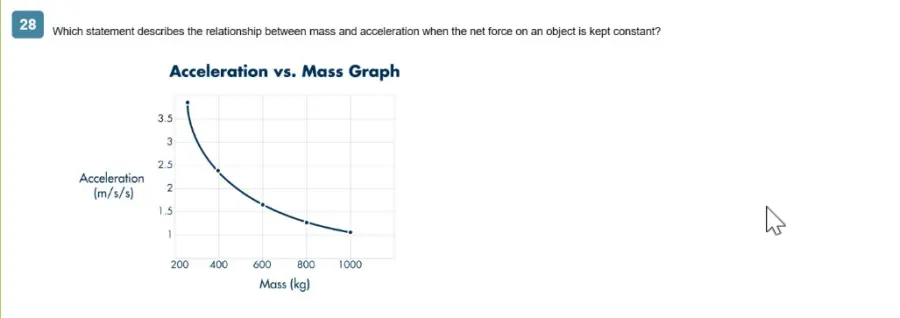
Correct Answer: B. Mass and acceleration are inversely proportional.
Explanation:

1. **Understanding the Graph**: The graph provided shows the relationship between acceleration (in m/s) and mass (in kg). The x-axis represents mass, and the y-axis represents acceleration. 2. **Observing the Trend**: The graph shows a decreasing curve, which indicates that as the mass increases, the acceleration decreases. 3. **Newton's Second Law of Motion**: According to Newton's Second Law of Motion, \( F = ma \), where \( F \) is the force, \( m \) is the mass, and \( a \) is the acceleration. If the net force (\( F \)) is kept constant, then \( a = \frac{F}{m} \). 4. **Inverse Proportionality**: The equation \( a = \frac{F}{m} \) suggests that acceleration \( a \) is inversely proportional to the mass \( m \). This means that if the mass increases, the acceleration decreases proportionally. 5. **Conclusion**: Based on the graph and Newton's Second Law, the correct description of the relationship is that mass and acceleration are inversely proportional. **Reference**: - Newton's Second Law of Motion: Basic principle in physics indicating the relationship between force, mass, and acceleration.


Question 2

On Tuesday morning, it was cool and clear. On Tuesday afternoon, light rain and fog occurred. On Wednesday morning, it was warmer and clear.

What caused the change in weather from Tuesday morning to Wednesday morning?

Correct Answer: C. A warm front moved through the area on Tuesday.
Explanation:

The weather change from cool and clear in the morning to light rain and fog in the afternoon, followed by warmer and clear conditions the next morning, is indicative of a warm front passing through the area. A warm front occurs when a warm air mass moves over a cold air mass, causing the warm air to rise and condense, leading to precipitation. After the front passes, the area experiences warmer temperatures and clearing skies.


Integrated Physical Sciences resources on weather fronts and their effects.

Meteorological studies on the impact of warm fronts on local weather patterns.

Question 3

In which phase change is energy being released to the surroundings?

Correct Answer: C. Rain turning into ice when it hits a cold surface
Explanation:

Energy is released to the surroundings during phase changes from higher energy states to lower energy states, such as from liquid to solid (freezing). When rain turns into ice upon hitting a cold surface, it undergoes freezing, a process in which the liquid water loses energy to the surroundings, releasing heat as it becomes solid ice.


Integrated Physical Sciences documents on phase changes and energy transfer.

Thermodynamics principles in phase transitions.

Question 4

Which particles are located in the nucleus of an atom?

Choose 2 answers.

Correct Answer: A. Neutrons; C. Protons
Explanation:

Atomic Nucleus Composition: The nucleus of an atom contains protons and neutrons.

Protons (C): Positively charged particles.

Neutrons (A): Neutral particles with no charge.

Electron Positioning:

Electrons (B): Negatively charged particles that orbit the nucleus, not located within it.

Positron Clarification:

Positrons (D): Positively charged particles similar to electrons, but they are not typically found in the nucleus of an atom in stable matter.

Conclusion: The particles located in the nucleus are protons and neutrons.


Atomic Nucleus: Composition and characteristics of atomic particles.

Question 5

The gravity exerted by Planet X is less than the gravity exerted by Planet Y.

If a ball were launched upwards on each planet with the same amount of net force, what would the difference be in the acceleration of the ball?

Correct Answer: A. It will initially accelerate more on Planet X.
Explanation:

*Gravitational force comparison:** Planet X has less gravity than Planet Y. - **Acceleration due to force:** The acceleration of an object is given by \( a = \frac{F}{m} \). With the same force applied, the acceleration will be higher where the gravitational pull is weaker. - **Initial acceleration:** Since Planet X has less gravity, the same force will cause the ball to accelerate more on Planet X than on Planet Y. - **Conclusion:** The ball will initially accelerate more on Planet X. **Reference:** Physics textbooks on Newton's laws of motion, principles of gravitation, and kinematics.


Question 6

Sand is composed of small rock and mineral particles.

Which type of substance is sand?

Correct Answer: D. Mixture
Explanation:

Definition of Substance Types:

Element (A): A pure substance consisting of only one type of atom.

Compound (B): A substance formed when two or more elements are chemically bonded.

Isotope (C): Atoms of the same element with different numbers of neutrons.

Mixture (D): A combination of two or more substances that are not chemically bonded.

Composition of Sand: Sand is composed of various small rock and mineral particles, which are physically combined but not chemically bonded.

Conclusion: Sand is a mixture.


Properties of Mixtures: Characteristics and examples of mixtures in physical science.

Question 7

The Space Shuttle's engines used the reaction between hydrogen and oxygen to generate thrust. In this reaction, hydrogen and oxygen react to form water.

How is mass affected in this reaction, according to the law of conservation of matter?

Correct Answer: C. The mass of water must equal the total mass of hydrogen and oxygen.
Explanation:

In the reaction between hydrogen and oxygen to form water, the law of conservation of matter dictates that the total mass of the reactants (hydrogen and oxygen) must equal the total mass of the product (water). This is because mass cannot be created or destroyed in a chemical reaction. Thus, the combined mass of hydrogen and oxygen before the reaction will be equal to the mass of water produced after the reaction.


Integrated Physical Sciences materials on chemical reactions and mass conservation.

Standard principles in chemistry related to the law of conservation of mass.

Question 8

Kepler discovered that planets move in elliptical paths around the sun. Repeated observations have confirmed Kepler's finding.

Which type of scientific statement is Kepler's discovery?

Correct Answer: C. Law
Explanation:

Kepler's discovery that planets move in elliptical paths around the sun is an example of a scientific law. A scientific law describes a relationship in nature that has been consistently observed to be true. Kepler's laws of planetary motion describe the predictable patterns of planetary orbits, which have been repeatedly confirmed through observation. Reference:

Integrated Physical Sciences, Chapter 4: Scientific Laws and Theories


Question 9

A water molecule consists of two hydrogen atoms bonded to an oxygen atom.

Which type of substance is water?

Correct Answer: D. Compound
Explanation:

Understanding Molecular Structure:

Water Molecule: Consists of two hydrogen atoms and one oxygen atom chemically bonded together.

Classification of Substances:

Element (B): A pure substance of one type of atom.

Compound (D): A substance made of two or more different elements chemically bonded.

Isotope (C): Variants of a particular chemical element with different neutron numbers.

Mixture (A): A combination of substances not chemically bonded.

Chemical Bonding in Water: The hydrogen and oxygen atoms in a water molecule are chemically bonded, forming a compound.

Conclusion: Water is a compound.


Chemical Compounds: Definitions and examples of chemical compounds.

Question 10

A man holding a stick hits a ball directly upward with the stick.

What type of energy conversion takes place from just after the ball leaves the stick to when it reaches its highest point?

Correct Answer: A. The kinetic energy of the ball is converted to gravitational potential energy.
Explanation:

When a man hits a ball directly upward with a stick, the kinetic energy imparted to the ball is converted into gravitational potential energy as the ball rises. As the ball reaches its highest point, its kinetic energy decreases to zero, and all of its energy is stored as gravitational potential energy. Reference:

Integrated Physical Sciences, Chapter 5: Energy Transformations