
Limited-Time Offer: Enjoy 50% Savings! Ends in 00h 00m 00s Coupon code: 50OFF
Skip to content

Free UiPath Agentic Automation Professional UiPath-AAPv1 Exam Questions

Page: 1 / 6 Total 60 questions

Want more questions? Get Premium Access.

Question 1

Which of the following is a properly structured system prompt based on best practices?
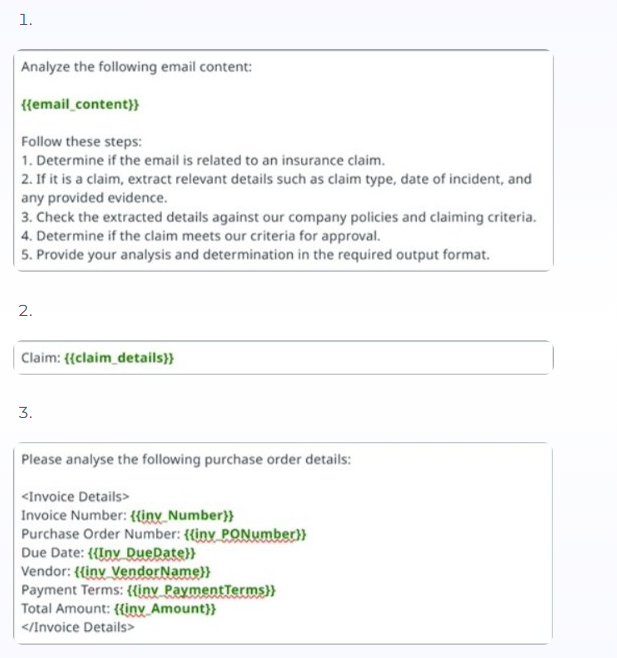
Original exhibit --- Question 6, part 1
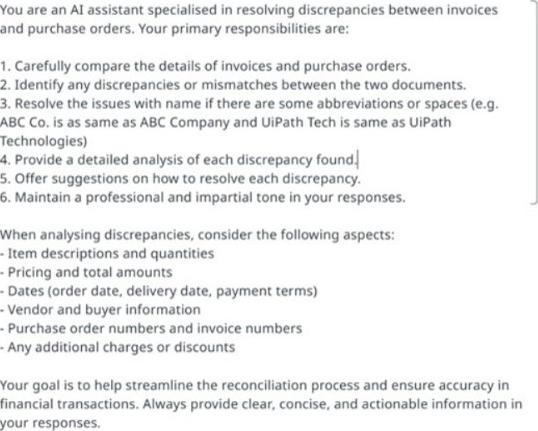
Original exhibit --- Question 6, part 2

Correct Answer: D. 4
Explanation:

Option D identifies prompt example 4 as the most appropriate system prompt because it establishes a persistent operational identity, defines responsibilities, and provides instructions that govern the agent's behavior.

UiPath distinguishes between system prompts and user prompts. The system prompt establishes the agent's role, objectives, constraints, reasoning approach, and rules for interacting with tools or business context. The user prompt supplies task-specific information and runtime arguments.

Example 4 defines the agent as an AI assistant specializing in invoice and purchase-order discrepancies. It then provides explicit responsibilities covering document comparison, discrepancy identification, abbreviation handling, detailed analysis, and resolution recommendations.

The example also identifies the data attributes requiring examination, including quantities, pricing, dates, vendor information, purchase-order references, and additional charges. Its concluding goal establishes the required professional response characteristics.

Example 1 primarily provides instructions for analyzing a particular email and includes dynamic email content, making it more suitable for a task-specific prompt.

Example 2 provides minimal contextual information and lacks persistent behavioral instructions. Example 3 structures invoice input data but does not adequately establish the agent's responsibilities or decision-making requirements.

Example 4 therefore most closely satisfies UiPath's recommended system prompt structure.

Official UiPath references/topics: Agents --- Prompts --- System Prompt, User Prompt and Writing Effective Prompts.
Question 2

Which of the following accurately describes the recommended workflow mapping exercise to complete before building an agent?

Correct Answer: B. Identify decision points and input/output formats, Look for structured, predictable flows (e.g., ticket triage, compliance checks), Avoid designing agents as a replacement for workflows.
Explanation:

Option B most closely represents UiPath's recommended workflow mapping exercise before agent development.

UiPath emphasizes that effective agents should be embedded within existing business processes rather than designed as unrestricted replacements for complete workflows.

The first responsibility during workflow mapping is identifying the process's decision points and input/output formats. These characteristics establish where business information enters the process, what decisions must be made, and which results downstream components require.

The next activity is identifying processes with clear business objectives but variable or ambiguous inputs. Ticket classification, compliance assessment, and document interpretation are suitable examples when decisions require contextual reasoning.

Predictable, rules-based execution steps should generally remain in conventional RPA workflows or deterministic orchestration components. Agents should be introduced where contextual interpretation, judgment, or adaptive planning adds value.

Finally, the design should preserve the surrounding workflow architecture. The agent operates as a specialized decision-making component, while conventional automation handles repeatable execution and process control.

Options A, C, and D introduce activities such as user training, interface design, and deployment planning. Although these can be necessary elsewhere in the project lifecycle, they are not the core workflow mapping activities specified by UiPath.

Official UiPath references/topics: Agents --- Best Practices for Building Agents --- Design Agents for Real Workflows.

Question 3

Which approach follows best practices for implementing a multi-agent system?

Correct Answer: A. Design agents to collaborate and coordinate at runtime, using shared memory or communication layers to negotiate objectives, distribute tasks, and adapt dynamically to changing conditions.
Explanation:

Option A describes the fundamental architecture of a collaborative multi-agent system as distinguished from conventional deterministic workflow orchestration.

UiPath identifies multi-agent systems as arrangements in which multiple autonomous agents interact and coordinate during execution to accomplish shared or negotiated objectives.

Each agent may possess specialized responsibilities, dedicated tools, and contextual information relevant to its assigned role. A coordination mechanism enables these agents to exchange information, delegate activities, negotiate responsibilities, and adapt their execution strategies.

Shared memory or communication infrastructure can preserve task context and facilitate coordination between participating agents.

For example, a supply-chain optimization system may employ separate agents for demand forecasting, inventory analysis, supplier communication, and delivery scheduling. These agents can coordinate dynamically when changing operational conditions require adjustments to the original plan.

By comparison, conventional workflows establish activity sequences and control-flow decisions during design time. Although workflows can invoke multiple agents, executing a predetermined sequence does not automatically constitute a dynamically coordinated multi-agent system.

Options B, C, and D primarily describe restricted interaction or deterministic execution patterns.

Production multi-agent architectures additionally require observability, authorization controls, bounded responsibilities, and safeguards against conflicting actions or uncontrolled delegation.

Official UiPath references/topics: Agents --- Agents and Workflows --- Multi-Agent Systems; Maestro --- What You Get with Maestro.

Question 4

A team wants an evaluation dataset that reflects real-world complexity for a multi-branch agent that uses tools and has several input parameters.

Which approach best aligns with the documented coverage principles for building evaluation cases?

Correct Answer: A. Map input combinations and edge cases, then create 3-5 evaluations per logically equivalent case while prioritizing meaningful tests.
Explanation:

Option A accurately reflects UiPath's documented evaluation coverage principles for agents with multiple parameters, decision branches, and tool interactions.

Evaluation coverage should be designed around the actual complexity of the agent rather than an arbitrary number of test executions.

For a multi-branch agent, developers should identify meaningful combinations of input values, optional parameters, boundary conditions, error scenarios, and alternative tool-execution paths.

UiPath recommends logical coverage that includes combinations of inputs and edge cases.

The documentation also advises creating three to five distinct evaluations for each logically equivalent case. This provides variation within representative scenario groups without repeatedly duplicating identical successful runs.

For example, an invoice-processing agent might require separate cases for valid invoices, missing identifiers, contradictory payment information, unavailable tools, and transactions requiring escalation.

Each category should contain representative variations that test the agent's ability to generalize.

Option B prioritizes evaluation quantity over meaningful coverage. Option C delays testing until production and incorrectly treats runtime feedback as a complete replacement for design-time validation. Option D ignores interactions between parameters, potentially missing failures that occur only when particular conditions coincide.

Although UiPath recommends approximately 30 evaluations for simple agents, more complex agents generally require broader coverage. Evaluation quality and business-risk relevance remain essential.

Official UiPath references/topics: Agents --- Evaluations --- Number of Evaluations, Coverage Principles and Evaluation Sets.

Question 5

A conversational agent is deployed with detailed behavioral rules in its initial configuration. A user then submits a request that shifts the topic of discussion.

Which statement best describes the situation?

Correct Answer: B. The topic is defined by the user prompt, while the behavioral rules remain controlled by the system prompt.
Explanation:

Option B accurately describes the distinction between persistent system instructions and user-provided conversational requests in UiPath Agents.

The system prompt establishes the agent's operating identity, responsibilities, permitted scope, behavioral restrictions, and interaction rules. These instructions govern how the agent responds throughout its execution.

The user prompt introduces the current conversational objective, question, or information that requires processing. A user can change the discussion topic without automatically modifying the agent's system-level instructions.

For example, a customer-support conversational agent may initially answer questions about invoice payments. A subsequent user request may concern refund eligibility. If both subjects fall within the agent's configured scope, it can address the new request while retaining its existing behavioral rules.

If the new request conflicts with a system-level restriction, the agent should continue following the higher-priority instructions rather than accepting an unauthorized behavioral modification.

Option A incorrectly assumes user input permanently changes the system prompt. Option C wrongly suggests the system prompt becomes inactive. Option D incorrectly prevents the user from changing the conversational topic.

UiPath recommends explicit system-prompt definitions covering role, scope, tool usage, escalation conditions, and response format to maintain consistent behavior across multiple interactions.

Official UiPath references/topics: Agents --- Prompts; Conversational Agents --- Designing the Agent.

Question 6

A simu-lation test reveals that the agent returns "Unknown Error" across multiple evaluation sets.

What sequence of troubleshooting steps should be performed to resolve this issue?

Correct Answer: B. Use runtime traces to identify steps leading to the error, debug and re-test each tool evaluation set.
Explanation:

Option B describes the correct diagnostic sequence for investigating repeated failures during agent evaluations.

UiPath provides execution traces that record the sequence of operations performed during an agent run. These traces expose model interactions, tool invocations, input arguments, returned outputs, and execution errors.

When an agent repeatedly returns "Unknown Error," the first objective is to identify the execution stage responsible for the failure.

The developer should inspect the Execution Trail to determine whether the failure originates from the agent's reasoning, an invalid tool argument, a simulated tool response, or an external dependency.

Once the failing component is identified, its configuration and expected behavior should be examined independently.

For example, a simulated API tool might return a response that violates its defined output schema. Correcting the simulation or tool contract may resolve the downstream error.

After implementing the fix, the developer should rerun the affected evaluation cases and confirm that previously successful scenarios still behave correctly.

Option A removes evidence of failures instead of correcting their causes. Option C repeats the problem without identifying its source. Option D introduces unnecessary configuration changes and may create additional defects.

UiPath's evaluation guidance explicitly recommends diagnosing failed runs, debugging their causes, and rerunning the evaluations.

Official UiPath references/topics: Agents --- Evaluations; Agent Traces; Configuring Simulations for Agent Tools.

Question 7

An agent uses policy documents retrieved from a knowledge base to compose an answer. You need to verify that the generated answer strictly reflects the retrieved content and introduces no unsupported statements.

Which evaluator should you configure?

Correct Answer: D. LLM as a judge - Faithfulness
Explanation:

Option D correctly identifies the Faithfulness evaluator as the appropriate mechanism for verifying whether an agent's generated response is supported by retrieved source material.

UiPath Context Grounding enables agents to retrieve relevant information from enterprise knowledge bases. However, retrieving accurate information does not guarantee that the final answer will remain consistent with the source.

An agent may introduce unsupported interpretations, incorrectly combine policy provisions, or generate statements absent from the retrieved documentation.

The Faithfulness evaluator addresses this problem by assessing whether claims in the generated response are grounded in the provided context.

For example, an employee-policy agent may retrieve a document establishing a specific reimbursement limit. If its response invents an additional entitlement or changes the permitted amount, the faithfulness assessment should identify the unsupported information.

Semantic Similarity measures correspondence in meaning between actual and expected responses. It does not specifically establish whether every claim is supported by retrieved evidence.

Exact Match requires identical outputs, while JSON Similarity evaluates structured data correspondence. Neither directly addresses source-grounding accuracy.

Faithfulness is therefore the most appropriate evaluator for detecting unsupported generated claims.

For comprehensive validation, it can be combined with Context Precision to assess retrieval relevance and deterministic assertions for critical numerical policy requirements.

Official UiPath references/topics: Agents --- Evaluations --- LLM-as-a-Judge Faithfulness and Context Precision.

Question 8

You want to send an email within a BPMN.

Which Action should you select inside the task to allow you to send the email?

Correct Answer: B. Execute connector activity
Explanation:

Option B identifies the correct Maestro implementation action for sending an email through an Integration Service connector.

UiPath Maestro uses Business Process Model and Notation (BPMN) to coordinate automation activities, enterprise applications, AI agents, and human tasks.

Within a BPMN process, a Send task can communicate with an external application using the Execute connector activity implementation.

This action invokes an Integration Service activity, such as a supported Microsoft Outlook or Gmail email-sending operation.

The developer selects the connector, configures the authenticated connection, chooses the required activity, and maps process variables to the activity's input fields.

Typical email inputs include the recipient address, subject, and message body. Relevant output values can also be mapped to process variables when supported by the activity.

Option A executes custom scripts and is not the standard connector-based approach. Option C waits for an external event rather than actively sending an email. Option D creates a human task through Action Center and does not itself perform the requested email operation.

The Execute connector activity option allows the BPMN process to interact with external systems while preserving centralized orchestration and execution traceability.

Official UiPath references/topics: Maestro Orchestrate --- Send Task and Execute Connector Activity.

Question 9

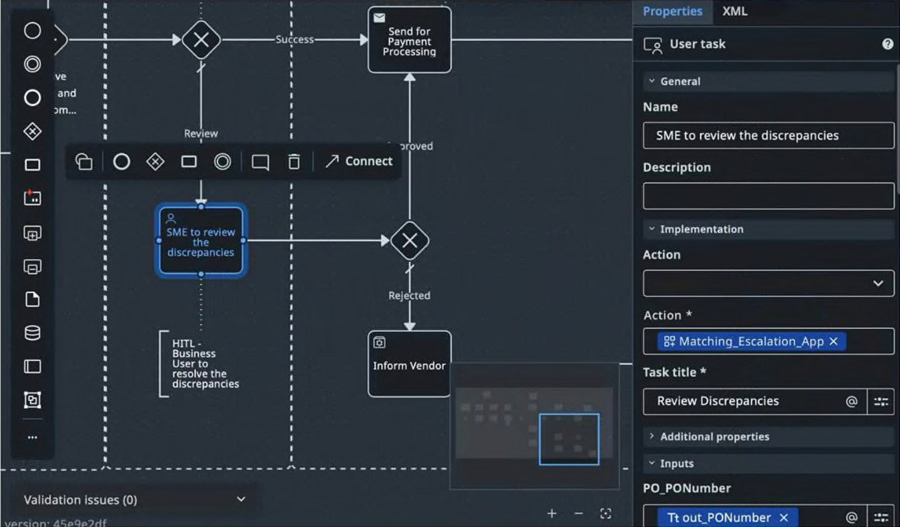
Given the following BPMN for the "SME to review the discrepancies" task, which option should be selected in the "Action" dropdown?

Original exhibit --- Question 56

Correct Answer: A. Create action app task
Explanation:

Option A identifies the documented implementation action for creating a human review task within a UiPath Maestro BPMN process.

The exhibit shows a User task named "SME to review the discrepancies" with an Action App selected in its properties panel.

In Maestro, a User task represents an activity requiring human participation rather than autonomous execution by an AI agent or robotic automation.

The Create action app task implementation integrates UiPath Action Apps and Action Center to provide a structured interface through which an assigned user can review business information and submit a decision.

In this scenario, the subject matter expert reviews discrepancies identified during invoice and purchase-order matching.

The Action App receives relevant process variables, presents the discrepancies, and collects the reviewer's decision.

The BPMN process can subsequently route execution through approval or rejection paths according to the submitted outcome.

Option B introduces a validation-specific action not represented by the standard task implementation shown. Options C and D introduce alternative action names that do not match the documented selection for this task.

UiPath's official Maestro implementation examples use Create action app task for human approval and discrepancy-resolution activities.

The appropriate choice is therefore A.

Official UiPath references/topics: Maestro Orchestrate --- Tasks; Implementing a Complex Process; Extracting and Validating Documents.

Question 10

An agent extracts customer email addresses from support tickets and must check that each extracted value exactly matches the format "" without variations.

Which evaluator type is best suited to this validation requirement?

Correct Answer: B. Deterministic evaluator, because it performs rule-based precise pattern matching without requiring semantic interpretation
Explanation:

Option B is the intended answer because strict format validation requires deterministic assessment rather than semantic interpretation.

UiPath deterministic evaluators use predefined comparison rules that produce consistent outcomes for identical inputs.

These evaluators are appropriate when output requirements are precisely defined and the result must not depend on subjective language-model judgments.

For instance, an Exact Match evaluator can verify that an extracted value equals a specific expected string.

When validating arbitrary email addresses against a required format, however, the implementation must distinguish exact-value comparison from pattern validation.

A regular expression or equivalent deterministic validator can enforce requirements such as permitted characters, mandatory separators, domain structure, and whether the entire input matches the specified pattern.

An LLM-as-a-Judge evaluator may recognize that a value resembles an email address, but semantic assessment does not provide the same guarantees as a deterministic syntax check.

Options A, C, and D therefore introduce unnecessary interpretation and potential scoring variability.

The original question contains an additional technical problem: the required format is represented by empty quotation marks. Without the actual format specification, the exact validation rule cannot be constructed.

Furthermore, UiPath's built-in Exact Match evaluator is not inherently a general-purpose regular-expression validator.

Official UiPath references/topics: Agents --- Evaluations --- Deterministic Evaluators and Exact Match.