Limited-Time Offer: Enjoy 50% Savings! Coupon code: 50OFF Use it at checkout
Skip to content

Free HP HPE Network Security Expert Written Exam HPE7-A10 Exam Questions

Page: 1 / 8 Total 75 questions

Want more questions? Get Premium Access.

Question 1

Introduction to the customer

You are assisting a company with adding HPE Aruba Networking ClearPass to its network, which uses HPE Aruba Networking network-infrastructure devices.

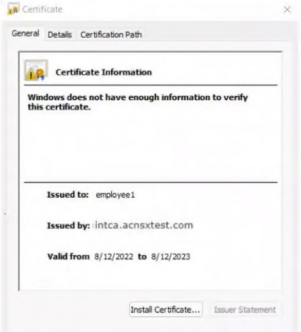
The company already has a Windows domain and Windows CA. The Windows CA issues certificates to domain computers, domain users, and servers such as domain controllers.
ClearPass cluster IP addressing and hostnames

Publisher = 10.47.47.5

Subscriber 1 = 10.47.47.6

Subscriber 2 = 10.47.47.7

Virtual IP with Subscriber 1 and Subscriber 2 = 10.47.47.8

Refer to the scenario.

You imported the root certificate for the Windows CA into the ClearPass CA Trust list. Based on the scenario requirements, which usages should be added to it?

Correct Answer: B. EAP and AD/LDAP Server
Explanation:

In ClearPass Policy Manager, the Certificate Authority (CA) Trust List enforces strict trust domain separation using granular usage flags. When an enterprise root or intermediate CA certificate is imported, administrators must assign specific trust usages depending on which subsystems will validate certificates signed by that authority.

1. **EAP Usage**: The Windows CA issues user and computer authentication certificates used for 802.1X/EAP-TLS (or TEAP) client authentication. ClearPass must validate the cryptographic trust chain of these incoming client certificates during RADIUS authentication; therefore, the `EAP` usage is required.

2. **AD/LDAP Server Usage**: ClearPass queries Active Directory Domain Controllers for authentication and authorization over secure transport (LDAPS over port 636 or StartTLS). The Domain Controllers present directory server certificates issued by the internal Windows Enterprise CA. To validate the TLS identity of the domain controllers during LDAPS handshakes, ClearPass requires the `AD/LDAP Server` usage flag on the root CA.

Usages such as RadSec or HPE Aruba Networking Infrastructure apply strictly to RADIUS-over-TLS communication with network access devices and device management tunnels, which are unrelated to Windows CA client and directory certificates.
Question 2

A hospital uses an AOS-10 architecture managed by HPE Aruba Networking Central. The customer has deployed a pair of HPE Aruba Networking 9000 Series gateways, with Security licenses, at each clinic. The gateways run IDS/IPS in IDS mode.

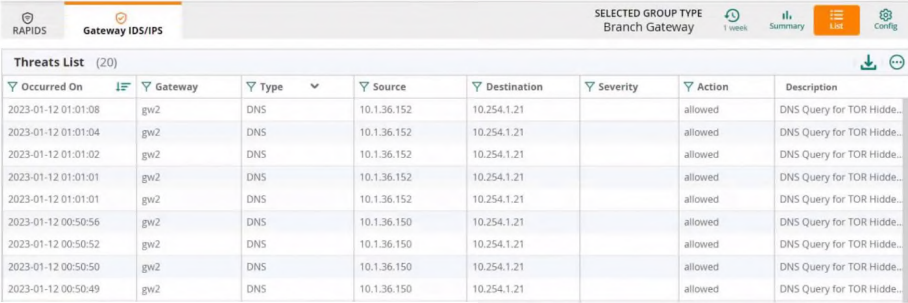
The Security Dashboard displays several recent events with the same signature, as shown below:

Occurred On: 2023-01-12 | Gateway: gw2 | Type: DNS | Source: 10.1.36.152 | Destination: 10.254.1.21 | Action: allowed | Description: DNS Query for TOR Hidden...

You want a record of the specific traffic that triggered the threat event. What should you do?

Correct Answer: B. From the Threats List, view the details for one of the threats. Then, download the packet.
Explanation:

The HPE Aruba Networking Central Gateway IDS/IPS dashboard provides integrated forensic capabilities for security analysts. When a security gateway running IDS/IPS identifies traffic matching a threat signature, the underlying threat inspection engine captures the exact offending network packet(s) that triggered the event.

Within Central's **Gateway IDS/IPS > Threats List**, clicking on any specific threat event opens the **Packet Info / Threat Details** window. This view displays granular forensic metadata, including signature ID, category, severity, timestamp, flow tuples, and raw packet headers. More importantly, it provides a direct option to download the raw packet data (PCAP format) for the selected threat. This allows administrators to perform offline packet analysis using Wireshark to inspect payload details without having to run retroactive live captures, check DNS server logs, or pull generic logs from access points.

Question 3

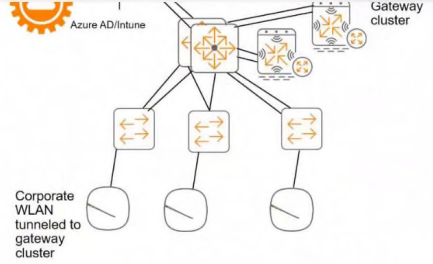
Refer to the scenario.

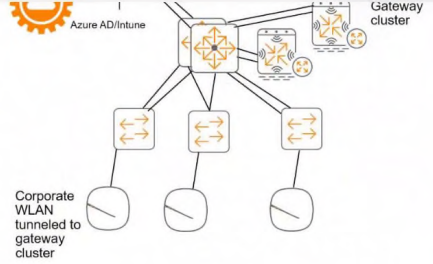
You must configure HPE Aruba Networking ClearPass Onboard to issue client certificates for Azure AD-joined devices. Which step is required to accomplish this objective?

Correct Answer: D. Install the Intune SCEP extension on the ClearPass subscribers.
Explanation:

Issuing client certificates from ClearPass Onboard to Microsoft Entra ID (Azure AD)-joined devices managed via Microsoft Intune requires integrating the Simple Certificate Enrollment Protocol (SCEP) with Intune's certificate validation API.

ClearPass utilizes the Microsoft Intune Onboard Enrollment (Intune SCEP) extension to securely interface between the Onboard Certificate Authority (CA) and Microsoft Intune. When an Intune-managed device receives a SCEP configuration profile, it contacts the SCEP enrollment URL exposed by ClearPass Onboard. ClearPass must validate the incoming SCEP transaction challenge token with Microsoft Cloud Graph/Intune APIs before the Onboard CA signs and issues the client certificate.

Because the Onboard enrollment URL and SCEP service endpoints are hosted and serviced by the ClearPass subscriber nodes (typically bound to the subscriber cluster Virtual IP address), the Intune SCEP extension must be deployed directly onto all ClearPass subscriber servers that handle device enrollment traffic. Installing the extension enables each subscriber to locally process and validate SCEP challenge payloads in real time.

Question 4

A customer uses an AOS-10 architecture managed by HPE Aruba Networking Central. HPE Aruba Networking infrastructure devices authenticate clients against an HPE Aruba Networking ClearPass cluster.

In HPE Aruba Networking Central, you are reviewing network traffic flows for a wireless IoT device categorized as a ''Raspberry Pi'' client. You observe SSH traffic. You then inspect several additional wireless IoT clients and find that they are also sending SSH.

Refer to the scenario.

What potential issue does this indicate?

Correct Answer: D. These clients might be controlled by hackers through reverse SSH tunnels.
Explanation:

In standard enterprise architectures, wireless IoT devices (such as Raspberry Pi controllers, sensors, or display nodes) operate as endpoints or servers receiving management connections, or they initiate outbound application transactions using lightweight protocols such as MQTT, HTTPS, or CoAP. Under normal operations, IoT endpoints do not originate outbound SSH (TCP port 22) connections to external destinations.

Observing outbound SSH traffic originating from multiple IoT devices strongly indicates the establishment of reverse SSH tunnels. State-sponsored adversaries and botnet operators routinely compromise embedded Linux IoT devices running default or weak credentials and script them to open persistent outbound SSH tunnels to external command-and-control (C2) servers. Because stateful perimeter and role-based firewalls typically permit outbound connections while blocking unsolicited inbound sessions, an outbound reverse SSH tunnel allows remote attackers to establish an interactive shell back into the enterprise network, effectively bypassing edge ingress firewall protections.

Question 5

A customer needs the following rights for clients in the medical-mobile AOS firewall role on HPE Aruba Networking Mobility Controllers (MCs):

* They may receive IP addresses through DHCP.

* They may access DNS services at 10.8.9.7, and no other server.

* They may access all subnets in the 10.1.0.0/16 range, except 10.1.12.0/22, which must be denied.

* They must be denied access to other 10.0.0.0/8 subnets.

* They may access the Internet.

* They must be denied WLAN access for a period of time if they send any SSH traffic.

* They must be denied WLAN access for a period of time if they send any Telnet traffic.

* They must be denied access to all high-risk websites.

* External devices must not be allowed to initiate sessions with medical-mobile clients; they may send only return traffic.

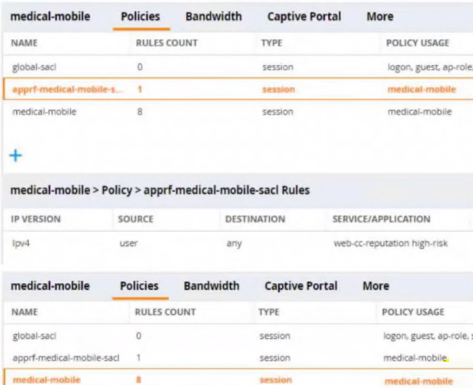
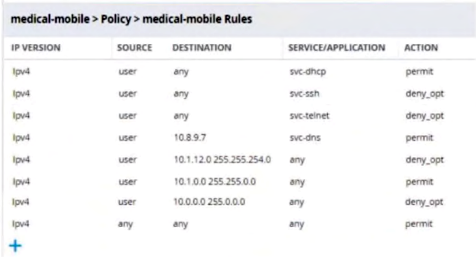
Refer to the scenario. The exhibits below show the role configuration.

* Role policies: `apprf-medical-mobile-sacl` (Rule: `user any web-cc-reputation high-risk deny`) and `medical-mobile` (8 rules configured).

Which setting not shown in the exhibits must you check to ensure the scenario requirements are met?

Correct Answer: A. That AppRF and WebCC are enabled globally and on the medical-mobile role
Explanation:

The policy requirements dictate that clients assigned to the `medical-mobile` user role must be denied access to high-risk websites. In ArubaOS, filtering web traffic based on reputation categorization is powered by Web Content Classification (WebCC), which operates as a specialized component of Application Programming and Recognition Framework (AppRF).

While the session ACL `apprf-medical-mobile-sacl` includes an ACE matching `web-cc-reputation high-risk`, this rule remains inert unless Web Content Classification and AppRF are globally enabled on the Mobility Controller and enabled within the assigned role configuration. WebCC queries cloud-hosted reputation feeds to dynamically score URLs into risk tiers.

Regarding other requirements: the Policy Enforcement Firewall (PEF) is inherently stateful and bidirectional by default, automatically allowing session return traffic while preventing externally initiated sessions without manual stateful activation. Therefore, verifying that AppRF and WebCC are actively operational is the critical requirement.

Question 6

A company has HPE Aruba Networking gateways and plans to begin implementing gateway IDS/IPS. The customer has chosen Block as the Fail Strategy.

What could you recommend to help reduce unexpected outages caused by this particular fail strategy?

Correct Answer: A. Enabling alerts and email notifications for events related to gateway IPS engine utilization and errors
Explanation:

When deploying Gateway IDS/IPS on HPE Aruba Networking 9000 and 7000 Series gateways, the Fail Strategy determines how traffic is handled if the underlying deep-packet inspection container/engine fails, crashes, or becomes resource-starved.

Setting the Fail Strategy to **Block** is a fail-closed posture: if the IPS inspection engine experiences memory exhaustion, packet queue overflows, or process failures, all client traffic subject to inspection is dropped, leading to network downtime.

To prevent unanticipated outages under a fail-closed design, administrators must proactively monitor the operational health of the IPS inspection pipeline. Enabling alerts and automated email notifications within HPE Aruba Networking Central for gateway IPS engine utilization, memory/CPU thresholds, and engine error events gives engineering teams early warning. Administrators can address resource constraints or configuration anomalies before the inspection engine falters and triggers an outage.

Question 7

A customer operates an HPE Aruba Networking ClearPass cluster. The customer has AOS-CX switches that use 802.1X authentication with HPE Aruba Networking ClearPass Policy Manager (CPPM).

The switches use local port-access policies. The customer wants to begin tunneling only wired clients that successfully pass user authentication to an HPE Aruba Networking gateway cluster. The gateway cluster must place these clients in the eth-internet role. The gateway must also assign clients to VLAN 20.

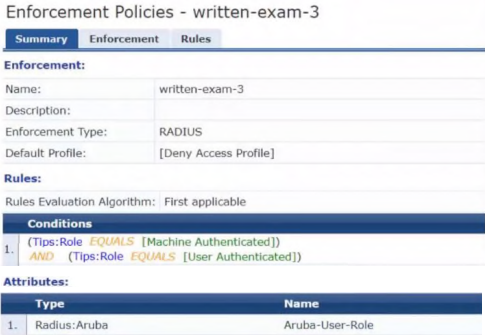
The planned enforcement policy and profiles are shown below:

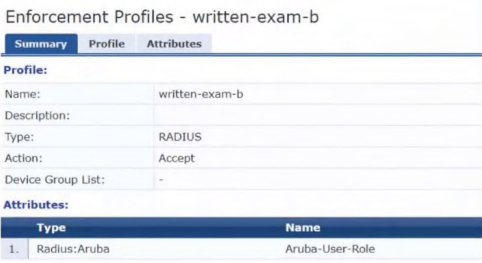
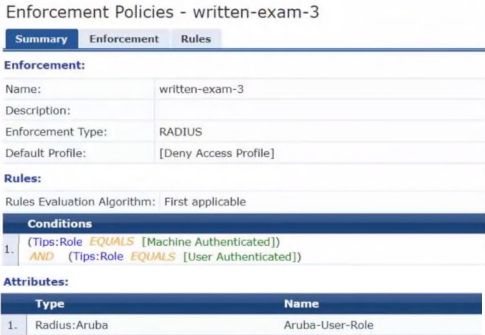
* Policy: `written-exam-3`

* Conditions: `(Tips:Role EQUALS [Machine Authenticated]) AND (Tips:Role EQUALS [User Authenticated])`

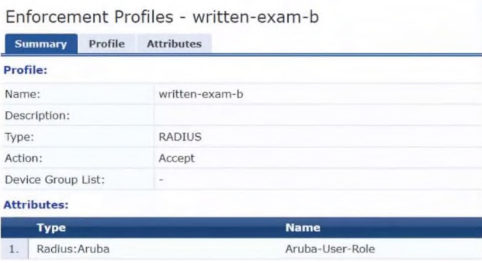
* Profile: `written-exam-b` (Attributes: `Radius:Aruba-User-Role = Aruba-User-Role`)

The gateway cluster includes two gateways with the following IP addresses:

Gateway 1: VLAN 4085 (system IP) = 10.20.4.21 | VLAN 20 (users) = 10.20.20.1 | VLAN 4094 (WAN) = 198.51.100.14

Gateway 2: VLAN 4085 (system IP) = 10.20.4.22 | VLAN 20 (users) = 10.20.20.2 | VLAN 4094 (WAN) = 198.51.100.12 | VRRP on VLAN 20 = 10.20.20.254

Refer to the scenario. Assume the correct UBT zone and port-access role settings have been configured. However, the solution does not work.

What else must you ensure you do?

Correct Answer: C. Create a new VLAN on the AOS-CX switch and configure that VLAN as the UBT client VLAN.
Explanation:

In HPE Aruba Networking Dynamic Segmentation utilizing User-Based Tunneling (UBT) on AOS-CX switches, client traffic encapsulation is handled via point-to-point GRE tunnels to the gateway cluster.

When UBT is configured using Local/Reserved VLAN mode, the gateway assigns the user's true operational VLAN (VLAN 20) and firewall policies at the gateway termination point. However, on the AOS-CX switch, client frames arriving on the physical port cannot be placed directly into an unconfigured or unassigned Layer 2 domain. The switch requires a dedicated, locally created reserved VLAN defined specifically as the `ubt-client-vlan`.

The command `port-access ubt-client-vlan ` designates this local transit VLAN, which acts as the internal datapath holding and forwarding vehicle before the switch wraps the frame into GRE towards the gateway. If this VLAN does not exist in the switch database and is not mapped to the UBT zone, the switch drops the traffic before tunnel encapsulation.

Question 8

A company wants its AOS-CX switches to obtain certificates from ClearPass Onboard and use those certificates to implement RadSec with ClearPass Policy Manager (CPPM).

ClearPass Onboard has a CA with EST enabled and this EST URL: `[https://cp1.acnsxtest.com/.well-known/est/ca:2](https://cp1.acnsxtest.com/.well-known/est/ca:2)`

ClearPass Guest has an account whose username is `switchcorp123`. (Assume CPPM also has a valid service to authenticate users who access the EST application.)

CPPM has a network-device account for the switches with RadSec enabled. The RadSec settings validate by CN or SAN using this regex: `switchcorp123`

ClearPass has these certificates:

* HTTPS certificate signed by DigiCert

* RadSec certificate signed by DigiCert

* RADIUS/EAP certificate signed by MyDomainCA

This configuration is on the AOS-CX switches:

```text

crypto pki est-profile est1

url https://clearpass1.acnsxtest.com/.well-known/est/ca:2

username switchcorp123

password plaintext %FY212h&zaTk

vrf default

exit

crypto pki certificate cert1

subject switchcorp123

enroll est-profile onboard

crypto pki application radsec-client certificate cert1

```

The switches' TA-profile list includes DigiCert.

Assume you have obtained the correct password associated with the indicated username. What error or errors are present?

Correct Answer: C. Only the URL in the EST profile is incorrect.
Explanation:

In AOS-CX Public Key Infrastructure (PKI), Enrollment over Secure Transport (EST, RFC 7030) automates certificate provisioning and renewal. To establish the initial TLS handshake to enroll for a certificate, the switch validates the server certificate presented by the EST server against its configured Trust Anchor (TA) profiles.

In this scenario, ClearPass presents an HTTPS certificate signed by DigiCert. Because the switch's TA-profile list includes DigiCert, cryptographic trust for the EST connection is established. Furthermore, the Subject specified in the certificate profile (`switchcorp123`) matches the validation regular expression configured in the CPPM RadSec device profile.

The defect lies in the EST profile configuration:

The active Onboard EST endpoint is `[https://cp1.acnsxtest.com/.well-known/est/ca:2](https://cp1.acnsxtest.com/.well-known/est/ca:2)`. However, the switch profile is configured with `[https://clearpass1.acnsxtest.com/.well-known/est/ca:2](https://clearpass1.acnsxtest.com/.well-known/est/ca:2)`. Because `clearpass1.acnsxtest.com` does not match the published FQDN of the server, the switch will experience DNS resolution errors or TLS hostname validation mismatches during enrollment. No other parameters are misconfigured, making "Only the URL in the EST profile is incorrect" the accurate diagnosis.

Question 9

A customer uses an AOS-10 architecture that includes HPE Aruba Networking APs. The customer recently enabled WIDS at the High level on the APs. Administrators observe many "detect disconnect station" events.

What should you explain?

Correct Answer: D. Client drivers and interference can cause false positives of this event. You will look out for other stronger signs of attack such as rogue APs and disassociation broadcasts.
Explanation:

The "detect disconnect station" signature in HPE Aruba Networking Wireless Intrusion Detection System (WIDS) is intended to identify 802.11 Layer 2 Denial-of-Service (DoS) attacks, such as an attacker injecting spoofed unicast deauthentication or disassociation frames to tear down client associations.

When WIDS is set to the **High** sensitivity profile, the detection threshold for disassociation framing anomalies is configured with aggressive timing and frequency limits. In dense wireless deployments, poorly implemented client Wi-Fi drivers, aggressive roaming algorithms, and transient radio frequency (RF) multipath interference routinely cause client devices to rapidly disconnect and reconnect, triggering high volumes of false positive alerts.

Observing isolated or high-volume "disconnect station" events without correlating indicators does not establish an active attack. Senior security architects advise administrators to corroborate these alerts with higher-confidence signatures---such as excessive broadcast deauthentication bursts (`detect disassoc broadcast`), AP spoofing, or active rogue AP detections---before taking containment measures.

Question 10

A customer is migrating from on-premises AD to Microsoft Entra ID (Azure AD) as its only domain solution. The customer also manages wired and wireless devices with Microsoft Endpoint Manager (Intune).

The customer wants to strengthen security at the network edge. You are assisting with the design of an HPE Aruba Networking ClearPass deployment for this purpose. HPE Aruba Networking devices will authenticate wired and wireless clients to a ClearPass Policy Manager (CPPM) cluster that uses version 6.10.

The customer has several authentication requirements. Clients must pass EAP-TLS authentication only when a Microsoft Entra ID (Azure AD) query confirms that they have Microsoft Entra ID (Azure AD) accounts. To further refine client privileges, ClearPass must also use information gathered by Intune to make access-control decisions.

Refer to the scenario.

Assume that the Microsoft Entra ID (Azure AD) deployment has the required prerequisites in place.

You are planning the CPPM authentication source that you will use as the authentication source in 802.1X services. How should you configure this authentication source?

Correct Answer: C. As HTTP type, referencing the IP address for an Intune SCEP extension
Explanation:

In ClearPass Policy Manager version 6.10, native Microsoft Entra ID (Azure AD) OAuth2 token integration was not yet implemented as a built-in authentication source type. Native Azure AD authentication sources were introduced later in ClearPass 6.11 as authorization-only sources.

In ClearPass 6.10 environments where on-premises Active Directory is fully decommissioned, ClearPass interfaces with cloud identity and endpoint management via the ClearPass Extensions framework. Specifically, the Microsoft Intune Onboard / SCEP extension acts as a local RESTful proxy between CPPM and the Microsoft Graph API.

To authenticate and validate connecting 802.1X EAP-TLS clients against Microsoft Entra ID / Intune, administrators configure a generic HTTP-type authentication/authorization source. This HTTP source points directly to the loopback/local IP address where the Intune SCEP extension microservice is running (e.g., [http://127.0.0.1:9000](http://127.0.0.1:9000) or the dedicated extension container IP). During 802.1X transactions, ClearPass submits a REST query through this HTTP source to verify that the user/machine account exists in Entra ID and extracts real-time compliance attributes from Intune to enforce dynamic policy decisions. Active Directory, SQL, and Kerberos types rely on traditional directory services and cannot interface with Intune Graph APIs in 6.10.